

Commentary
Sarah Chayes
{
  "authors": [
    "Sarah Chayes"
  ],
  "type": "legacyinthemedia",
  "centerAffiliationAll": "dc",
  "centers": [
    "Carnegie Endowment for International Peace"
  ],
  "collections": [
    "Anti-Corruption"
  ],
  "englishNewsletterAll": "democracy",
  "nonEnglishNewsletterAll": "",
  "primaryCenter": "Carnegie Endowment for International Peace",
  "programAffiliation": "DCG",
  "programs": [
    "Democracy, Conflict, and Governance"
  ],
  "projects": [],
  "regions": [
    "Southern, Eastern, and Western Africa"
  ],
  "topics": [
    "Political Reform",
    "Democracy",
    "Security"
  ]
}
Source: Getty
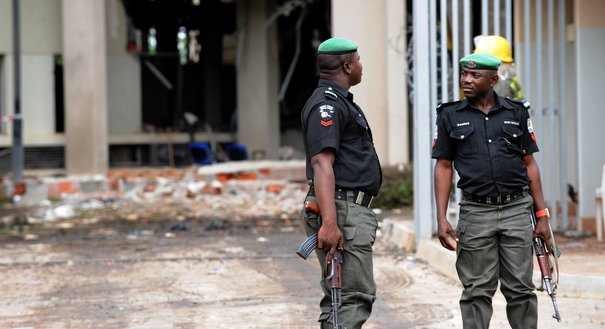
To combat Boko Haram, U.S. officials need to get tough on Nigerian leaders for their flagrant effort to control the outcome of the election.
Source: Defense One
The rumors had been swirling around the Nigerian capital, Abuja, for days: the government was going to find some way to delay the presidential election in Africa’s most populous and economically powerful country. The vote was to be held on Feb. 14. There were court cases, complaints about voter card distribution and the ability of those displaced by the Boko Haram insurgency to cast their ballots.
In the end, the pretext selected—with an almost barefaced cynicism—was security. Late Saturday, the election was delayed by six weeks. The head of the National Electoral Commission issued a statement to announce his decision that, reading between the lines, carries a whiff of blackmail. “The national security advisor,” wrote Attahiru Jega, “and all the armed services and intelligence chiefs unanimously reiterated that the safety and security of [electoral] operations can not be guaranteed.”
That’s the type of language organized criminals use to gift-wrap a threat. U.S. officials, already losing patience with the leadership of President Goodluck Jonathan and his key ministers, should add this flagrant effort to control the outcome of the election to the list of reasons why it’s time to get tough.Of course, the security situation in northern Nigeria is terrible. A glance at recent headlines is enough to confirm that. But for months, those same headlines have made it clear that the Nigerian government has been less than diligent in combatting Boko Haram. Soldiers driven to mutiny by the lack of weapons and munitions despite soaring defense budgets have been court-martialed and sentenced to death. Late last year, Abuja abruptly cancelled a U.S. training program aimed at building a new counterinsurgency battalion. So widespread and well-documented are the human rights abuses of existing units that by law, the U.S. is prohibited from partnering with them.
There is no reason for Nigerians to believe that their government, which has thus far failed to address the Boko Haram insurgency or the political and economic grievances that have given rise to it, will do a better job over the next six weeks. The sudden preoccupation with the safety and wellbeing of citizens in the marginalized northeast does not ring true. Even if the African Union’s recently-approved 7,500 troops rushed in, U.S. Africa Command’s Gen. David Rodriguez said in Washington just two weeks ago that it would take a full-scale multinational counterinsurgency (like the one he ran in Afghanistan)—with a constructive government—to turn the tide against Boko Haram.
Having lived for a decade through several rigged elections in the southern Afghan city of Kandahar, I know well how security concerns can be manipulated for electoral purposes. In Afghanistan, the approach was the reverse of Nigeria’s. Since the dangerous south was presumed to favor President Hamid Karzai, a native son, he put his entire security apparatus to work ensuring that as many polling places were open as possible. Not so people could vote—they couldn’t, the Taliban intimidated them away from the polls. Karzai’s objective was to secure a generous number of empty ballot boxes that could later be stuffed.
But the martyred Nigerian north is presumed to favor the opposition, now running the closest national race in the country’s 16 years as a democracy. The ruling clique, now in a real horserace, has never tried hard to ensure north-easterners could vote. As many as 40,000 displaced people are reportedly assigned to a single polling place in some states. If adverse security conditions depressed turnout, say many Nigerians I have interviewed, the ruling party would not mind. Now, with the outcome in doubt even with the reduced turnout, the violence is a pretext for putting the whole process in jeopardy.
For the ruling party, say many, the Boko Haram insurgency is proving a godsend.
Nigeria is not the only country where corrupt elites that have bent the levers of power to the service of personal enrichment have retained their grip on power by means of electoral exercises that were anything but democratic. Karzai did it in Afghanistan. In Egypt, former President Hosni Mubarak and now Abdel Fattah el-Sisi bask in elections whose results are a foregone conclusion, as do the rulers of Algeria, Bahrain and most Central Asian countries.
Patently rigged elections frequently lead to explosions of violence. Algeria’s bloody civil war was ignited when the military cancelled a 1991 election the opposition was set to win. Kenya suffered a bloodletting in 2008, after an apparently rigged vote in December 2007. And widespread presumption of electoral fraud is seen as contributing to the strength of extremist movements in Iraq and Afghanistan.
The U.S. does not have much influence over the situation in Nigeria. But what influence it has should be used to reduce the impunity with which that country’s political elite has been abusing its people. Responding to the announced delay on Saturday, Secretary of State John F. Kerry used strong language: “Political interference with the Independent National Election Commission is unacceptable,” he said in a statement, “and it is critical that the government not use security concerns as a pretext to impede the democratic process.”
Here’s hoping he’s got a team working on actions to give those words bite.
Former Senior Fellow, Democracy, Conflict, and Governance Program
Sarah Chayes is internationally recognized for her innovative thinking on corruption and its implications. Her work explores how severe corruption can help prompt such crises as terrorism, revolutions and their violent aftermaths, and environmental degradation.
Recent Work
Sarah Chayes
Carnegie does not take institutional positions on public policy issues; the views represented herein are those of the author(s) and do not necessarily reflect the views of Carnegie, its staff, or its trustees.

Are Germany’s economic, industrial, and political struggles becoming a liability for the EU’s ability to rise to the geopolitical moment?

Rym Momtaz, ed.

Radical-right parties are expected to do well in upcoming elections in four of the EU's biggest member states. If successful, they could prevent the union from addressing key challenges ahead.

Stefan Lehne

An overwhelming victory by a far-right-wing party in a small state in eastern Germany will have major repercussions for Chancellor Friedrich Merz’s coalition.

Judy Dempsey

European states control several Overseas Countries and Territories around the world that carry strategic, economic, and environmental weight. As great powers challenge the rules-based order, defending them is a geopolitical imperative for Europe.

Marc Pierini

In supporting Europe’s far-right, MAGA and Russia both want the same thing: a weaker EU. Europe must defend itself without abandoning the openness these forces exploit.

Armida van Rij