

Commentary
Sarah Chayes
{
  "authors": [
    "Sarah Chayes"
  ],
  "type": "legacyinthemedia",
  "centerAffiliationAll": "dc",
  "centers": [
    "Carnegie Endowment for International Peace",
    "Malcolm H. Kerr Carnegie Middle East Center"
  ],
  "collections": [
    "Anti-Corruption"
  ],
  "englishNewsletterAll": "democracy",
  "nonEnglishNewsletterAll": "",
  "primaryCenter": "Carnegie Endowment for International Peace",
  "programAffiliation": "DCG",
  "programs": [
    "Democracy, Conflict, and Governance"
  ],
  "projects": [],
  "regions": [
    "Middle East",
    "North Africa",
    "South Asia",
    "Central Asia"
  ],
  "topics": [
    "Political Reform",
    "Security",
    "Democracy"
  ]
}
Source: Getty
If Western officials truly mean to curb the underlying drivers of extremism, corruption is a good—and remarkably overlooked—place to start.
Source: Reuters
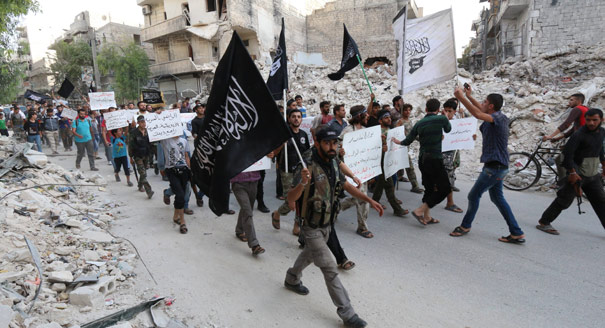
Why did nearly half of Iraq open itself to Islamic State, a militant group seen as one of the most psychotic on record? Why have Boko Haram militants gained a solid foothold in northern Nigeria? Why aren’t the ranks of al Qaeda in the Arabian Peninsula thinning, despite regular drone strikes in Yemen? Do these disparate countries have some trait in common?
They do: the rampant corruption of their ruling elites.
At issue is no ad hoc venality, such as exists everywhere. The populations of these nations — and of Ukraine and the half-dozen Arab countries that rose in revolt four years ago, with spiraling consequences — are subjected to a far more virulent strain of this disease than are most of their Western counterparts.This corruption is not some silent drain on nondescript public funds. It happens directly to people, every day. If police board their bus, they have to hand over cash or be dragged off the vehicle and maybe beaten. If they take their child to the hospital to sew up a gash, they have to pay to be seen. I spoke with an Uzbek journalist who was agonizing about whether to sell his car so he could bribe his son’s way into college — though he had high scores on the entrance exam. An Afghan I know had to pay a bribe to get the death certificate for his father, who had been blown up by a remote-controlled bomb.
The bribe-takers at the bottom of these ladders send a share of the take all the way up the line. These governments can best be described not as governments at all, but as highly effective criminal organizations.
When people are shaken down like this, day after day, when they are insulted and abused in the process, when the perpetrators are members of their government — the very institution they expect to uphold laws, not break them — they get mad. And angry people, especially young men who are injured in their pride as well as their prospects, can sometimes get violent.
Extremist movements offer such men — and a growing number of women — two things. They offer an explanation. As Central Asia scholar Marlene Laruelle put it to me, “The argument the Islamists are making is that the regime is corrupt and unjust because it’s secular. Such reasoning didn’t have much resonance in the past, now it does.”
Jihadists, in other words, play on the ambiguous meaning of the word ‘corruption,’ arguing that the reason government officials are so abusive is because they have strayed from a rigorous reading of religious obligations. They say that the only way to reform public life is to stick to a stringent code of private morality — imposed, if necessary, by force.
The second thing jihadists offer the victims of severe government corruption is an outlet for their rage. They hand them a gun and a chance to regain some of their injured pride — at the cost, if need be, of their lives. For many, the frustration is so intense the bargain seems worth it.
President Barack Obama keeps stressing that without “a strategy that reduces the wellsprings of extremism, a perpetual war … will prove self-defeating.” Yet the vast bulk of U.S. effort, focus, and expenditure remains channeled toward military solutions, be they drones or airstrikes over Iraq, or efforts to train and equip the armies or fighters of so-called front-line states. The defense budget for the 2016 fiscal year just submitted to the U.S. Congress includes a $5.8 billion allocation for those activities in Iraq and Syria alone.
No such spending is earmarked for the kleptocracy unit at the U.S. Department of Justice, whose handful of prosecutors and dozen FBI investigators are taking on some of the most flagrant — and well-endowed — criminals on earth.
Nor is a mandatory class on corruption included in the syllabus for people training to enter the U.S. Foreign Service. Intelligence agencies are not systematically collecting or analyzing information on the way corrupt ruling networks function: what levers of power they capture, what revenue streams, where their vulnerabilities lie, their relationships with organized crime or apparently legitimate businesses.
Allying with such governments to fight terrorists — which the U.S. and Western partners habitually do — is only making matters worse. It only confirms jihadist propaganda that the West benefits from the corruption, that it condones and encourages it. While taking a few terrorists out of circulation, such policies are minting many new ones.
If Western officials truly mean to curb the underlying drivers of extremism, corruption is a good — and remarkably overlooked — place to start.
Former Senior Fellow, Democracy, Conflict, and Governance Program
Sarah Chayes is internationally recognized for her innovative thinking on corruption and its implications. Her work explores how severe corruption can help prompt such crises as terrorism, revolutions and their violent aftermaths, and environmental degradation.
Recent Work
Sarah Chayes
Carnegie does not take institutional positions on public policy issues; the views represented herein are those of the author(s) and do not necessarily reflect the views of Carnegie, its staff, or its trustees.

Are Germany’s economic, industrial, and political struggles becoming a liability for the EU’s ability to rise to the geopolitical moment?

Rym Momtaz, ed.

Radical-right parties are expected to do well in upcoming elections in four of the EU's biggest member states. If successful, they could prevent the union from addressing key challenges ahead.

Stefan Lehne

An overwhelming victory by a far-right-wing party in a small state in eastern Germany will have major repercussions for Chancellor Friedrich Merz’s coalition.

Judy Dempsey

European states control several Overseas Countries and Territories around the world that carry strategic, economic, and environmental weight. As great powers challenge the rules-based order, defending them is a geopolitical imperative for Europe.

Marc Pierini

In supporting Europe’s far-right, MAGA and Russia both want the same thing: a weaker EU. Europe must defend itself without abandoning the openness these forces exploit.

Armida van Rij