

Commentary
The EU can impose sanctions but struggles to enforce them without the United States. With Washington increasingly disinterested in backing European interests, the bloc must now fend for itself.
Nicu Popescu, Tiago Antunes
{
  "authors": [
    "Vladimir Dvorkin"
  ],
  "type": "commentary",
  "centerAffiliationAll": "",
  "centers": [
    "Carnegie Endowment for International Peace",
    "Carnegie Russia Eurasia Center"
  ],
  "collections": [],
  "englishNewsletterAll": "",
  "nonEnglishNewsletterAll": "",
  "primaryCenter": "Carnegie Russia Eurasia Center",
  "programAffiliation": "",
  "programs": [],
  "projects": [],
  "regions": [
    "Russia",
    "Eastern Europe",
    "Ukraine"
  ],
  "topics": [
    "Security",
    "Military",
    "Foreign Policy"
  ]
}
Source: Getty
The Russian government’s decision to end cooperation with Ukraine on two space launch programs is likely due to political motivations alone and goes against the economic and technological interests of Russia, Ukraine, and many other countries. This decision is worth reconsidering.
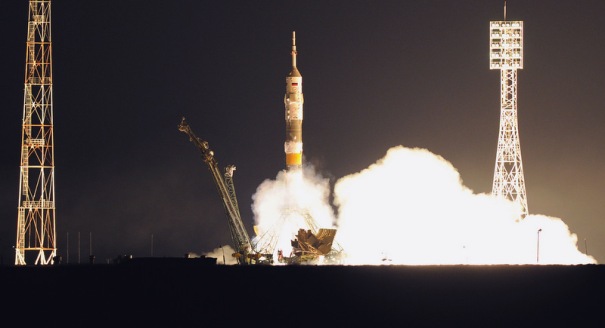
Until recently, the space and defense sector was one of the few remaining mutually beneficial areas of cooperation between Russia and Ukraine. But in early-February, Russia announced that it would suspend cooperation with Ukraine on the Dnepr program which uses converted SS-18 intercontinental ballistic missiles (ICBMs) manufactured at the Dnipropetrovsk Yuzhmash plant to launch commercial satellites. Russian officials also announced that they would no longer buy Yuzhmash-made Zenit booster rockets used in the Sea Launch project. This decision is likely to hurt not only Ukrainian, but Russian interests as well.
The Dnepr program owes its success to several factors. Its launch vehicle can remain on the launch site for a long period of time, thus allowing for rapid launch even in challenging weather conditions at any time of the day or season. It has been exceptionally reliable, and greatly reduced the cost of putting a payload into space.
The first launch of a Dnepr launch vehicle took place in April 1999. From then until November 2013, 18 launches were carried out using R-36M rockets, putting a total of 86 satellites in orbit. The launch vehicle’s large payload—up to 4 tons—and reliability made it an attractive choice for governments and commercial customers. One recent launch put 24 satellites into orbit all at once. Customers for the Dnepr launch service have included space agencies and private companies from 19 countries, including Russia, Ukraine, the UK, the United States, Italy, Saudi Arabia, Germany, and France.
The program has brought tens of millions of dollars in revenue to Ukraine’s premier defense-industrial enterprise—the Yuzhmash plant in Dnipropetrovsk. Had it not been for the launch business, the factory would have shut down long ago due to the lack of orders. Following the announcement by Russia to suspend its cooperation with Yuzhmash, the factory has furloughed thousands of workers. The program has also benefited Kazakhstan, whose Baikonur space launch facility has been used for multiple launches.
The program has also resulted in significant benefits for Russia. In addition to commercial benefits for Russia from the space launch program, it made it possible for the Strategic Rocket Forces (SRF) to extend the service life of the SS-18 ICBM. The space launch vehicles and the SS-18 ICBMs share a number of systems and components, and the continuing manufacture of these components has made it possible for the SRF to keep the SS-18s in service.
Yuzhmash is not the only Ukrainian defense enterprise to have benefited from this cooperation. The Kharkiv-based Khartron-Arkos electronics plant has supplied both the Dnepr and the SS-18 programs with guidance systems. Since 1999, Khartron-Arkos has greatly improved the rocket’s guidance system, thereby satellite launch accuracy.
Although the loss of contracts with Russia is likely to hurt Yuzhmash, it appears likely to recover from this setback. The company has a contract with the U.S. Orbital Sciences Corporation to build the first stage of the Antares launch vehicle (a 1.9-billion dollars contract through 2018); with the Brazilian Space Agency to develop the Cyclone-4 launch vehicle; with the European Space Agency to participate in the Vega space launch system project; as well as with several other countries.
Russian decision to stop buying Zenit launch vehicles from Ukraine is likely to hurt Russian interests as well. Established in 1995 as a joint Russia-Ukraine-U.S.-Norway venture called Sea Launch, the company has used the Zenit 3SL launch vehicle, designed and built by Yuzhmash to launch satellites from a sea platform, as well as from the Baikonur space launch facility in Kazkahstan.
From March 1999 to May 2014, Sea Launch carried out a total of 36 launches. The program suffered several setbacks when three launches failed in 2000, 2007, and 2013, but the problems were identified and fixed, as was subsequently demonstrated by the successful launch of an Israeli satellite from Baikonur in September 2013. At least five launches were planned for 2014-2015, but only one was carried out in 2014.
Sea Launch has also experienced financial difficulties and had to file for bankruptcy in 2009. It emerged from bankruptcy in 2010, but reportedly its future is still in question.
It would make sense for Russia to help Sea Launch resolve its financial difficulties. The project offers the possibility of using a launch vehicle and platform for Russian military and civilian satellites, as well as international commercial satellites. Moreover, future joint projects could include the use of Zenit rockets for manned space flight. Such cooperation can benefit both countries. Yuzhmash remains an important potential partner with a vast unrealized potential for Russian defense and space industries. Russia should do everything within its powers to sustain this cooperation.
Russian official statements about the intended replacement of Zenit with the Angara launch vehicle are overly optimistic and premature. So far, only two launches of the Angara have been carried out, and it is not yet certain that the launch vehicle and its supporting infrastructure can be used with confidence.
The Russian government’s decision to end cooperation with Ukraine on these two space launch programs is likely due to political motivations alone and goes against the economic and technological interests of Russia, Ukraine, and many other countries that rely on the Dnepr and Zenit launch vehicles. This decision is worth reconsidering.
Vladimir Dvorkin
Major General Dvorkin (retired) is a chief researcher at the Center for International Security at the Institute of World Economy and International Relations.
Carnegie does not take institutional positions on public policy issues; the views represented herein are those of the author(s) and do not necessarily reflect the views of Carnegie, its staff, or its trustees.

The EU can impose sanctions but struggles to enforce them without the United States. With Washington increasingly disinterested in backing European interests, the bloc must now fend for itself.


Nicu Popescu, Tiago Antunes

Russia is testing the waters of NATO’s mutual defense clause. What do strikes in Romanian territorial waters mean for the alliance’s posture toward Moscow?

Dimitar Bechev

With its public finances in shambles, the far right polling at 35 percent ahead of the 2027 presidential election, and a growing protest movement, is France’s crisis a threat to the EU’s geopolitical awakening?

Rym Momtaz, ed.

Ahead of a tough winter for Ukraine, Donald Trump’s swing back toward Russia bodes ill. But instead of panicking, Kyiv’s European allies are focusing on action.
Rym Momtaz

Funding Ukraine remains a priority for European leaders. As Russia’s war of aggression heads into another winter, two feasible options to mobilize support for Kyiv should be fast-tracked.


Vladyslav Rashkovan, Gregory P. Wilson