

Commentary
Thomas de Waal
{
  "authors": [
    "Thomas de Waal"
  ],
  "type": "legacyinthemedia",
  "centerAffiliationAll": "dc",
  "centers": [
    "Carnegie Endowment for International Peace",
    "Carnegie Europe",
    "Malcolm H. Kerr Carnegie Middle East Center"
  ],
  "collections": [],
  "englishNewsletterAll": "ctw",
  "nonEnglishNewsletterAll": "",
  "primaryCenter": "Carnegie Europe",
  "programAffiliation": "russia",
  "programs": [
    "Russia and Eurasia"
  ],
  "projects": [],
  "regions": [
    "Middle East",
    "Türkiye",
    "Caucasus",
    "Armenia"
  ],
  "topics": [
    "Political Reform",
    "Foreign Policy"
  ]
}
Source: Getty
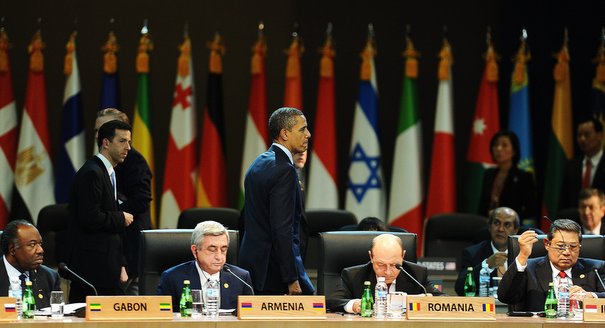
Friday marks the 100th anniversary of the mass killing of 1.5 million Armenians at the hands of the Ottoman Turks, but President Obama won’t be using the term ‘genocide’ to describe them.
Source: KPCC AirTalk
Friday marks the 100th anniversary of the mass killing of 1.5 million Armenians at the hands of the Ottoman Turks, but President Obama won’t be using the term ‘genocide’ to describe them.
The White House broke the news Tuesday in meetings with Armenian American groups, contradicting a promise then-Senator Obama made while campaigning for president in 2008 to “recognize the Armenian Genocide.”
Maybe nowhere in the U.S. does this news hit harder than in Los Angeles, which is home to the largest Armenian population outside of Armenia or Russia. The White House says the decision was made in order to keep relations with Turkey, a NATO ally, stable in the hopes of cooperation on Middle Eastern conflicts.
Did the White House make the right decision, politically, in not using the word ‘genocide?’ What would the impact be on U.S.-Turkish relations if he did? What does this decision mean for U.S. foreign policy?

Senior Fellow, Carnegie Europe
Thomas de Waal is a senior fellow at Carnegie Europe, specializing in Eastern Europe and the Caucasus.
Recent Work
Thomas de Waal
Thomas de Waal
Carnegie does not take institutional positions on public policy issues; the views represented herein are those of the author(s) and do not necessarily reflect the views of Carnegie, its staff, or its trustees.

Before the next wave of EU enlargement takes place, the union needs to grapple with thorny questions of how power is distributed among its members.


Emil Sondaj Hansen, Ditte Brasso Sørensen

The new U.S.–Denmark–Greenland agreement will help Washington exert political, economic, and financial dominance under the guise of security. Yet, it acknowledged Copenhagen’s and Nuuk’s sovereignty on the island.

Marc Pierini

A summer of escalation in the Black Sea has hurt Ukraine economically and is exacerbating world food security. A truce is needed—as is a broader reframing of Europe’s Ukraine strategy.
Thomas de Waal

Are Germany’s economic, industrial, and political struggles becoming a liability for the EU’s ability to rise to the geopolitical moment?

Rym Momtaz, ed.

European Commission President Ursula von der Leyen is about to give her annual address on the state of the EU. Here’s what she won’t—but should—say.
Rym Momtaz