

Article
Frederic Wehrey, Charles H. Johnson
{
  "authors": [
    "Frederic Wehrey"
  ],
  "type": "legacyinthemedia",
  "centerAffiliationAll": "dc",
  "centers": [
    "Carnegie Endowment for International Peace",
    "Malcolm H. Kerr Carnegie Middle East Center"
  ],
  "collections": [],
  "englishNewsletterAll": "menaTransitions",
  "nonEnglishNewsletterAll": "",
  "primaryCenter": "Carnegie Endowment for International Peace",
  "programAffiliation": "MEP",
  "programs": [
    "Middle East"
  ],
  "projects": [],
  "regions": [
    "Middle East",
    "Iran",
    "Saudi Arabia",
    "Yemen",
    "Gulf"
  ],
  "topics": [
    "Political Reform",
    "Security",
    "Foreign Policy"
  ]
}
Source: Getty
The nuclear deal’s potential benefits to sectarian relations in the Gulf have been offset by the escalating violence in Yemen and a wave of Sunni triumphalism.
Source: Washington Post
How has the Iran nuclear framework deal affected Sunni-Shiite tensions in the Persian Gulf region?
In an ideal world, the framework should begin to lower the region’s sectarian tensions, paving the way for a new era of interdependence. As Iran’s moderates ascend and as its malign meddling in fractured Arab states declines – the theory goes – the jittery gulf monarchies will in turn feel more confident to dial down their sect-based bashing of the Islamic Republic. They will be less inclined to treat Iran as an existential menace and more as a friendly competitor – if not a full-fledged partner – in regional order. With their airwaves, clerical pulpits and Twitter feeds cleared of sectarian vitriol, the gulf monarchies’ domestic spaces will enjoy new breathing room, perhaps even enabling a fresh push for measured political reforms.
This was certainly part of President Obama’s long-term vision for the plan – to establish what he called an “equilibrium … between the Sunni, or predominantly Sunni, gulf states and Iran.”Unfortunately, this happy scenario is still a long way off: The Persian Gulf region is actually experiencing an alarming surge in sectarianism. Iran’s militant adventurism embodied in its Quds Force has continued unabated – and might even increase after the injection of funds from the lifting of sanctions. Although the framework received a tepid official endorsement from Riyadh, Sunni commentators in the gulf media are universally suspicious, seeing in it continued U.S. weakness, if not duplicity and unchecked Iranian power. “A palace made of sand,” one Saudi columnist wrote of the agreement. More sectarian voices like Saad al-Burayk attacked the deal as an ongoing war on Sunnis that was meant to free up Iranian funds for Yemen’s Houthis, while the Sahwa activist Mohsen al-Awajy condemned it as a “Zionist-Safavid platform” and urged Saudi Arabia to acquire its own nuclear capability.
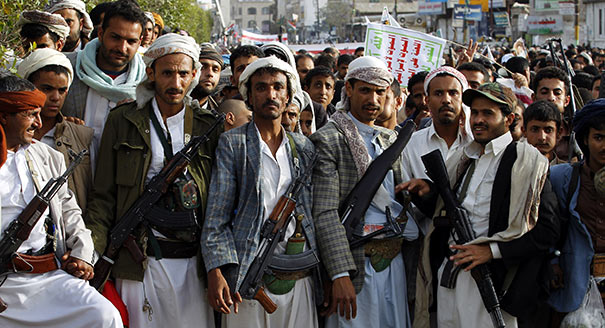
Perhaps more importantly, though, the run-up to the nuclear deal saw a spike in Saudi-driven Sunni triumphalism stemming from the Arab military intervention in Yemen. Whatever potential benefits to sectarian relations the Iran deal could have offered have been offset by the escalating violence in Yemen – strife that gulf commentators and clerics are framing in starkly sectarian terms.
The Saudi decision to launch “Operation Decisive Storm” was rooted in very real security concerns about the Houthi’s military buildup on the border. It was also intended to force Washington’s hand on confronting Iran’s regional policies. Yet there was also an unstated domestic calculus behind the invasion that followed a longstanding practice of playing the sectarian card to bolster domestic support for ruling families. This is certainly not new, as I’ve argued in a recent book. Simplified, the strategy goes something like this: Keep your political opposition divided amongst Sunnis and Shiites, keep your publics fixated on an external threat, and portray your benevolent rule as the only buffer against the impending chaos – the glue that keeps an otherwise fractious polity together.
Aside from its deleterious humanitarian effects in Yemen, Decisive Storm has been an effective execution of this strategy from the Arab gulf rulers’ point of view. The Saudi-led war with Yemen’s Houthis came at a time when potentially troublesome and deeply sectarian Sunni constituents in gulf states, including clerics within the “official” establishment, were obliquely criticizing the Arab gulf regimes for their participation in the U.S.-led coalition against the Islamic State.
Now those same Sunni Islamists – and even the normally antagonistic Muslim Brotherhood – are rallying behind al-Saud and other dynasties. For example, the enormously influential Sahwa cleric Salman al-Awda lauded the war as a new display of Sunni unity against “Persian authoritarianism.” Even in Kuwait, where sectarianism has been relatively muted, this dynamic is unfolding, albeit in a mirror image of the other gulf states, as Madeleine Wells has recently shown. Here, historically loyalist Shiite factions are seeking greater protection from the ruling al-Sabah family from resurgent sectarianism by Sunni tribal oppositionists.
Across the gulf region, the sectarian ripples of the Saudi-led military campaign have been toxic and violent. Most recently, it has launched an increasingly heated war of words between the United States’ two principal allies in the region, Iraq and Saudi Arabia. In remarks to reporters in Washington, Iraqi Prime Minister Hayder al-Abadi slammed the Saudi-led campaign and asked rhetorically if the Saudis also had Iraq in their sights. Meanwhile, on the streets of Baghdad, thousands of Shiite protesters, including Shiite militias, have condemned the war and announced their willingness to aid the Houthis. Although such developments are unlikely to spark actual bilateral conflict – Abadi’s comments were directed at domestic audiences and Iran – they further complicate Washington’s efforts to construct a unified Arab front against the Islamic State.
But the war’s more insidious effects are being felt within the Arab gulf states, where the war is closing off political space and enabling a crackdown on dissent. Shiite citizens who do not join in the chorus of nationalist support for the war are being attacked once again for suspect loyalties. Activists that question the intervention on social media are arrested. In Bahrain, pro-regime Sunni parliamentarians are drawing up legislation that criminalizes any criticism of the operation by “Houthi supporters,” i.e. Shiite oppositionists from al-Wefaq. In the Shiite areas of Saudi Arabia’s eastern province, a policeman died and dozens of Shiite locals were wounded after security forces tried to preemptively disrupt protests in the restive town of Awamiya.
All of this serves to underscore Obama’s comments to the New York Times about the imperative of gulf domestic reform in the wake of the Iran deal. Much of the gulf’s insecurity and sectarian tensions stems from longstanding problems of governance and the uneven distribution of political and economic capital, rather than Iran’s power projection. These are vulnerabilities that no amount of U.S. security guarantees and arms transfers can protect. U.S. policymakers should therefore emphasize at the upcoming Camp David talks that while they will continue to assist in the gulf’s external defense they are also committed to moving the gulf forward on political reform – and they reserve the right to call out gulf deficiencies in public and also condition future aid on reform progress. They should also be leery of lending support to Arab interventions in fractured states that, while ostensibly undertaken for counter-terrorism aims or to check Iranian influence, often have more partisan agendas and end up exacerbating communal conflict.
Even if the nuclear deal paves the way for an eventual Saudi-Iranian rapprochement, we should not overestimate the ability of Tehran and Riyadh to control the region’s sectarian temperature like a thermostat. Non-state actors like the Islamic State, radical Salafis and Shiite militias are increasingly calling the shots, irrespective of the wishes of their regional patrons in the Arab gulf states and Iran. To be sure, a curtailing of outside funding from gulf or Iranian coffers would diminish their capacity to fan sectarian fires. But sectarianism is ultimately a by-product of institutional breakdown and state collapse in the Levant and Iraq – and that won’t be changing anytime soon.
This article was originally published in the Washington Post.

Senior Fellow, Middle East Program
Frederic Wehrey is a senior fellow in the Middle East Program at the Carnegie Endowment for International Peace, where his research focuses on governance, conflict, and security in Libya, North Africa, and the Persian Gulf.
Recent Work
Frederic Wehrey, Charles H. Johnson
Frederic Wehrey, Charles H. Johnson
Carnegie does not take institutional positions on public policy issues; the views represented herein are those of the author(s) and do not necessarily reflect the views of Carnegie, its staff, or its trustees.

Russia is testing the waters of NATO’s mutual defense clause. What do strikes in Romanian territorial waters mean for the alliance’s posture toward Moscow?

Dimitar Bechev

With its public finances in shambles, the far right polling at 35 percent ahead of the 2027 presidential election, and a growing protest movement, is France’s crisis a threat to the EU’s geopolitical awakening?

Rym Momtaz, ed.

Ahead of a tough winter for Ukraine, Donald Trump’s swing back toward Russia bodes ill. But instead of panicking, Kyiv’s European allies are focusing on action.
Rym Momtaz

Funding Ukraine remains a priority for European leaders. As Russia’s war of aggression heads into another winter, two feasible options to mobilize support for Kyiv should be fast-tracked.


Vladyslav Rashkovan, Gregory P. Wilson

While the EU and European governments are embracing the much-lauded middle-power moment, this entails three difficult conundrums.

Richard Youngs