

Article
C. Raja Mohan, Darshana M. Baruah
{
  "authors": [
    "C. Raja Mohan"
  ],
  "type": "legacyinthemedia",
  "centerAffiliationAll": "dc",
  "centers": [
    "Carnegie Endowment for International Peace",
    "Carnegie India"
  ],
  "collections": [],
  "englishNewsletterAll": "ctw",
  "nonEnglishNewsletterAll": "",
  "primaryCenter": "Carnegie India",
  "programAffiliation": "SAP",
  "programs": [
    "South Asia"
  ],
  "projects": [],
  "regions": [
    "Asia",
    "South Asia",
    "India"
  ],
  "topics": [
    "Foreign Policy",
    "Economy"
  ]
}
Source: Getty
Modi is trying to move the Sino-Indian relationship out of the stasis that it finds itself in.
Source: Indian Express
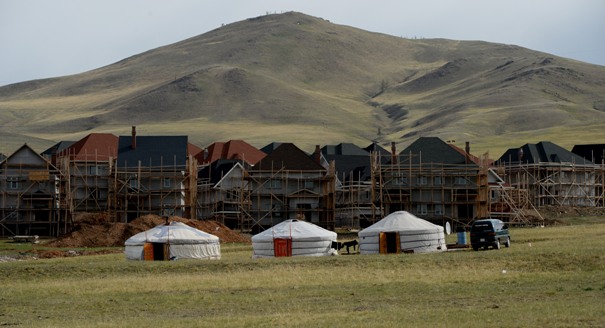
With barely three million people deep inside the Eurasian steppe and sandwiched between Russia and China, Mongolia is an unlikely destination for Prime Minister Narendra Modi this week. China will certainly loom large over Modi’s three-nation tour, beginning Thursday. For, Modi is trying to move the Sino-Indian relationship out of the stasis that it finds itself in. Given his focus on “Make in India” and attracting foreign direct investment, Modi would want to end India’s prolonged political neglect of South Korea, one of the world’s leading economies, located at the heart northeast Asia. But Mongolia? Why has Modi chosen to be India’s first prime minister to visit Mongolia?
Some point to Mongolia’s potential as a source of natural uranium and other valuable minerals for India. But New Delhi already has agreements on uranium supplies with many countries from where it is easier to ship uranium than the landlocked Mongolia. Others would see rivalry with China as the driver behind Modi’s brief sojourn in Mongolia. If China spends so much political energy in cultivating India’s neighbours in the subcontinent and the Indian Ocean, it has been argued, Delhi should be doing the same on China’s periphery.
Mongolia is indeed a very sensitive neighbour of China, and the investment of the PM’s time in Mongolia seems worthwhile. To be sure, there has been a geopolitical dimension to India’s engagement with Mongolia. Over the last few years there, India and Mongolia have steadily expanded their defence exchanges and security cooperation.But there are also limits to any Indian powerplay in Mongolia. With just two neighbours, with whom Mongolia has had difficult relations in the past, Ulaanbaatar has no interest in provoking either Russia or China by undertaking activities hostile to them. Like all small states with large neighbours, Mongolia wants a measure of “strategic autonomy” from them. The country, however, carefully calibrates its partnerships with other major powers. It also had to carefully circumscribe its relations with the Dalai Lama amid Chinese protestations.
Over the last quarter of a century, Mongolia has diversified its relations with an approach that is called the “third neighbour” policy. Originally developed vis-a-vis the United States in the immediate aftermath of the Cold War, Mongolia has sought active cooperation with Germany, Europe, Japan and Korea. Ulaanbaatar has also taken to multilateralism, regional and international. Mongolia holds annual multilateral military exercises on its soil called the “Khaan Quest”, and has participated in UN Peacekeeping Operations. These activities have already given Mongolia an interesting global personality.
For Mongolia, India is more than a third neighbour — it is the “spiritual neighbour”. Buddhism travelled to Mongolia in different periods from India and Tibet to emerge as the dominant religious faith over the last two millennia. It has survived the Stalinist-era oppression of religion, when Mongolia became part of the Soviet sphere of influence after the Bolshevik Revolution.
India was the first country outside the socialist bloc to establish diplomatic relations with Mongolia in 1955. Reviving its religious heritage and celebrating its new democratic orientation have become the major attributes of Mongolia after the 1990s, and India figures prominently in both domains. If the Mongolian state has put special emphasis on reaffirming the nation’s cultural identity, it might have found the right man in Modi.
During his travels over the last year — whether it was offering prayers to Lord Pashupatinath in Kathmandu, Nepal, meditating at a Buddhist temple in Kyoto, Japan or visiting the Sri Maha Bodhi tree in Anuradhapura, Sri Lanka — Modi has put shared religious heritage with neighbours at the centre of his regional engagement. Mongolia, then, offers many possibilities for Modi’s cultural diplomacy.
Modi, who used to express his interest in Buddhism when he was the chief minister of Gujarat, has now lent it a special mission in shaping the future of the subcontinent and Asia. Speaking in Delhi earlier this month on the occasion of Buddha Purnima, Modi said, “Without Buddha, the 21st century will not be Asia’s century.”
Modi has talked about the possibilities of restoring historic Buddhist sites in the subcontinent and promoting tourism by integrating them across borders through modern transportation facilities. If spiritualism and economic development are presented as two sides of the same coin by Modi, his three-nation tour this week will see Buddhism at the very forefront of India’s new Asian outreach.
Former Nonresident Senior Fellow, Carnegie India
A leading analyst of India’s foreign policy, Mohan is also an expert on South Asian security, great-power relations in Asia, and arms control.
Recent Work

C. Raja Mohan, Darshana M. Baruah


Alexander Gabuev, Paul Haenle, C. Raja Mohan, …
Carnegie does not take institutional positions on public policy issues; the views represented herein are those of the author(s) and do not necessarily reflect the views of Carnegie, its staff, or its trustees.

European states control several Overseas Countries and Territories around the world that carry strategic, economic, and environmental weight. As great powers challenge the rules-based order, defending them is a geopolitical imperative for Europe.

Marc Pierini

As we close out another season of Strategic Europe, it is worth taking stock of the deep shifts underway.

Rym Momtaz
The EU had to compromise to adopt a twenty-first sanctions package against Russia, exposing growing cracks in the union’s resolve. Is this latest, weaker round worth it to keep pressure on Moscow?
Rym Momtaz, ed.

Trump is distracted and Ukraine wants Europe to step up. The continent’s leaders must find their voice and assert it in talks with Russia.

Alissa de Carbonnel

Mounting economic strain and battlefield losses will not necessarily make the Kremlin less dangerous. They could instead push Moscow toward a more aggressive hybrid campaign designed to test NATO’s Eastern flank, exploit allied hesitation, and fracture European resolve.

Maksym Beznosiuk