

Commentary
Alexander Gabuev
{
  "authors": [
    "Alexander Gabuev"
  ],
  "type": "legacyinthemedia",
  "centerAffiliationAll": "",
  "centers": [
    "Carnegie Endowment for International Peace",
    "Carnegie Russia Eurasia Center"
  ],
  "collections": [],
  "englishNewsletterAll": "",
  "nonEnglishNewsletterAll": "",
  "primaryCenter": "Carnegie Endowment for International Peace",
  "programAffiliation": "",
  "programs": [],
  "projects": [
    "Eurasia in Transition"
  ],
  "regions": [
    "East Asia",
    "China",
    "Central Asia",
    "Russia",
    "Caucasus"
  ],
  "topics": [
    "Economy",
    "Trade",
    "Foreign Policy"
  ]
}
Source: Getty
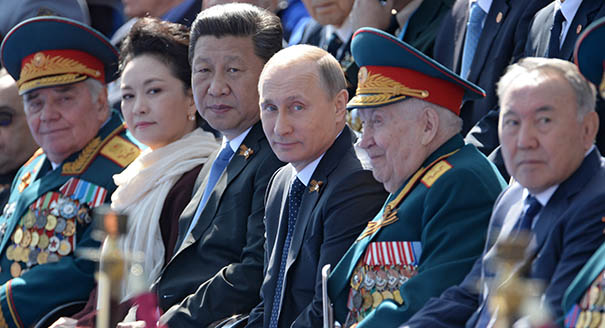
If China and Russia manage to coordinate the Eurasian Economic Union and the Silk Road Economic Belt, the change will mean not only a more genuine partnership between Moscow and Beijing, but China’s arrival, with Russia’s support, as a truly Eurasian power.
Source: Diplomat
More than a year after the annexation of Crimea triggered a major rupture in the relationship between the West and Russia, Moscow’s attempts to build new partnerships in Asia are no longer surprising. Since the announcement of a $400 billion gas deal with China in May 2014, the Kremlin has tried to portray an emerging partnership with the world’s number two global economic powerhouse as an antidote to Western sanctions.
Grand summits between Russian President Vladimir Putin and Chinese President Xi Jinping, with dozens of agreements and triumphant declarations, have been met with skepticism in Western capitals. Russia-China rapprochement is frequently brushed off as spin doctoring, which both an isolated Russian regime and an assertive Chinese party-state try to sell for domestic consumption. It is widely believed that the two countries remain deeply suspicious of each other, and internal rifts will prevent them from forming a meaningful partnership.
One of the realms where Moscow and Beijing are strategic competitors is Central Asia. China’s economic and political clout in this resource-rich region is growing, sometimes at Russia’s expense. Many see China’s “Silk Road Economic Belt” initiative, first unveiled by Xi on a 2013 trip to Kazakhstan, as an attempt to drive Russia out of the region, where Moscow is trying to promote its own integration project, the Eurasian Economic Union (EEU). It’s widely believed that it’s just a matter of time before clashes occur between the two integration projects.But after the May 8 Putin-Xi summit in Moscow, maybe it’s time to change that perspective. The two leaders signed a joint declaration “on cooperation in coordinating development of EEU and the Silk Road Economic Belt.” Moscow and Beijing declared a goal to coordinate the two projects in order to build a “common economic space” in Eurasia, including a Free Trade Agreement between the EEU and China. Though still equivocal in language, the document signifies major departure from the previous collision course.
In private conversations Chinese officials acknowledge that, since unveiling “One Belt, One Road,” Russia was their major concern. Since the 2013 announcement that the Kremlin was reluctant to engage in any meaningful negotiation on how Xi’s initiative will coexist with the EEU, Putin’s pet project. Beijing’s fear was that Moscow, anxious about its own fading status as a regional superpower, will regard “One Belt, One Road” as an intrusion into Russia’s sphere of influence and therefore pressure Central Asian states to block their participation in the Chinese project. Beijing was surprised and relieved when Igor Shuvalov, Russia’s first deputy prime minister and Putin’s troubleshooter for economic problems, first announced at the Boao Forum that the EEU is ready to cooperate with “One Belt, One Road,” and then personally embarked on negotiating a framework document with Chinese leaders on Putin’s behalf.
For the Russian leadership, the agreement with China was a result of painful internal discussions, in which its economic team had to win Putin’s support even with the security community’s concerns. In the end, the Kremlin concluded that the benefits of coordinating the EEU with the Chinese initiative outweighed the risks. It is now understood that it is inevitable that China will become the major investor in Central Asia and the major market for the region’s vast natural resources. The only way Russia can maintain its influence is to recalibrate its role in the region to accommodate its own ambitions, Beijing’s quest for raw materials, and the region’s appetite for Chinese money. The document signed by Putin and Xi outlines the possible formula.
First, China has recognized the EEU and is ready to deal with this structure and not only talk to separate member-states. On May 8 the Eurasian Economic Commission, the supranational body of the EEU, was mandated by the presidents of Russia, Kazakhstan, Belarus and Armenia to start negotiations on a trade and investment agreement with China. At the same time Moscow will look for Chinese infrastructure investment and secure access to the $40 billion “Silk Road Fund” for upgrading Russia’s infrastructure. The question of a free trade agreement with China, which is a problem for both Russia and Central Asian states given their high protectionism, was declared a distant goal and effectively put off for the future.
What the Kremlin is hoping for is a division of labor between Moscow and Beijing in Central Asia. China, with its deep pockets and resource hunger, will be the major driver for economic development in the region, while Moscow will remain the dominant hard security provider through its Collective Security Treaty Organization. This formula satisfies both China, which is still uncomfortable deploying troops beyond its borders, and also the Central Asian states – given their anxiety about a rising China and habitude to Russia’s military presence.
Of course, the Russian-Chinese consensus is just the first step on a road that may be bumpy as the two powers try to navigate it. The imperial syndrome of Russia’s ruling class, particularly in the security community, may prevent Moscow from fully embracing a pragmatic strategy of accommodating China’s growing influence in what used to be exclusively Russia’s backyard. At the same time, the Russian bureaucracy’s track record of executing such bold strategies toward its neighbors is ambiguous at best. For China it will be very hard to abandon the old habit of doing business with “the Stans” one-on-one, without informing the Kremlin. But if China and Russia manage to deliver, the change will be significant. It will mean not only a more genuine partnership between Moscow and Beijing, but China’s arrival, with Russia’s support, as a truly Eurasian power.

Director, Carnegie Russia Eurasia Center
Alexander Gabuev is director of the Carnegie Russia Eurasia Center. Gabuev’s research is focused on Russian foreign policy with particular focus on the impact of the war in Ukraine and the Sino-Russia relationship. Since joining Carnegie in 2015, Gabuev has contributed commentary and analysis to a wide range of publications, including the Financial Times, the New York Times, the Wall Street Journal, and the Economist.
Recent Work
Alexander Gabuev
Alexander Gabuev
Carnegie does not take institutional positions on public policy issues; the views represented herein are those of the author(s) and do not necessarily reflect the views of Carnegie, its staff, or its trustees.

With its public finances in shambles, the far right polling at 35 percent ahead of the 2027 presidential election, and a growing protest movement, is France’s crisis a threat to the EU’s geopolitical awakening?

Rym Momtaz, ed.

Ahead of a tough winter for Ukraine, Donald Trump’s swing back toward Russia bodes ill. But instead of panicking, Kyiv’s European allies are focusing on action.
Rym Momtaz

Funding Ukraine remains a priority for European leaders. As Russia’s war of aggression heads into another winter, two feasible options to mobilize support for Kyiv should be fast-tracked.


Vladyslav Rashkovan, Gregory P. Wilson

While the EU and European governments are embracing the much-lauded middle-power moment, this entails three difficult conundrums.

Richard Youngs

Europe is facing rising populism internally as well as external pressures from Russia, China, Turkey, and the United States.

Dimitar Bechev