

Commentary
The European Commissioner for Trade is headed to China. But after President Xi’s bridge-building visit to Washington, can a more isolated EU overcome Beijing’s stranglehold on critical raw materials? Who will blink first?
Rym Momtaz, ed.
{
  "authors": [
    "Alexey Arbatov"
  ],
  "type": "legacyinthemedia",
  "centerAffiliationAll": "",
  "centers": [
    "Carnegie Endowment for International Peace",
    "Carnegie Russia Eurasia Center"
  ],
  "collections": [],
  "englishNewsletterAll": "",
  "nonEnglishNewsletterAll": "",
  "primaryCenter": "Carnegie Endowment for International Peace",
  "programAffiliation": "",
  "programs": [],
  "projects": [
    "Eurasia in Transition"
  ],
  "regions": [
    "North America",
    "United States",
    "Russia",
    "Eastern Europe",
    "Ukraine"
  ],
  "topics": [
    "Security",
    "Military",
    "Foreign Policy",
    "Nuclear Policy",
    "Arms Control"
  ]
}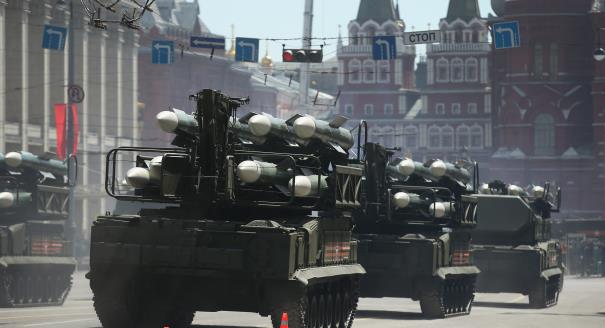
Source: Getty
Dialogue between Russia and the United States is needed to defuse tension and tone down irresponsible statements on both sides about nuclear weapons.
Source: Defense News
The threat of nuclear war between Russia and the West, long relegated to Cold War history, reappeared last year as the crisis in East-West relations escalated.Russian strategic bombers now fly long-range patrols near the coast of the US and its NATO allies, while Russian missile tests and military exercises involving simulated use of nuclear weapons raise the specter of nuclear war. The US responds as its defense analysts discuss options for boosting nuclear deterrence in Europe to counter Russian threats.
President Vladimir Putin unambiguously warned the West in August 2014, as the fighting raged in eastern Ukraine, not to forget that "Russia is not to be messed with. I want to remind you that Russia is one of the largest nuclear powers."
All of this has been interpreted in Europe and the US as aggressive posturing intended to intimidate the West. But inside Russia there is a different conversation. In a recent article in the highly regarded Russian defense weekly Voenno-Promyshelnnyi Kuryer (VPK) (Military Industrial Courier), prominent Russian defense expert retired Col. Mikhail Khodarenok draws alarming — for Russia — conclusions about the Russia-NATO military balance and the Russian military's prospects in a hypothetical conflict with the West. ...
Alexey Arbatov
Alexey Arbatov is the head of the Center for International Security at the Primakov National Research Institute of World Economy and International Relations.
Carnegie does not take institutional positions on public policy issues; the views represented herein are those of the author(s) and do not necessarily reflect the views of Carnegie, its staff, or its trustees.

The European Commissioner for Trade is headed to China. But after President Xi’s bridge-building visit to Washington, can a more isolated EU overcome Beijing’s stranglehold on critical raw materials? Who will blink first?

Rym Momtaz, ed.

European NATO countries are wrestling with the possibility of U.S. disengagement from the alliance. With the continent’s security increasingly uncertain, governments must restore the credibility of their collective defense.



Hans-Dieter Lucas, Adam Thomson, Pierre Vimont

The domestic impacts of how long it is taking to end the war in Ukraine have pushed the French electorate to the political extremes and compromised the country’s diplomatic capacity.
Rym Momtaz

Before the next wave of EU enlargement takes place, the union needs to grapple with thorny questions of how power is distributed among its members.


Emil Sondaj Hansen, Ditte Brasso Sørensen

The new U.S.–Denmark–Greenland agreement will help Washington exert political, economic, and financial dominance under the guise of security. Yet, it acknowledged Copenhagen’s and Nuuk’s sovereignty on the island.

Marc Pierini