

Commentary
Alexander Gabuev
{
  "authors": [
    "Alexander Gabuev"
  ],
  "type": "commentary",
  "centerAffiliationAll": "",
  "centers": [
    "Carnegie Endowment for International Peace",
    "Carnegie Russia Eurasia Center"
  ],
  "collections": [],
  "englishNewsletterAll": "",
  "nonEnglishNewsletterAll": "",
  "primaryCenter": "Carnegie Endowment for International Peace",
  "programAffiliation": "",
  "programs": [],
  "projects": [],
  "regions": [
    "East Asia",
    "China",
    "Southeast Asia",
    "Russia"
  ],
  "topics": [
    "Security",
    "Foreign Policy"
  ]
}
Source: Getty
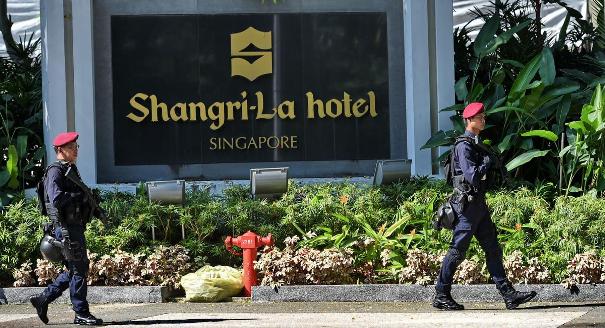
Triumphant summits between Vladimir Putin and Xi Jinping may end with propaganda fanfare, but multilateral meetings are where one can really measure the progress of Russia’s “pivot to Asia”. Moscow’s showing at the recent Shangri-La Dialogue is an indicative example.
Triumphant summits between Vladimir Putin and Xi Jinping may end with propaganda fanfare and dozens of signed documents, but multilateral meetings are where one can really measure the progress of Russia’s “pivot to Asia.” Moscow’s showing at the recent Shangri-La Dialogue hosted by IISS and the government of Singapore, the prime platform of formal and informal exchanges between the region’s top security policymakers, is an indicative example. The quantity of Russian participants and the quality of the official presentations speak volumes about Moscow’s ability to navigate a complex security environment in a region, which the Kremlin wants to see as a new driver of economic growth to replace the hostile West.
Last year, Deputy Minister of Defense Anatoly Antonov, leading a very small Russian delegation, was given a speaking slot at one of the prestigious plenary sessions. In his speech, Antonov named “the rise of fascism in Ukraine” and West-supported “color revolutions” among major threats for Asia-Pacific security. The words “South China Sea” were not mentioned. This performance received mixed reviews from Asian participants, to put it mildly.
Russia didn’t deliver on any of these expectations. Despite organizers’ efforts to attract more Russian guests, there were just four experts, two of them, including this author, formally represented American research institutions. It is symbolic that the majority of high-level decisionmakers on Kremlin policy toward Asia preferred a conference on Russia-China relations in Moscow, organized by Russian International Affairs Council, to the Shangri-La Dialogue.
Anatoly Antonov, who in the meantime was put on the EU list of sanctioned Russian officials, confirmed his participation a few days before the SLD conference and thus was given a speaking slot on a panel discussion, not at the more prestigious plenary session. He used his five-minutes to speak on topics mainly irrelevant to the audience, but still safe, including transparency of Russian military drills, the general importance of the Asia-Pacific to the global economy, and events that the Russian Defense Ministry will host this year. The words “freedom of navigation” or “territorial disputes in South China Sea”, the core issues on which all other participating countries had a stance, were not mentioned again—but neither were “Ukrainian fascists” or “color revolutions”.
But when the full transcript of Antonov’s remarks was distributed among participants on the last day of SLD, “fascists” and the “color revolutions” found their way back into the official Russian narrative. “No one can feel absolutely safe, entertaining the fact that ‘color revolutions’ have not come to Asia-Pacific. The thing is, it may happen at any moment once the Western elites feel unhappy about the policy of a state and make a decision to introduce ‘democratic’ values. We recall the Umbrella revolution in Hong Kong. Who is next?” the Russian deputy minister of defense asserted. Fortunately, the message has not reached the larger audience as the majority of the guests simply didn’t bother to read the 12-page document.
One of the reasons for these awkward moves is the traditional habit of toeing the boss’s line so immanent to Russian bureaucratic culture. Sergei Lavrov employed a similar tactic during the most recent Munich Security Conference. Instead of trying to engage the audience in front of him, Lavrov just read out a statement, which would go to show his loyalty to the Kremlin, just like Antonov has now done in Singapore. Working for the ultraconservative Ministry of Defense as the only senior person who speaks English and oversees external relations, Antonov, one of the most capable Russian diplomats and a respected arms-control expert, sometimes needs to be a better Catholic than the Pope. The second factor is Russia’s neglect for informal platforms like the Shangri-La Dialogue. Similar events in Russia play insignificant roles in foreign policymaking, just like outside experts, so Moscow is not really worried about the quality of its performance at such international conferences.
But it’s deeper than that. The third reason is a new factor, which may have graver long-term implications for Russia’s Asian policy. As many insiders acknowledge, Moscow simply wants to stay away from controversial issues where China, Russia’s major international partner, can get upset. Despite the fact that free passage of ships and peaceful resolution of territorial disputes in the South China Sea are potentially in Russia’s interests if it wants to compete on Asian oil and LNG markets, it’s currently much easier to avoid the topics completely. Russia’s policy of relying on direct pipelines to China as a way to increase its presence in the Asian energy market only fortifies this approach and decreases incentives to formulate an agenda based on pragmatic national interests, rather than anti-Americanism.
Following this path to the end, Russia risks turning itself not only into a mere supplier of hydrocarbons to a single customer, but also into China’s junior partner in international diplomacy—with formal paraphernalia of an equal. To avoid this fate, Moscow should learn from Beijing, which can officially stick to a very different position on Crimea than the Kremlin, but maintain pragmatic cooperation with Russia.

Director, Carnegie Russia Eurasia Center
Alexander Gabuev is director of the Carnegie Russia Eurasia Center. Gabuev’s research is focused on Russian foreign policy with particular focus on the impact of the war in Ukraine and the Sino-Russia relationship. Since joining Carnegie in 2015, Gabuev has contributed commentary and analysis to a wide range of publications, including the Financial Times, the New York Times, the Wall Street Journal, and the Economist.
Recent Work
Alexander Gabuev
Alexander Gabuev
Carnegie does not take institutional positions on public policy issues; the views represented herein are those of the author(s) and do not necessarily reflect the views of Carnegie, its staff, or its trustees.

While the EU and European governments are embracing the much-lauded middle-power moment, this entails three difficult conundrums.

Richard Youngs

Europe is facing rising populism internally as well as external pressures from Russia, China, Turkey, and the United States.

Dimitar Bechev

Much has been said of the changes Brussels is trying to make to the EU enlargement process. Here’s why gradual integration might—or might not—be the answer.
Dimitar Bechev

The European Commissioner for Trade is headed to China. But after President Xi’s bridge-building visit to Washington, can a more isolated EU overcome Beijing’s stranglehold on critical raw materials? Who will blink first?

Rym Momtaz, ed.

European NATO countries are wrestling with the possibility of U.S. disengagement from the alliance. With the continent’s security increasingly uncertain, governments must restore the credibility of their collective defense.



Hans-Dieter Lucas, Adam Thomson, Pierre Vimont