

Report
- +3
James M. Acton, Alexey Arbatov, Vladimir Dvorkin, …
{
  "authors": [
    "Petr Topychkanov"
  ],
  "type": "legacyinthemedia",
  "centerAffiliationAll": "",
  "centers": [
    "Carnegie Endowment for International Peace",
    "Carnegie Russia Eurasia Center"
  ],
  "collections": [],
  "englishNewsletterAll": "",
  "nonEnglishNewsletterAll": "",
  "primaryCenter": "Carnegie Russia Eurasia Center",
  "programAffiliation": "",
  "programs": [],
  "projects": [
    "Eurasia in Transition"
  ],
  "regions": [
    "Russia",
    "Eastern Europe",
    "Ukraine",
    "Western Europe"
  ],
  "topics": [
    "Security",
    "Military"
  ]
}
Source: Getty
A theory of “hybrid war” based on the events in Crimea and eastern Ukraine ignores both the chronology and cause-and-effect links between events on the ground.
Source: Russian International Affairs Council
In June 2015 the Finnish Institute of International Affairs (FIIA) published a report entitled “Russia’s Hybrid War in Ukraine: Breaking the enemy’s ability to resist”, by András Rácz, a senior research fellow at the institute 1. As the title indicates, the subject of the paper is the phenomenon of “hybrid war”. Following Russia’s annexation of Crimea and the start of military actions between Ukrainian security forces and units of the non-recognised Donetsk and Luhansk People’s Republics in 2014, this phenomenon has attracted the close attention of political, military, academic and journalistic circles in western countries and in Russia.
The concept of “hybrid war” has begun to be used frequently of late by the leadership of the North Atlantic alliance. In March 2015, for example, NATO’s deputy secretary-general Alexander Vershbow gave the following definition: “‘Hybrid war’, combining military threat, covert intervention, secret supplies of arms and weapons systems, economic blackmail, diplomatic dissimulation and manipulation of the media with outright disinformation”. This is how the American diplomat described Moscow’s actions in relation to Ukraine the growing threat from Russia to NATO members.
This term has also become popular in Russia. For example, on 24 April 2015 Colonel-General Anatoly Sidorov, commander of the Western Military District, said that the USA and its allies were conducting the first stage of a “hybrid war” against Russia, which consisted of destabilising the internal political situation with the aid of political and economic tools and waging an information campaign with the aim of spreading anti-Russian feeling in Eastern Europe.In the introduction to his paper András Rácz says: “The new Ukrainian government was largely disabled by the hybrid war, and thus was unable to prevent the Russian annexation of Crimea” (p. 12). According to the author, having started a hybrid war against Ukraine before annexing Crimea, Russia was so successful that by the time the military and political steps associated with its assimilation of the peninsula began Kiev had lost the possibility of defending its state sovereignty and integrity. If that is a true interpretation of Rácz’s words, it requires as a minimum justification in the form of quotations from authoritative sources. Otherwise such a position is debatable. If the words of Russia’s president Vladimir Putin are to be believed, the decision to “return” Crimea to Russia was taken only on the night of 22—23 February 2014. That means that before this, Moscow had not taken any active steps against Ukraine that could be described by the concept of “hybrid war”, and consequently it would be mistaken to accuse Moscow of destabilising the government of Ukraine and causing the collapse of its armed forces.
A broad interpretation of the concept of “hybrid war” might allow one to retort that since the protests started in Kiev at the end of 2013 Moscow had perpetrated actions which could be described by this concept: Russian politicians criticised the political forces standing behind the protests, the official media broadcasting to the country and to the wider world painted a negative picture of these political forces, and Russian special services were involved in getting president Viktor Yanukovich out of Ukraine.
These actions by Moscow in relation to Ukraine did indeed take place before Crimea’s annexation. But if we link them by the concept of “hybrid war” one gets the sense that the Russian authorities had a prepared plan of action against Ukraine, at the earliest from the end of 2013 or even earlier, and that this plan was consistently implemented, leading to success for Russia and defeat for Ukraine.
András Rácz asserts that the “attack phase” against Crimea was preceded by the “preparatory phase”, which according to him must have included strategic, political and operational preparations (p. 59).
The strategic preparations, he says, include identifying vulnerabilities in the country’s administration, economy and armed forces, creating a network of loyal non-profit-making organisations and media on the territory of that country, and using diplomatic and information tools to influence the international audience.
The political preparation, says Rácz, means disseminating a feeling of dissatisfaction with the central authorities, developing separatist movements, using the media against the country and its government, bribing politicians, officials and military personnel, and establishing links with representatives of business and criminal circles.
The operational preparation, according to this paper, includes coordinated actions aimed at applying political pressure and disinformation, mobilising representatives of the authorities, the armed forces and organised crime in the country, and mobilising the Russian armed forces on the pretext of military exercises.
Most of the elements of the “preparatory phase” in a “hybrid war” look logical in the picture painted by Rácz, but are not confirmed either by the official statements of the Russian authorities or by the results of journalistic investigations, or by the assessments of Russian and western observers. The available evidence gives grounds for thinking that Moscow did not have a prepared plan against Ukraine in place and its military and political actions during the Ukrainian crisis were predominantly of a responsive nature.
Before the night of 22—23 February 2014, when the Russian leadership took the decision to annex Crimea, it is doubtful whether here existed a Russian strategy in relation to Ukraine in which the main weapon could have been “hybrid war”. Such a strategy could have emerged from the end of February, but it would have included several elements at the same time, listed by Rácz as part of the “preparatory phase”, the “attack phase” and the “stabilisation phase”. One of the central roles in the implementation of the Russian strategy, especially in the period preceding the annexation of Crimea, was given to the Airborne Troops, the Special Operations Forces and other arms and units of the Russian Armed Forces.
But even in relation to the events at the end of February 2014 the use of the term “hybrid war” is debatable. András Rácz says that “in accordance with Russian military thinking about ‘new generation war’, hybrid war is based on the integrated use of military and non-military instruments covering the whole range of the state’s political toolbox, including diplomatic, economic, political, social, information, and also military resources” (p. 87). Russia could not have used anywhere near the full range of resources cited by the researcher in the process of annexing Crimea, and also in the context of conflict between the central authorities of Ukraine and the non-recognised Donetsk and Luhansk People’s Republics.
In the winter of 2014-2014 and spring 2014 it was difficult to notice any significant efforts by Russia in Crimea and in eastern Ukraine in the economic, social and information areas. Ruslan Pukhov, for example, Director of the Centre for Analysis of Strategies and Technologies, says: “Russia’s propaganda support for its actions in Crimea was generally quite sluggish… Moscow did not create propaganda messages about the meaning and direction of its actions in Crimea, but in fact was silent on these and the final aims of its actions…”
If Russia’s use of military resources in Crimea can be represented as part of an integrated set of measures aimed at implementing a unified strategy, i.e. at annexing the peninsula, in eastern Ukraine Russian military resources were at various times used for different purposes.
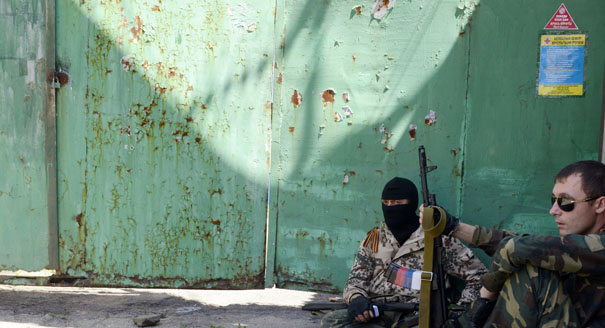
Unlike Crimea, where Russia’s use of military resources as initially denied, and then admitted, the presence of Russian military personnel in eastern Ukraine has not yet been officially confirmed by Moscow, although there is evidence of this in journalistic research as well as in photos and videos published on the Internet. Russian observers do not dispute the presence of Russian servicemen, weapons and military equipment on the territory of the non-recognised Donetsk and Luhansk People’s Republics. For example, Mikhail Khodarenok, editor of Voyenno-Promyshlenny Kuryer, says: “It’s well known that volunteer soldiers on leave are fighting on the side of the south-east, generally using their authorised weapons.”
In spite of this evidence one should not talk about the entry of Russian forces into Ukrainian territory, although such a possibility was considered by Moscow before the end of April 2014. But the Russian Federation Security Council rejected this aim as early as 24 April, and on 25 June the Council of the Federation revoked the president’s permission to make operational use of the Armed Forces outside the country, which had been given on 1 March. Thus, according to the Russian researcher M. Barabanov, “There was no full-scale war between Russia and Ukraine”. But András Rácz sees events differently. According to him, “Since August 2014 the conflict has been transformed from a hybrid war into a war using the two states’ general-purpose forces, albeit on a limited scale” (p. 14).
The above data shows that the Russian authorities had neither a prepared plan in relation to Ukraine nor long-term goals in connection with the crisis in that country, not fixed objectives that required the use of military resources. It is therefore difficult to explain Moscow’s actions in Crimea and eastern Ukraine in terms of the concept of “hybrid war”, including a “preparatory phase”, an “attack phase” and a “stabilisation phase” as described by András Rácz.
This forces one to have doubts not only about the applicability of the concept of “hybrid war” in relation to the events in Ukraine, but also about whether it is valid at all. This is partially confirmed even by those who use this concept. For example, the NATO Secretary-General Jens Stoltenberg said on 25 March 2015: “Of course, there’s nothing new in hybrid war. It’s as old as the Trojan Horse. What distinguishes it is the fact that its scale is bigger, its speed and intensity are higher, and it’s taking place on our borders.” András Rácz also indicates that elements of “hybrid war” are not new. In his opinion, “the novelty lies in the high level of effectiveness and in many cases the real-time coordination in the use of various resources, including political, military, special operations and measures in the area of information” (p. 87).
The features of “hybrid war” cited by Jens Stoltenberg and András Rácz are too unspecific to form the basis for a new term which could apply not only to the events in Ukraine but also in other cases. Neither the NATO Secretary General nor the FIIA researcher explains what criteria apply in their assessments of the scale, intensity and effectiveness of Moscow’s actions. In other words, it’s not clear from the quotations cited what scale, intensity and effectiveness are required for the actions of one state against another to be described as “hybrid war”.
András Rácz’s paper confirms the words of Ruslan Pukhov, who wrote that “the use of the term ‘hybrid war’ is more a matter of propaganda than of classification” 2. Attempts to develop the theory of “hybrid war” on the basis of analysing the events in Crimea and eastern Ukraine can be successful only if the chronology and cause-and-effect links between these events are ignored. Otherwise, such attempts are doomed to failure, since the facts do not confirm this theory.
1 Rácz A. Russia’s Hybrid War in Ukraine. Breaking the Enemy’s Ability to Resist. – Helsinki: The Finnish Institute of International Affairs, 2015.
2 Pukhov, R.N. Op. cit.
This article originally appeared on the Russian International Affairs Council site.
Former Fellow, Nonproliferation Program, Moscow Center
Topychkanov was a fellow in the Carnegie Moscow Center’s Nonproliferation Program.
Recent Work

James M. Acton, Alexey Arbatov, Vladimir Dvorkin, …
Petr Topychkanov
Carnegie does not take institutional positions on public policy issues; the views represented herein are those of the author(s) and do not necessarily reflect the views of Carnegie, its staff, or its trustees.

Before the next wave of EU enlargement takes place, the union needs to grapple with thorny questions of how power is distributed among its members.


Emil Sondaj Hansen, Ditte Brasso Sørensen

The new U.S.–Denmark–Greenland agreement will help Washington exert political, economic, and financial dominance under the guise of security. Yet, it acknowledged Copenhagen’s and Nuuk’s sovereignty on the island.

Marc Pierini

A summer of escalation in the Black Sea has hurt Ukraine economically and is exacerbating world food security. A truce is needed—as is a broader reframing of Europe’s Ukraine strategy.

Thomas de Waal

Are Germany’s economic, industrial, and political struggles becoming a liability for the EU’s ability to rise to the geopolitical moment?

Rym Momtaz, ed.

European Commission President Ursula von der Leyen is about to give her annual address on the state of the EU. Here’s what she won’t—but should—say.
Rym Momtaz