

Article
C. Raja Mohan, Darshana M. Baruah
{
  "authors": [
    "C. Raja Mohan"
  ],
  "type": "legacyinthemedia",
  "centerAffiliationAll": "dc",
  "centers": [
    "Carnegie Endowment for International Peace",
    "Carnegie India"
  ],
  "collections": [],
  "englishNewsletterAll": "ctw",
  "nonEnglishNewsletterAll": "",
  "primaryCenter": "Carnegie India",
  "programAffiliation": "SAP",
  "programs": [
    "South Asia"
  ],
  "projects": [],
  "regions": [
    "South Asia",
    "India",
    "Middle East",
    "United Arab Emirates"
  ],
  "topics": [
    "Foreign Policy"
  ]
}
Source: Getty
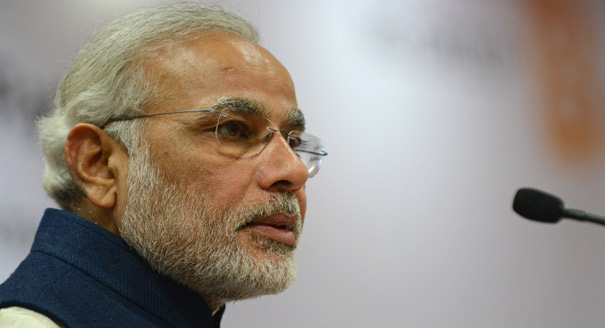
Prime Minister Narendra Modi has seized a rare moment of change in the Gulf and launched a new phase in India’s relations with the United Arab Emirates.
Source: Indian Express
In proclaiming a “natural strategic partnership” with the United Arab Emirates and putting security cooperation, including counter-terrorism, at the centre of it, Prime Minister Narendra Modi has seized a rare moment of change in the Gulf and launched a new phase in India’s relations with a very critical region.
The new chapter will be marked not just by an even-handed approach by the UAE to India’s disputes with Pakistan, but an unprecedented political endorsement of Delhi’s concerns about violent extremism, and a strong commitment to jointly combat the sources of terrorism in the subcontinent and the Middle East.
Modi’s decision to travel to the Emirates at short notice was based on Delhi’s recognition of the need to discard the traditional thinking on the region, and grasp the new opportunities for a restructuring of relations between the subcontinent and the Gulf.Despite the historical links, civilisational intimacy, geographical proximity, growing economic interdependence, and the presence of a large Indian labour force in the Gulf, political relations between India and the region have long been strained by the Pakistan factor.
Islamabad’s emphasis on shared religious bonds and the region’s reluctance to understand India’s difficulties in dealing with cross-border terrorism from Pakistan had long cast a shadow over India’s relations with the Gulf.
In his engagement with the leaders of the Emirates on Monday, Modi obtained a rare expression of empathy for India’s long-standing security concerns vis-a-vis Pakistan.
The joint statement issued by India and UAE referred to the issue of giving a religious colour to political disputes (Islamabad’s promotion of jihadi culture), dismantling the infrastructure of terrorism (on Pakistani soil), bringing perpetrators of terrorism to justice ( Zakiur Rehman Lakhvi of 26/11), and dismantling the alliance between money laundering, criminal networks and violent extremism (Dawood Ibrahim).
That this support has come from the Emirates, one of the countries closest to Pakistan, underlines the profound changes that are threatening the Gulf.
In the past, the region could afford to look the other way as Pakistan used religious extremism and terrorism as a tool of its foreign policy in Afghanistan and India. Recall that the UAE and Saudi Arabia were the only countries that recognised the Taliban government in Afghanistan during the late 1990s.
Today, the region can no longer take a detached view, given the threat that violent extremism and religious strife pose to the existing political order in the Gulf kingdoms.
That the region was beginning to appreciate India’s concerns on terrorism and take a more balanced approach to the issues between Delhi and Islamabad was evident when King Abdullah of Saudi Arabia visited India nearly a decade ago.
The understanding arrived between Modi and the UAE leadership on the nature of the threat from terrorism, and the measures needed to counter it go much farther, and are far more explicit.
This welcome advance is understandable given the mounting challenges to the security of the Gulf kingdoms. The rise of the Islamic State and the deepening sectarian tensions between the Sunni and the Shia are threatening to tear apart the political fabric of the Sheikhdoms.
Unlike Pakistan which can live with a measure of internal chaos, the Gulf kingdoms need internal tranquility to sustain the prosperity of their deeply globalised economies run by workers and professional managers drawn from diverse nations.
The joint statement’s reference to the shared commitment between the two countries to “openness, peaceful coexistence and social harmony” are not the kind of phrases that normally figure in India’s engagement with monarchies anywhere in the world.
The reference to the UAE as “a shining example of a multi-cultural society” is a political recognition of the high stakes involved in defending the economies of the region that are so vulnerable to violent religious extremism.
Once this political challenge was understood, it was not difficult for Modi and his Gulf interlocutors to devise an ambitious framework for security cooperation.
The bold new agenda between the two countries now ranges from intelligence sharing and police training to cooperation between law enforcement agencies against criminal networks and joint anti-terror operations.
The statement also calls for intensive engagement between the two national security establishments, interoperability between the armed forces, and even proposes joint development of weapon systems.
Having negotiated this extraordinary agenda with the Emirates, Delhi must now focus on translating it into concrete action on the ground. At the same time, India needs to demonstrate the discretion not to crow about a diplomatic victory against Pakistan.
As it reaches out to Pakistan’s traditional friends in the Gulf, Delhi must affirm its commitment to work with them in transforming the whole of subcontinent into a more peaceful and prosperous place.
This article was originally published in the Indian Express.
Former Nonresident Senior Fellow, Carnegie India
A leading analyst of India’s foreign policy, Mohan is also an expert on South Asian security, great-power relations in Asia, and arms control.
Recent Work

C. Raja Mohan, Darshana M. Baruah


Alexander Gabuev, Paul Haenle, C. Raja Mohan, …
Carnegie does not take institutional positions on public policy issues; the views represented herein are those of the author(s) and do not necessarily reflect the views of Carnegie, its staff, or its trustees.

The European Commissioner for Trade is headed to China. But after President Xi’s bridge-building visit to Washington, can a more isolated EU overcome Beijing’s stranglehold on critical raw materials? Who will blink first?

Rym Momtaz, ed.

European NATO countries are wrestling with the possibility of U.S. disengagement from the alliance. With the continent’s security increasingly uncertain, governments must restore the credibility of their collective defense.



Hans-Dieter Lucas, Adam Thomson, Pierre Vimont

The new U.S.–Denmark–Greenland agreement will help Washington exert political, economic, and financial dominance under the guise of security. Yet, it acknowledged Copenhagen’s and Nuuk’s sovereignty on the island.

Marc Pierini

A summer of escalation in the Black Sea has hurt Ukraine economically and is exacerbating world food security. A truce is needed—as is a broader reframing of Europe’s Ukraine strategy.

Thomas de Waal

Are Germany’s economic, industrial, and political struggles becoming a liability for the EU’s ability to rise to the geopolitical moment?
Rym Momtaz, ed.