

Q&A
Eugene Rumer
{
  "authors": [
    "Eugene Rumer"
  ],
  "type": "legacyinthemedia",
  "centerAffiliationAll": "dc",
  "centers": [
    "Carnegie Endowment for International Peace",
    "Malcolm H. Kerr Carnegie Middle East Center"
  ],
  "collections": [],
  "englishNewsletterAll": "ctw",
  "nonEnglishNewsletterAll": "",
  "primaryCenter": "Carnegie Endowment for International Peace",
  "programAffiliation": "russia",
  "programs": [
    "Russia and Eurasia"
  ],
  "projects": [],
  "regions": [
    "Middle East",
    "Syria",
    "Russia",
    "Levant"
  ],
  "topics": [
    "Political Reform",
    "Security",
    "Foreign Policy",
    "Global Governance"
  ]
}
Source: Getty
With no solution to the Syria crisis in sight, it is time to resort to what has worked in other seemingly unsolvable crises: the P5+1 mechanism.
Source: Time
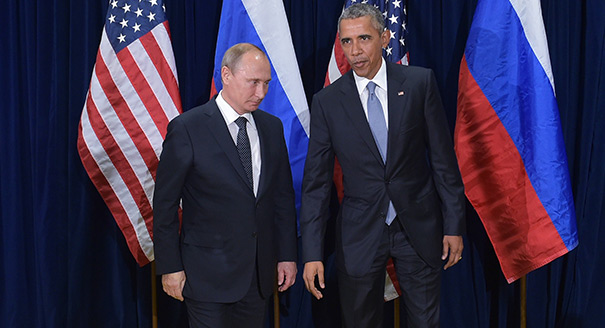
The crisis in Syria has become a standoff between the U.S. and Russia. Each side is blaming the other for it. Moscow charges the Syrian tragedy is the direct consequence of U.S. unilateral, delusional pursuit of democracy in the Middle East. Washington insists that Russian support for Syrian President Bashar al-Assad is the cause. The most the two seem to be able to agree on is to talk about de-conflicting their air operations to avoid a mid-air collision between their planes. With no solution in sight, it is time to resort to what has worked in other seemingly unsolvable crises: the P5+1 mechanism.
The P5+1—the U.S., Russia, France, Great Britain, China, all U.N. Security Council permanent members joined by Germany—is a unique forum where the key parties can come together to seek a way to solve the Syrian crisis. In addition to the major powers, the P5+1 format has the advantage of being able to engage Iran, a critical actor in Syria without whom no solution can be found. The trust built up between the P5+1 countries and Iran in the course of the negotiations about Iran’s nuclear program, and the success of those talks make for a unique basis to address the Syrian crisis. The U.S. and Russia can ill afford to squander it.
For Russia, President Vladimir Putin’s deployment of air assets to Syria was a clever tactical move that reasserted Russia’s power. Getting into Syria was easy for Putin. Getting out of it may be harder. Air strikes alone will not end the conflict. Even though some in Moscow have hinted that Russian “volunteers” may go to Syria to fight ISIL and other enemies of Assad, Putin said he has no plans to put Russian boots on the ground in Syria. The Russian public is opposed to sending troops there. Many voices in Moscow have sounded the alarm about getting bogged down. P5+1 talks on Syria would offer Putin a way out. And as in nuclear talks with Iran, this format guarantees Putin a seat at the big powers’ table.Unlike other powers, Iran, an important Russian ally, has boots on the ground in Syria. Iran’s client Hezbollah has been deeply involved in the war, and Iranian troops have been reported fighting in Syria as well, backing Assad. Through its involvement in Syria, Iran, too, has positioned itself as a key party to any future resolution of the Syrian war. It has the ability to undermine any agreement reached without it. It should have a seat at the table.
For Europe, scrambling to deal with Syrian refugees, ending the conflict is top priority. European leaders have yet to offer any comprehensive solution to the crisis other than appealing for all parties to end the fighting. Anything that offers a way out of the crisis is better than nothing.
For the U.S., the P5+1 format would bring some advantages as well as a measure of compromise. It would insulate the U.S. from the charge of unilateralism and create a real coalition to deal with the crisis whose legitimacy under the U.N. umbrella would be unassailable. It would impose the P5+1 framework on what otherwise is Russian unilateralism and could potentially harness Russian military presence constructively on behalf of the coalition. If this was not accepted by Putin, the U.S. could expose his bluff and open him to the charge of unilateralism.
The P5+1 format would require that the U.S. put aside the condition that Assad must step down prior to or as a result of the settlement talks. In fact, recent U.S. statements suggest there is some flexibility in the U.S. position on this issue. U.S. willingness to stop insisting on Assad’s departure and agree to address this issue in the future would open the possibility of creating a real coalition to defeat ISIL and a political solution for the Syrian war, which are the key U.S. goals, shared by Russia, Iran, Europe and—yes—Assad.
Other parties to the conflict—Turkey, Saudi Arabia, other Persian Gulf States—may complain about Iran’s role and Assad remaining in power for now. But in all the years of the war in Syria, they have offered no solution to the crisis, and no way to stop the bloodshed. They should have a voice, but they should not be in a position to block the talks.
Finally, for the Syrians themselves, the P5+1 involvement would offer the reassurance of the international community’s support and involvement in any future settlement in Syria. For the beleaguered Syrian opposition, it would be a commitment by the P5+1 countries that they will not be abandoned to the mercy of Assad’s troops after the conflict is over. For Assad and his supporters, Russia’s and Iran’s presence would serve as a reassurance and hold out the possibility of an orderly transition instead of a defeat or endless conflict.
This is neither the perfect nor a guaranteed solution to the Syrian war. But insisting on the perfect and ignoring the good is not an option while thousands of Syrians are dying.
Director and Senior Fellow, Russia and Eurasia Program
Rumer, a former national intelligence officer for Russia and Eurasia at the U.S. National Intelligence Council, is a senior fellow and the director of Carnegie’s Russia and Eurasia Program.
Recent Work
Eugene Rumer
Eugene Rumer
Carnegie does not take institutional positions on public policy issues; the views represented herein are those of the author(s) and do not necessarily reflect the views of Carnegie, its staff, or its trustees.

Funding Ukraine remains a priority for European leaders. As Russia’s war of aggression heads into another winter, two feasible options to mobilize support for Kyiv should be fast-tracked.


Vladyslav Rashkovan, Gregory P. Wilson

While the EU and European governments are embracing the much-lauded middle-power moment, this entails three difficult conundrums.

Richard Youngs

Europe is facing rising populism internally as well as external pressures from Russia, China, Turkey, and the United States.

Dimitar Bechev

A notable degree of participative democracy has firmly arrived in Europe. But to have more far-reaching impact, democratic deliberation needs to move into a radically new phase.
Richard Youngs

Much has been said of the changes Brussels is trying to make to the EU enlargement process. Here’s why gradual integration might—or might not—be the answer.
Dimitar Bechev