

Commentary
Richard Youngs
{
  "authors": [
    "Richard Youngs"
  ],
  "type": "legacyinthemedia",
  "centerAffiliationAll": "dc",
  "centers": [
    "Carnegie Endowment for International Peace",
    "Carnegie Europe"
  ],
  "collections": [],
  "englishNewsletterAll": "ctw",
  "nonEnglishNewsletterAll": "",
  "primaryCenter": "Carnegie Europe",
  "programAffiliation": "EP",
  "programs": [
    "Europe"
  ],
  "projects": [],
  "regions": [
    "Europe",
    "Western Europe",
    "Iran"
  ],
  "topics": [
    "Foreign Policy",
    "Security"
  ]
}
Source: Getty
While a new EU Global Strategy could act as a welcome catalyst, a number of factors risk distorting or diluting its impact on EU foreign policy.
Source: LSE EUROPP Blog
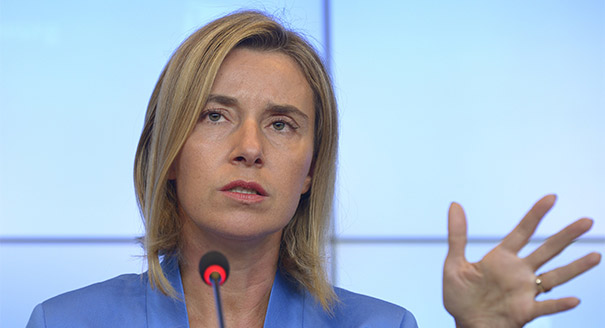
Based on a Strategy review paper agreed this summer, high representative Federica Mogherini is drawing up a new EU Global Strategy. Last week she launched a consultation process to feed into the strategy. While a new Global Strategy could act as a welcome catalyst, a number of factors risk distorting or diluting its impact on EU foreign policy.
According to the review paper, a new strategy is warranted because the world has become more ‘connected, complex and contested’ since the EU’s existing security strategy was drawn up in 2003. Whether this assertion suffices as the basis for a new strategy is open to question. Connectivity and complexity are not especially new. And these long-present, generic features of international politics are now morphing into more specific, emerging trends: pockets of de-globalisation; burgeoning localism; recidivist nationalism; growing antipathy between online communities; the shaping of new concepts of power; and non-Western powers’ varied stances on global problem-solving.
The EU needs to make sure that its Global Strategy anticipates these kind of new issues that are driving future challenges, and is not based on premises that are either overly generic or already behind-the-curve. Moreover, the mandate given by the review paper focuses on very standard issues of EU coherence and policy-making silos – the need to make sure security and trade decisions are better linked, for example – that seem very narrow alongside the magnitude of change to the global system.The (familiar) call that animates the new strategy is for faster foreign policy responses that are not so beholden to the deadening weight of bureaucratic procedure. Yet the EU will take over two years to complete the review process and devise a new strategy. Of course, building consensus takes time and the United States was not much quicker in finalising its security strategy. However, by the time the EU’s Global Strategy becomes operational geopolitics are likely to have moved on from the initial assumptions of the review process. Think of how the EU’s Middle East policies have been thrown into disarray by the recent refugee surge.
The review paper also calls for a foreign policy that is less obsessed with tortured internal EU processes and institutional competences. To this end, the high representative has now promised a wider process of public consultation and engagement. Of course, many EU strategies are preceded by open consultations that are mere box-ticking exercises and do little in practice to change external policies’ ‘insider’ tenor or their focus on sui generis EU governance instruments. One hopes that the new Global Strategy will not follow the same pattern. Despite the calls for fundamental change, it is only the Brussels bubble of functionaries, MEPs, advisors, think-tankers and specialist journalists that have had any influence so far. At present, the exercise feels a bit like Alcoholics Anonymous retiring to the pub to get a better grip on abstinence.
A common line heard from analysts and diplomats is that an updated Global Strategy will be beneficial even if it does not introduce major tangible changes to EU foreign policy output. A highly possible outcome is that the new strategy will contain impressive and sophisticated new language and analysis but have little impact on the way EU diplomats manage very specific, fast-moving, day-to-day challenges.
The danger is that this lulls policy-makers into a false comfort zone. The 2003 security strategy was a masterful document that was deservedly celebrated as the first clear statement of the way the EU defined its own ostensible uniqueness in the world. Today the EU does not have the luxury of another process that is primarily about self-identity.
From the documents and talks driving the process so far, it seems likely that the new strategy will call for more strategic dialogue with international partners. It will need to be more specific here if it is to add anything to the existing foreign policy framework. The EU has in recent years strengthened foreign policy dialogues on a whole range of issues and with a large number of new global partners. The focus now must be on tangible results. The EU needs to move beyond its tendency to see foreign policy dialogues only in terms of process, not outcomes.
The review paper acknowledges that EU enlargement is no longer a primary foreign policy tool. But it offers no remedy. If national governments are really to let domestic considerations derail further enlargement, EU foreign policy needs to find a new category ‘between in and out’. This is especially imperative in the light of current unrest in Turkey, Ukraine and the Balkans, as well as the talk of two-level membership among EU member states themselves. If the Global Strategy does not provide a concrete solution to this challenge it will leave unresolved a major problem for EU strategic influence that has been evident for several years.
The most significant development since 2003 is the near collapse of the EU integration model. Yet the review paper rather breezily suggests that the crisis is likely to prompt further integration and thus provide a positive opportunity for foreign policy. A global strategy today must surely go beyond such platitudes, and spell out how it will tackle the more problematic linkages between internal and external EU policy dynamics.
While the Global Strategy cannot hope to define every aspect of European foreign and security policy, it should be succinct in justifying what the EU will now do differently, and exactly how these changes will be brought about. We should be spared yet another document that simply lists every region and every issue as a priority that the EU will henceforth take more seriously.
All assertions that the EU ‘will do more about x’ or ‘engage more with power y’ should open the way to more detailed policies that include actionable guidelines in different areas of foreign policy. These guidelines should be specific enough to allow EU citizens to hold the foreign policy elite to account.
Of course the strategy itself cannot delineate definitive solutions to international challenges; but it can and should push on-going strategic reflection towards more tightly specified types of foreign policy choices. A mere restatement of well-known generalities would serve little purpose and may well be counter-productive. If the strategy fails to open the way towards sharper foreign policy tools, updated for the precise ways in which global politics will change over the next decade, it will simply slow the necessary adjustment of EU security policies.

Senior Fellow, Democracy, Conflict, and Governance Program
Richard Youngs is a senior fellow in the Democracy, Conflict, and Governance Program, based at Carnegie Europe. He works on EU foreign policy and on issues of international democracy.
Recent Work
Richard Youngs

Richard Youngs, Erik Jones, Dan Baer, …
Carnegie does not take institutional positions on public policy issues; the views represented herein are those of the author(s) and do not necessarily reflect the views of Carnegie, its staff, or its trustees.

A summer of escalation in the Black Sea has hurt Ukraine economically and is exacerbating world food security. A truce is needed—as is a broader reframing of Europe’s Ukraine strategy.

Thomas de Waal

Are Germany’s economic, industrial, and political struggles becoming a liability for the EU’s ability to rise to the geopolitical moment?

Rym Momtaz, ed.

European Commission President Ursula von der Leyen is about to give her annual address on the state of the EU. Here’s what she won’t—but should—say.
Rym Momtaz

Radical-right parties are expected to do well in upcoming elections in four of the EU's biggest member states. If successful, they could prevent the union from addressing key challenges ahead.

Stefan Lehne

The aftermath of the Ceuta crisis shows Europe has drawn the wrong lessons. Rather than doubling down on failed migration policies, the EU needs to address the underlying roots of such episodes.
Richard Youngs