

Commentary
Alexey Malashenko
{
  "authors": [
    "Alexey Malashenko"
  ],
  "type": "commentary",
  "centerAffiliationAll": "",
  "centers": [
    "Carnegie Endowment for International Peace",
    "Carnegie Russia Eurasia Center"
  ],
  "collections": [
    "Inside Russia"
  ],
  "englishNewsletterAll": "",
  "nonEnglishNewsletterAll": "",
  "primaryCenter": "Carnegie Russia Eurasia Center",
  "programAffiliation": "",
  "programs": [],
  "projects": [],
  "regions": [
    "Russia"
  ],
  "topics": [
    "Security",
    "Religion"
  ]
}
Source: Getty
Russia’s official Muslim establishment blames the West for the rise of the self-proclaimed Islamic State and refuses to admit that radical Islam has a real social base, ignoring the radicalization of many ordinary Muslims in Russia and Central Asia.
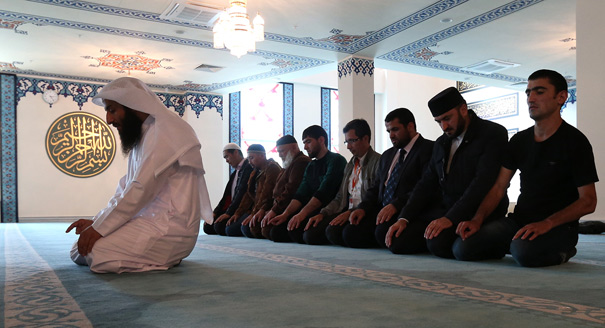
The terrorist attacks against the Russian passenger jet over Egypt and in Paris have found Russia’s Muslim community (umma) divided, despised and defiant.
The Russian umma is large and diverse. It comprises around 16.5 million Russian citizens and approximately four million migrants from Central Asia and Azerbaijan. Members of this sizeable group hold very different opinions on the so-called Islamic State, Russia’s intervention in Syria, and the recent terrorist attacks.
Many representatives of Russia’s Muslim political establishment and the clergy is voice conspiracy theories similar to those aired in the Russian media, claiming that the Islamic State is a Western plot designed to destabilize the global situation and squeeze Russia out of the greater Middle East. Mukhamed Salyakhetdinov, the head of the Association of Muslim Public Organizations, said that the authorities “shouldn’t look for masterminds among Muslims” and that the Islamic State is managed “from the outside.”
In a similar fashion, Chechen President Ramzan Kadyrov has declared that the Islamic State and other Islamist organizations are the brainchildren of Western intelligence services. Earlier this year, Kadyrov said that the Charlie Hebdo massacres were aimed at “inciting anti-Islamic sentiments.”
The message is that radical Islamist terrorism is an invented phenomenon, a weapon used to discredit Muslims worldwide. If Islamic fundamentalism is an illness or a “cancerous tumor,” then it can be tackled only through “invasive surgery.”
This approach ignores the inconvenient fact that Islamic fundamentalism has a strong social base across the Muslim world. Islamist parties have gained seats in parliaments and won elections in several countries. The Islamic State is the most extreme manifestation of this trend, but it is not an artificial creation.
This mindset also dangerously fails to confront the fact that grassroots radical Islam is on the rise throughout Russia. A few years ago, it could only be found in the North Caucasus. Now, Islamist activists can be found throughout Russia, even as far as the Far East.
In Russia, these Islamists are more usually referred to as Salafis or Wahhabis. They are increasingly exploiting the weaknesses of mainstream Islam in Russia, where two thirds of imams are over 70 and out of touch with the modern world. More radical and charismatic young clerics, many of whom have graduated from Islamic universities in the Middle East, are now maneuvering to take over these mosques.
Russia has thousands of Salafi cells that belong to the radical Hizb ut-Tahrir movement from Central Asia. Several thousand Russian Muslims are now believed to be fighting with the Islamic State and many emissaries from Iraq and Syria have been arrested in Russia after trying to recruit young men and women.
The Islamic State may have as many as half a million sympathizers in Russia today. Many of these oppose the organization’s use of terrorism, but still see it as a kind of Muslim democracy that dispenses social justice and equality. It is an appealing idea, when contrasted with Russia’s economic crisis, corruption, and growing inequality.
Accordingly, many Russian Muslims see Russia’s military intervention in Syria as an unjust war against Islam.
The downing of the Russian airliner on October 31 brought Russia under direct attack. President Vladimir Putin has put Russia in the front line against international (meaning Islamist) terrorism, laying claim to be the Islamic State’s Enemy Number One—and potentially laying Russia open to terrorist retaliation on Russian soil.
Russia has endured terrorism before—from Chechen militants, but they made demands and asked to negotiate with the Russian authorities. But the men who organized the attacks in Paris and against the Metrojet Airbus A321 over Egypt are not interested in dialogue. The indiscriminate killing they perpetrated when they stormed the Bataclan concert hall makes that clear.
This time the threat is harder to determine. It could come from someone from the North Caucasus, where the Caucasus Emirate, formed at the end of the Second Chechen War, has dissolved and many of its commanders have transferred their allegiance to the Islamic State.
It could also come from a Central Asian migrant in Russia. The vast majority are there peacefully, with many working at construction sites and outdoor markets. But radical Islam also has many adherents in Central Asia, especially in the Fergana Valley. (In 2002, I had a conversation with an imam at one of the Uzbek mosques in the valley. After heaping praise on Uzbek President Islam Karimov, he whispered to me, “If we had fair elections now, bin Laden would win them hands down.” He may have been exaggerating, but there is no way of knowing as modern Uzbekistan has never held fair elections).
After the Paris tragedy, Russia is likely to adopt a zero-tolerance policy toward its migrants, as the United States has done for many years, with the slightest legal infraction getting a migrant deported back to his or her home country.
A new crackdown could have a serious effect on Russia’s changing Muslim community.
The Russian umma has become increasingly divided as its members choose among different interpretations of Islam. The growth of Middle Eastern Islamist radicalism and the latest acts of terror, with their anti-Western and anti-Russian ideology, are making those divisions sharper. They are also fueling Islamophobia and interconfessional tensions, which are likely to only radicalize fundamental Islamists even further.
Former Scholar in Residence, Religion, Society, and Security Program
Malashenko is a former chair of the Carnegie Moscow Center’s Religion, Society, and Security Program.
Recent Work
Alexey Malashenko
Alexey Malashenko

Are Germany’s economic, industrial, and political struggles becoming a liability for the EU’s ability to rise to the geopolitical moment?

Rym Momtaz, ed.

European Commission President Ursula von der Leyen is about to give her annual address on the state of the EU. Here’s what she won’t—but should—say.
Rym Momtaz

The EU’s responses to two recent incidents expose the gulf between European perceptions and capabilities. Unless the union can bridge that gap, it will never become a real geostrategic power.
Rym Momtaz

European states control several Overseas Countries and Territories around the world that carry strategic, economic, and environmental weight. As great powers challenge the rules-based order, defending them is a geopolitical imperative for Europe.

Marc Pierini

In supporting Europe’s far-right, MAGA and Russia both want the same thing: a weaker EU. Europe must defend itself without abandoning the openness these forces exploit.

Armida van Rij