

Paper
Renad Mansour, Faleh A. Jabar
{
  "authors": [
    "Renad Mansour"
  ],
  "type": "legacyinthemedia",
  "centerAffiliationAll": "dc",
  "centers": [
    "Carnegie Endowment for International Peace",
    "Malcolm H. Kerr Carnegie Middle East Center"
  ],
  "collections": [],
  "englishNewsletterAll": "menaTransitions",
  "nonEnglishNewsletterAll": "",
  "primaryCenter": "Malcolm H. Kerr Carnegie Middle East Center",
  "programAffiliation": "MEP",
  "programs": [
    "Middle East"
  ],
  "projects": [],
  "regions": [
    "Levant",
    "Iraq",
    "Middle East"
  ],
  "topics": [
    "Political Reform"
  ]
}
Source: Getty
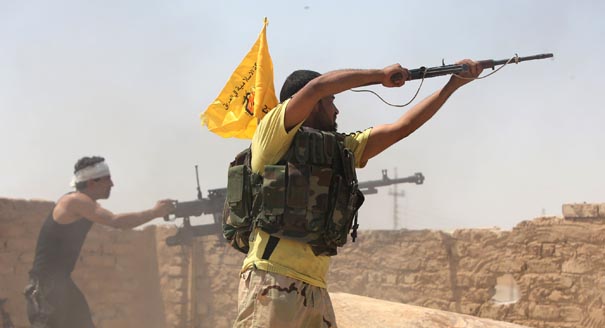
With the Iraqi state relying on Shiite paramilitary groups to combat ISIS, there are growing fears that such groups will only exacerbate sectarian tensions in the country.
Source: Al-Jazeera
Carnegie's Renad Mansour joined Al'Jazeera's Sami Zeidan, Ali Al-Dabbagh former spokesman for the Iraqi government, and Juan Cole of the University of Michigan to discuss the Iraqi government's problematic use of Shiite militias to fight ISIS and the growing tide of sectarian violence on the Sunni civilians in Iraq as a result. The discussion centered on the consequences, specifically the expanding sectarian tension, and growing concerns over the Iraqi government's reliance on, and lack of control over, Shiite militias.
Mansour argued that the Shiite militias, many under the umbrella group of 'Popular Mobilisation Forces', lack a common command structure, which prevents their effective oversight or accountability, and increases their risk of committing sectarian attacks. Mansour pointed to Prime Minister's assertion that Popular Mobilisation Forces are part of the state, which implies a state sanctioning of sectarian attacks and the risk this poses to Iraqi politicians and figures who want to reconcile with the Sunni community and others wishing to stop Abadi's reforms.

Former El-Erian Fellow, Middle East Center
Mansour was an El-Erian fellow at the Carnegie Middle East Center, where his research focuses on Iraq, Iran, and Kurdish affairs.
Recent Work
Renad Mansour, Faleh A. Jabar
Renad Mansour
Carnegie does not take institutional positions on public policy issues; the views represented herein are those of the author(s) and do not necessarily reflect the views of Carnegie, its staff, or its trustees.

A notable degree of participative democracy has firmly arrived in Europe. But to have more far-reaching impact, democratic deliberation needs to move into a radically new phase.

Richard Youngs

Before the next wave of EU enlargement takes place, the union needs to grapple with thorny questions of how power is distributed among its members.


Emil Sondaj Hansen, Ditte Brasso Sørensen

As the EU confronts profound challenges, several leaders have called for fundamental reform to the union’s model—but only modest, superficial changes have resulted. What if Europe really could be reimagined from zero today: What should such a redesigned European order look like?
Richard Youngs, ed.

The EU’s new migration policy is not suited to today’s realities. With climate change increasingly becoming a driver of displacement, Europe needs to rethink its deterrence-focused approach.

Shana Tabak
Europe seems to have accepted its sidelining in the Middle East. The EU must reassert its support for the international rules-based order and step up engagement.

Rym Momtaz