

Commentary
Nathan J. Brown
{
  "authors": [
    "Nathan J. Brown"
  ],
  "type": "other",
  "centerAffiliationAll": "dc",
  "centers": [
    "Carnegie Endowment for International Peace"
  ],
  "collections": [
    "Arab Awakening"
  ],
  "englishNewsletterAll": "menaTransitions",
  "nonEnglishNewsletterAll": "",
  "primaryCenter": "Carnegie Endowment for International Peace",
  "programAffiliation": "MEP",
  "programs": [
    "Middle East"
  ],
  "projects": [],
  "regions": [
    "Middle East",
    "North Africa",
    "Egypt"
  ],
  "topics": [
    "Political Reform",
    "Democracy",
    "Security",
    "Military"
  ]
}
Source: Getty
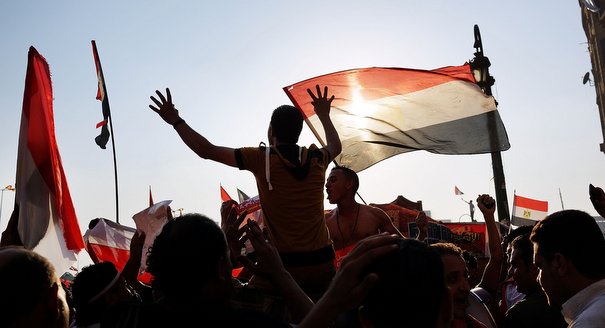
In the forty months between Mubarak’s departure and the inauguration of President Abdel Fattah el-Sisi, the numerous contradictions of Egypt’s revolution have exploded with full force.
Source: Taylor & Francis
The forced departure of Egypt’s long-time president, Hosni Mubarak, on 11 February 2011 was widely hailed as a popular revolution, not only in Egypt, but worldwide. And in many respects it was: a cascading series of demonstrations suddenly rendered the country ungovernable by a president whose tenure had extended almost three decades and who appeared to be slowly arranging his own succession. But the legal form his deposition took was a ‘constitutional declaration’ by the country’s Supreme Council of the Armed Forces (SCAF)—a body nominally headed by the president himself but in effect operating independently—that Mubarak was no longer president and that the SCAF would oversee a transition to a new political system. That announcement, which all political forces that had supported the uprising welcomed and all state institutions accepted, contained many underappreciated contradictions. A democratic transition was supposed to be combined with unchecked military rule; a popular uprising decided happily to leave the state apparatus intact; a non-ideological movement simply chose at first to ignore the deep divisions within its own ranks.The 40 months between Mubarak’s departure and the inauguration of President Abdel Fattah el-Sisi saw all these contradictions explode with full force. In the end, certain mechanical aspects of democracy did indeed emerge, and the memory of the uprising retained some political force and some established patterns that subsequent protest movements could draw on. But the tensions that were overlooked in February 2011 were resolved, at least for the moment, by the reassertion of a strong presidency and an unaccountable and authoritarian state apparatus—the very targets of the uprising...
This article was originally published by Taylor & Francis.

Nonresident Senior Fellow, Middle East Program
Nathan J. Brown, a professor of political science and international affairs at George Washington University, is a distinguished scholar and author of nine books on Arab politics and governance, as well as editor of five books.
Recent Work
Nathan J. Brown
Nathan J. Brown
Carnegie does not take institutional positions on public policy issues; the views represented herein are those of the author(s) and do not necessarily reflect the views of Carnegie, its staff, or its trustees.

Russia is testing the waters of NATO’s mutual defense clause. What do strikes in Romanian territorial waters mean for the alliance’s posture toward Moscow?

Dimitar Bechev

With its public finances in shambles, the far right polling at 35 percent ahead of the 2027 presidential election, and a growing protest movement, is France’s crisis a threat to the EU’s geopolitical awakening?

Rym Momtaz, ed.

Ahead of a tough winter for Ukraine, Donald Trump’s swing back toward Russia bodes ill. But instead of panicking, Kyiv’s European allies are focusing on action.
Rym Momtaz

Europe is facing rising populism internally as well as external pressures from Russia, China, Turkey, and the United States.
Dimitar Bechev

A notable degree of participative democracy has firmly arrived in Europe. But to have more far-reaching impact, democratic deliberation needs to move into a radically new phase.

Richard Youngs