

Book
Europe is facing rising populism internally as well as external pressures from Russia, China, Turkey, and the United States.
Dimitar Bechev
{
  "authors": [
    "Daniel Nerenberg",
    "Nathan J. Brown"
  ],
  "type": "legacyinthemedia",
  "centerAffiliationAll": "dc",
  "centers": [
    "Carnegie Endowment for International Peace",
    "Malcolm H. Kerr Carnegie Middle East Center"
  ],
  "collections": [
    "Arab Awakening"
  ],
  "englishNewsletterAll": "menaTransitions",
  "nonEnglishNewsletterAll": "",
  "primaryCenter": "Carnegie Endowment for International Peace",
  "programAffiliation": "MEP",
  "programs": [
    "Middle East"
  ],
  "projects": [],
  "regions": [
    "Middle East",
    "Israel",
    "Palestine",
    "Levant"
  ],
  "topics": [
    "Political Reform",
    "Democracy",
    "Security",
    "Civil Society"
  ]
}
Source: Getty
Deep changes are at work in Palestinian society and politics but a particular strategic goal remains elusive.
Source: Washington Post
Five years ago, as crowds of Egyptians, Tunisians, Libyans, Syrians, Bahrainis, and Yemenis rose up to demand the fall of their regimes, Palestinians were often seen as sitting out the upheaval. Only now is it apparent that events in Palestine do fit into a broader regional pattern—institutions have decayed; authoritarianism anchored in security services more nakedly dominates governance; youths show signs of political alienation; and political activists show far greater success at challenging existing authorities than in replacing them.
The failure of the protests is easy to explain: first, Palestinians have little faith in revolution as a means of ending the five decades-long occupation. Neither the mass-led first intifada, the armed second intifada, successive rocket salvos from Gaza nor the recent spate of stabbings and car rammings have led Palestinians to believe in the promises of revolutionary activity, or risk the high costs.
Second, the Palestinian national leadership in 2011 was – and still is – deeply divided, weak on legitimacy and incapable of guiding Palestinians on tactics, let alone grand strategy.
Third, Palestinians had no clear target for protests; disaffected by the Palestinian Authority (PA), Hamas and Israel protesters could not agree on which regime to undo.
But if Palestine’s rulers in Ramallah and Gaza won the battle of 2011, they may now be losing the war. It is just not clear who, if anybody, is winning. Deep changes are at work in Palestinian society and politics.
In a recent paper for the Carnegie Endowment, we show how official Palestinian institutions and leaders have lost their moral legitimacy in the eyes of the Palestinian people. The PLO, the Palestinian Authority, Fatah and even Hamas—the movements and institutions that have emerged over decades to speak on Palestinians’ behalf and lead them—have lost their moral claims in the eyes of their own people. They are seen as ineffective and even co-opted; while those who head them continue to occupy positions of authority, they can no longer lead.
The “peace process” that gave birth to the PA works only now in the area of security coordination between PA forces and Israel; in Gaza, Hamas has lost standing but similarly retains control through security forces and political controls that silence other voices.
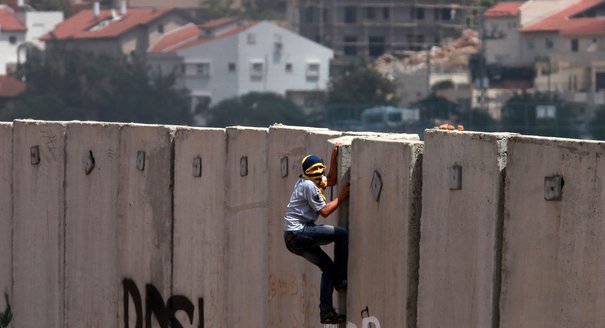
There is leadership in Palestinian society, but it takes new forms. Since Israel began construction of a wall in 2003, a robust civil society rooted in the discourse of international law has acted independent of Palestinian institutions—and with great effect. Groups like the International Solidarity Movement (ISM), the Palestinians Grassroots Anti-Apartheid Wall Campaign (also known as Stop the Wall), the Popular Struggle Coordinating Committee (PSCC) and, most vocally, the Boycott Divestment and Sanctions (BDS) movement serve as a loosely organized network of the new moral vanguard, pitching ethical standards to a diverse audience of consumers, laborers, politicians, educators, artists, farmers, and business leaders.
The new moral vanguard is in no position to unseat the official leadership—nor does it wish to—but the new leaders’ emphasis on international law has made an indelible mark on resistance discourse.
Where are the decline of the old institutions and the rise of a diffuse new moral vanguard leading Palestinians? That is not clear for two reasons—and the despair with the current situation and the desire for something to change means that not everybody is unhappy that the direction is unclear.
First, there has been a shift in Palestinian attention from national strategy and ends to shorter-term tactics. The whole raison d’être of the Palestinian national movement for generations; the effort to build a Palestinian state no longer exercises its former hold. Yes, there is some debate among Palestinians about ultimate goals and strategy, with the two-state solution and diplomacy losing their prominence. But nothing is clearly replacing them.
While we cannot deny that there is some growing interest in various one-state alternatives somehow combining Israelis and Palestinians, what seems more significant is the tendency to defer questions of solutions in favor of developing tactics that can improve the Palestinian position—such as new forms of resistance and boycott.
A new generation of Palestinians that is not cowed by memories of the tribulations of the last uprising is stepping forward. It is already having deep political effects but seems uninterested or unable—at least for now—in leading Palestinians toward any particular strategic goal.
Second, the new forms of politics seem to avoid institutions, at least the ones that exist. Rights-based activists are justifiably concerned that official leadership institutions might coopt and defang their initiatives, much like Jibril Rajoub, a Fatah strongman, did when he championed—and eventually abandoned—the Palestinian effort to eject Israel from FIFA.
Activists have been careful to avoid linking with the PA, PLO, or any of the factions for the preservation of their own autonomy, but they pay a price: with a set of movements that operate outside of official structures, Palestinians will find it difficult to develop strategies, make decisions that bind skeptics or negotiate authoritatively. Like other activists in the Arab world, Palestine’s vanguard seems adept at challenging official structures, but incapable of supplanting them.
The current wave of contention—a low-grade and unorganized series of violent attacks against Israeli soldiers, police, and civilians—reflects a tremendous political malaise: leaders are devoid of strategy, incapable of stopping the violence or guiding it toward a specific end; institutions are anemic; and rights-based activists continue their struggle with little chance of undoing the many regimes they oppose.
The result mirrors the status of contentious politics across the Arab world five years after the Arab Spring: robust but diffuse activism, stubborn but tested authoritarianism and only hints of actual political change.
This article was originally published at the Washington Post.
Daniel Nerenberg
Daniel Nerenberg is completing the doctoral program in political science at George Washington University. His research examines shifting redlines of cooperation between occupied and occupier under military occupation and colonial rule, based on fieldwork in Palestine between 2006 to 2008 and 2012 to 2013.

Nonresident Senior Fellow, Middle East Program
Nathan J. Brown, a professor of political science and international affairs at George Washington University, is a distinguished scholar and author of nine books on Arab politics and governance, as well as editor of five books.
Carnegie does not take institutional positions on public policy issues; the views represented herein are those of the author(s) and do not necessarily reflect the views of Carnegie, its staff, or its trustees.

Europe is facing rising populism internally as well as external pressures from Russia, China, Turkey, and the United States.

Dimitar Bechev

A notable degree of participative democracy has firmly arrived in Europe. But to have more far-reaching impact, democratic deliberation needs to move into a radically new phase.

Richard Youngs

The domestic impacts of how long it is taking to end the war in Ukraine have pushed the French electorate to the political extremes and compromised the country’s diplomatic capacity.

Rym Momtaz

Before the next wave of EU enlargement takes place, the union needs to grapple with thorny questions of how power is distributed among its members.


Emil Sondaj Hansen, Ditte Brasso Sørensen

The new U.S.–Denmark–Greenland agreement will help Washington exert political, economic, and financial dominance under the guise of security. Yet, it acknowledged Copenhagen’s and Nuuk’s sovereignty on the island.

Marc Pierini