

Q&A
Suzanne Maloney, Aaron David Miller, Karim Sadjadpour
{
  "authors": [
    "Karim Sadjadpour"
  ],
  "type": "legacyinthemedia",
  "centerAffiliationAll": "dc",
  "centers": [
    "Carnegie Endowment for International Peace"
  ],
  "collections": [
    "Iranian Proliferation"
  ],
  "englishNewsletterAll": "menaTransitions",
  "nonEnglishNewsletterAll": "",
  "primaryCenter": "Carnegie Endowment for International Peace",
  "programAffiliation": "MEP",
  "programs": [
    "Middle East"
  ],
  "projects": [],
  "regions": [
    "Middle East",
    "Iran"
  ],
  "topics": [
    "Political Reform",
    "Democracy",
    "Security",
    "Foreign Policy",
    "Nuclear Policy"
  ]
}
Source: Getty
Despite modest gains for reformists and moderates in Iran’s recent parliamentary elections, prospects for change remain limited.
Source: PBS’ NewsHour
JUDY WOODRUFF: The results are in from Iran’s elections. They show strong gains for relatively moderate allies of President Hassan Rouhani and a setback for more hard-line elements in Iran’s conservative Islamic establishment.
It’s the first national elections since last summer’s nuclear deal. There was heavy turnout Friday, as Iranians elected a new Parliament and the so-called Assembly of Experts, a council of senior clerics that is tasked with selecting the supreme leader.
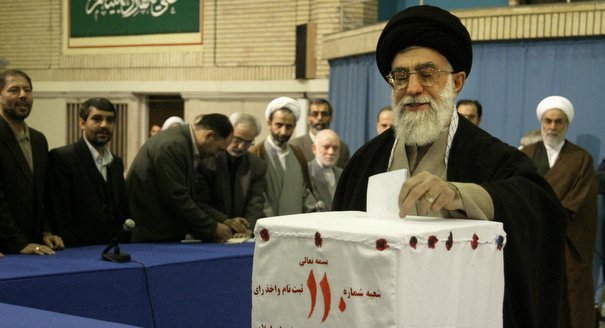
The man currently in that office, Ayatollah Ali Khamenei, praised the high turnout and advised the newly elected bodies to guard against Western influence. He remains the decisive voice in Iran.
So, what does this all mean inside Iran, and for the u.s? We turn to Karim Sadjadpour of the Carnegie Endowment for International Peace.
Karim, welcome back to the program.
So, how do you read these results?
KARIM SADJADPOUR: Judy, I think this was a best-case outcome for President Rouhani.
As you know, many of the moderates and reformist candidates were disqualified. They were prevented from running. So, before the elections, it looked pretty bleak for Rouhani. But they managed to come up with a list — what they called the list of hope. And that list swept Tehran. It did well in other urban areas.
It didn’t do as well in other — in the provinces. But I think that this doesn’t bring about liberal reformists to the Iranian Parliament, but it’s certainly a less hostile, less intolerant Parliament for President Rouhani.
JUDY WOODRUFF: Well, that’s my question, because, as you said, so many moderates were not even allowed to run. So how much more moderate are these newly elected members?
KARIM SADJADPOUR: Many of them are unknown, Judy.
I spoke to a friend of mine who has been involved in Iranian politic for three decades, and he said, of the 30 candidates who won Tehran, he was only familiar with four or five names. Among those 30 candidates, some of them actually self-identify as conservatives as well.
So, I think we should have sober expectations about the nature of these reformist Parliamentarians and, frankly, the Iranian Parliament’s ability to wield change. But there’s a great Persian expression that when someone has experienced near death, they’re content with a fever.
And I think that the Iranian population over the last decade has really experienced incredibly difficult times. And I think that many people went to vote, not because they were hoping for something. They had great expectations of a more liberal Parliament, but they fear, if they didn’t vote, it would bring about a much more intolerant, hard-line Parliament.
JUDY WOODRUFF: Will anything change, then?
KARIM SADJADPOUR: I — I think that, if you’re sitting at the White House or you’re sitting at the State Department, this election is not likely to change Iran’s policies in Syria, Iran’s objection to Israel, Iran’s animosity towards the United States. And it’s not likely to make Iran a tolerant democratic place.
But if you live in Tehran, if you learn in Shiraz, this can moderately improve your quality of life. And the Expert Assembly election is important as well, because they theoretically have responsibility for choosing the next supreme leader.
So, Iran’s current supreme leader, Ali Khamenei, is 76 years old. It could be that, if he dies in the next six to eight years, the Experts Assembly could have a role selecting his successor.
JUDY WOODRUFF: So, what should we expect to see tangibly there? Does this mean the hard-liners have somewhat less influence?
KARIM SADJADPOUR: Well, the supreme leader and the Revolutionary Guards remain pretty firmly entrenched. Iran remains a police state, in which, if you’re a journalist, you’re an author, you’re a civil society activist, you can be plucked off the street, put in prison without reason, without explanation.
There’s actually two U.S. citizens, Siamak Namazi, and his 80-year-old father, Baquer Namazi, that remain in prison in Iran. So, we certainly have to be sober about our expectations. But I think this, it just goes to show that President Rouhani’s more pragmatic agenda is deeply popular in Iran. And I think it really increases the likelihood that he will be reelected come next summer.
JUDY WOODRUFF: To what extent, Karim, was this a referendum on the nuclear deal with the West?
KARIM SADJADPOUR: You know, I think the nuclear deal and greater cooperation with the outside world, greater integration with the outside world, is something which has long been desired by the Iranian public.
This is a very young population. They’re really, I would argue, post-ideological. But, at the end of the day, the power in Iran — or, I should say, the power of institutions in Iran aren’t derived from their popular support. They are derived from their coercive capabilities.
So, I think the nuclear deal was very popular, and people would like to have much more of that type of detente with the United States. But as long as this current supreme leader remains in power, I think we should be realistic about the likelihood that this rapprochement with the United States will continue.
JUDY WOODRUFF: Karim Sadjadpour, interpreting these election results for us, we thank you.
KARIM SADJADPOUR: Thank you, Judy.

Senior Fellow, Middle East Program
Karim Sadjadpour is a senior fellow at the Carnegie Endowment for International Peace, where he focuses on Iran and U.S. foreign policy toward the Middle East.
Recent Work


Suzanne Maloney, Aaron David Miller, Karim Sadjadpour

Aaron David Miller, Karim Sadjadpour, Robin Wright
Carnegie does not take institutional positions on public policy issues; the views represented herein are those of the author(s) and do not necessarily reflect the views of Carnegie, its staff, or its trustees.

Russia is testing the waters of NATO’s mutual defense clause. What do strikes in Romanian territorial waters mean for the alliance’s posture toward Moscow?

Dimitar Bechev

With its public finances in shambles, the far right polling at 35 percent ahead of the 2027 presidential election, and a growing protest movement, is France’s crisis a threat to the EU’s geopolitical awakening?

Rym Momtaz, ed.

Ahead of a tough winter for Ukraine, Donald Trump’s swing back toward Russia bodes ill. But instead of panicking, Kyiv’s European allies are focusing on action.
Rym Momtaz

Funding Ukraine remains a priority for European leaders. As Russia’s war of aggression heads into another winter, two feasible options to mobilize support for Kyiv should be fast-tracked.


Vladyslav Rashkovan, Gregory P. Wilson

While the EU and European governments are embracing the much-lauded middle-power moment, this entails three difficult conundrums.

Richard Youngs