

Commentary
The EU can impose sanctions but struggles to enforce them without the United States. With Washington increasingly disinterested in backing European interests, the bloc must now fend for itself.
Nicu Popescu, Tiago Antunes
{
  "authors": [
    "Nikolay Kozhanov"
  ],
  "type": "legacyinthemedia",
  "centerAffiliationAll": "",
  "centers": [
    "Carnegie Endowment for International Peace",
    "Carnegie Russia Eurasia Center"
  ],
  "collections": [],
  "englishNewsletterAll": "",
  "nonEnglishNewsletterAll": "",
  "primaryCenter": "Carnegie Russia Eurasia Center",
  "programAffiliation": "",
  "programs": [],
  "projects": [],
  "regions": [
    "Middle East",
    "Syria",
    "Russia"
  ],
  "topics": [
    "Foreign Policy"
  ]
}
Source: Getty
Vladimir Putin’s announcement of Russia’s withdrawal from Syria is another cynical move by the Kremlin to retain control over the situation.
Source: Chatham House
The international community should not be deceived by Russia’s recent statements on its military withdrawal from Syria. Moscow’s latest move is not what it appears – and actually reflects its growing dexterity in playing power politics in the Middle East.
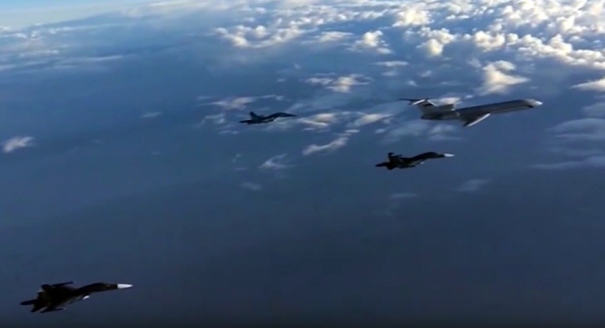
The withdrawal of Russian forces is partial at best and related only to aircraft deployed in the country after 30 September 2015. The Kremlin has confirmed that they plan to keep both the Tartus and Khmeimim military bases fully operational and continue to provide the Assad regime with the necessary equipment, training and military support. Moscow will keep an unspecified number of advanced fighter jets in the region − which have continued airstrikes even since the announcement. The Kremlin is also leaving strike helicopters and modern air defence systems − officially to guard Russian military installations, but there are reports of them being used to support the advance of the Syrian army. The S-400 anti-aircraft missile systems effectively allow them to close down Syrian airspace.The Russian withdrawal demonstrates that Moscow’s military intervention in Syria was largely about keeping the Assad regime in power and making the West look flat-footed. It was not about defeating Islamic State of Iraq and Syria (ISIS), as claimed. Putin declared the military pullback while ISIS still retains control of a large part of Syrian territory − the grouponly lost 14–20 per cent of its territory in 2015 because Russian air forces never considered them the major target. Instead, Russia concentrated its firepower against those opposition groupings that represented the greatest threat to the Assad regime.
The withdrawal is also aimed at retaining Russian influence in the region. Since September 2015, Moscow has been trying to take the lead in the conflict settlement process by making the international community react to Russia’s moves. Russia has now managed to prevent the Assad regime from falling and ensured it will be part of the conflict settlement process. This will force the West talk to Russia in spite of the desire to keep Moscow in political isolation for its actions in Ukraine.
By mid-March, the ‘shock’ effect of Russia’s military deployment had started to fade away. The international community had become used to seeing Moscow’s military muscle in Syria as a geopolitical reality. At least initially, Russia used the opportunities it created well, as Assad managed to regain control over some territories. But the Syrian army failed to achieve major military victories and turned in an unexpectedly poor performance from the position of Moscow. In order to give the required boost to the Syrian army, Moscow would need to deploy additional forces and thus risk a more protracted conflict with heavier Russian losses.
In any case, the Kremlin has been at maximum capacity, whereas its Iranian ‘partners’ are more reluctant about using troops in Syria. Bashar al-Assad, meanwhile, has become more confident and less ready to accept dialogue with the opposition, as Russia and (latterly) the West desire. Further Russian military actions could mean Turkish and Saudi involvement, and the US has started threatening to increase support to the Syrian opposition if the ceasefire fails and they see further Russian military involvement in the conflict on the side of the regime.
The Kremlin’s partial withdrawal will first and foremost send a clear signal to Assad that it is not willing to keep him in power in the way that the USSR kept the government in Afghanistan in power from 1979–92. In order to save his regime, Assad will need to be more flexible and seek compromise. Second, the Russian withdrawal is a conciliatory message to the West and the Syrian opposition that Moscow does not use military means alone. Finally, the Russian decision to decrease its presence in Syria might present Moscow’s main regional rivals – Turkey and some of the GCC states – in a negative light. By pulling back, the Russian authorities are (at least making a show of) demonstrating their fidelity to the concept of conflict settlement through negotiations. At the same time, the Turkish government, with its military deployment near the Syrian border, has made aggressive statements directed at Damascus; its attempts to present Syrian Kurds as terrorists could lead to it being seen as the main external antagonist.
Of course, pulling back the Russian military presence in Syria has a domestic rationale too. Decreasing military expenditure will relieve a weak economy in a key parliamentary election year. Moreover, the Russian authorities have never clearly stated their goals in Syria. Their approach allows the state propaganda machine to present any achievements as a success.
A partial withdrawal from Syria has every chance of playing out well for Putin. Indeed, it is actually an example of Moscow’s growing skill in managing the Middle East’s political turmoil and bending it to the Kremlin’s own interests.
This article originally appeared on the Chatham House’s site.
Nikolay Kozhanov
Former nonresident scholar, Foreign and Security Policy Program, Moscow Center
Kozhanov is a former nonresident scholar at the Carnegie Moscow Center and a contributing expert to the Moscow-based Institute of the Middle East.
Carnegie does not take institutional positions on public policy issues; the views represented herein are those of the author(s) and do not necessarily reflect the views of Carnegie, its staff, or its trustees.

The EU can impose sanctions but struggles to enforce them without the United States. With Washington increasingly disinterested in backing European interests, the bloc must now fend for itself.


Nicu Popescu, Tiago Antunes

Russia is testing the waters of NATO’s mutual defense clause. What do strikes in Romanian territorial waters mean for the alliance’s posture toward Moscow?

Dimitar Bechev

With its public finances in shambles, the far right polling at 35 percent ahead of the 2027 presidential election, and a growing protest movement, is France’s crisis a threat to the EU’s geopolitical awakening?

Rym Momtaz, ed.

Ahead of a tough winter for Ukraine, Donald Trump’s swing back toward Russia bodes ill. But instead of panicking, Kyiv’s European allies are focusing on action.
Rym Momtaz

Funding Ukraine remains a priority for European leaders. As Russia’s war of aggression heads into another winter, two feasible options to mobilize support for Kyiv should be fast-tracked.


Vladyslav Rashkovan, Gregory P. Wilson