

Commentary
Cornelius Adebahr
{
  "authors": [
    "Cornelius Adebahr"
  ],
  "type": "legacyinthemedia",
  "centerAffiliationAll": "dc",
  "centers": [
    "Carnegie Endowment for International Peace",
    "Carnegie Europe"
  ],
  "collections": [
    "Iranian Proliferation"
  ],
  "englishNewsletterAll": "ctw",
  "nonEnglishNewsletterAll": "",
  "primaryCenter": "Carnegie Europe",
  "programAffiliation": "EP",
  "programs": [
    "Europe"
  ],
  "projects": [],
  "regions": [
    "Middle East",
    "Iran",
    "Western Europe"
  ],
  "topics": [
    "Political Reform",
    "Nuclear Policy",
    "Foreign Policy"
  ]
}
Source: Getty
Despite encouraging results in recent elections, the road to change in Iran is still long. Europe has only very limited influence on events there.
Source: Europe’s World
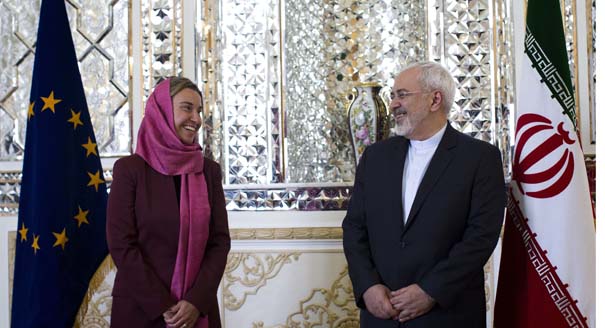
With Europeans agonising over the British EU referendum, or appalled by the US primary spectacle, there has now been a poll to bring some good news: Iranian citizens have largely backed the government led by the moderate president Hassan Rouhani, vindicating his approach to mend international ties. This provides new momentum to EU-Iran relations, but Brussels and member states should continue to tread with caution.
The twin elections for a new parliament, the Majles, and the Assembly of Experts, which will elect a new Supreme Leader once the current officeholder, Ayatollah Ali Khamenei, passes away, in effect became a referendum on the nuclear deal concluded last July. In both bodies, so-called moderates and reformers prevailed over conservatives and principalists. Thus, not only has Iran so far complied with its obligations under the Joint Comprehensive Plan of Action (JCPOA), facilitated by EU High Representative Federica Mogherini, but Iranians have reconfirmed their support for the deal’s on-going implementation.But this was no landslide victory that will profoundly change the country. First of all, exact numbers for each camp are still hard to give due to some outstanding runoffs and generally weak – or non-existent – party allegiances. More importantly, though, ‘the system’ under the leadership of Ayatollah Khamenei will continue to balance the various political factions of the country to maintain national unity. In a way, the election – which saw a turnout of nearly two-thirds, also signalled overall popular support for the Islamic Republic, reassuring the Supreme Leader himself, who had carefully put himself behind the nuclear deal.
For Europeans hoping for a continued rapprochement with Iran, the result is of course good news. Yet no one should get overexcited about an imminent ‘normalisation’ of EU relations with the country. Even if EU officials can now dust off their decade-old plans for a trade and cooperation agreement with Tehran, which were shelved when Iran’s clandestine nuclear activities were revealed in 2002, it is useful to recall how tense relations were even at that time.
In the short history of the Islamic Republic, Iranians have experienced a devastating war in the 1980s, a gradual recovery throughout the 1990s, an ultimately unsuccessful attempt to reform the system from within around the millennium as well as years of populism, mismanagement and corruption until 2013, interspersed by the violent suppression of the ‘green’ reform movement. By using the very circumscribed means of democracy at their disposal – the hard-line Guardian Council barred hundreds of reformist and moderate candidates from running in the elections –, the people have signalled that they prefer a change within the system rather than a change of the system. Iranians are all too aware of what has happened in other countries in their region, from Afghanistan to Iraq and Syria, once ‘regime change’ became a reality, or at least a distinct possibility.
The road to change in Iran is thus still long, and Europe has only very limited influence on events there. In the short term, there will be no major improvement of the human rights situation in Iran, nor will Tehran easily make peace with Syria. Europe can and should continue to raise these issues, but should focus most on where it can achieve more: kick-starting Iran’s economy, because the country wants and needs cooperation. Instead of allowing a free-for-all, the EU and its member states should accompany the market opening by pressing for transparent rules of the game, including through any partnership agreement.
If those citizens who voted for moderate change are to feel any positive effects of a warming of relations with Europe, the latter cannot limit itself to trading with Iran while making political charades about the lack of domestic freedoms. Instead, it is where rights and business come together that an EU built on both the rule of law and economic cooperation can have the biggest impact.

Former Nonresident Fellow, Carnegie Europe
Cornelius Adebahr was a nonresident fellow at Carnegie Europe. His research focuses on foreign and security policy, in particular regarding Iran and the Persian Gulf, on European and transatlantic affairs, and on citizens’ engagement.
Recent Work
Cornelius Adebahr

Cornelius Adebahr, Barbara Mittelhammer
Carnegie does not take institutional positions on public policy issues; the views represented herein are those of the author(s) and do not necessarily reflect the views of Carnegie, its staff, or its trustees.

Are Germany’s economic, industrial, and political struggles becoming a liability for the EU’s ability to rise to the geopolitical moment?

Rym Momtaz, ed.

European Commission President Ursula von der Leyen is about to give her annual address on the state of the EU. Here’s what she won’t—but should—say.
Rym Momtaz

The aftermath of the Ceuta crisis shows Europe has drawn the wrong lessons. Rather than doubling down on failed migration policies, the EU needs to address the underlying roots of such episodes.

Richard Youngs

Canadian Prime Minister Mark Carney has twice inspired praise for standing up to U.S. President Donald Trump: at the 2026 World Economic Forum in Davos and on Canada-U.S. trade negotiations. Is Carney showing a third way better than the EU has in dealing with the Trump administration?
Rym Momtaz, ed.

The EU’s responses to two recent incidents expose the gulf between European perceptions and capabilities. Unless the union can bridge that gap, it will never become a real geostrategic power.
Rym Momtaz