

Commentary
Marc Lynch
{
  "authors": [
    "Marc Lynch"
  ],
  "type": "legacyinthemedia",
  "centerAffiliationAll": "dc",
  "centers": [
    "Carnegie Endowment for International Peace",
    "Malcolm H. Kerr Carnegie Middle East Center"
  ],
  "collections": [
    "Arab Awakening"
  ],
  "englishNewsletterAll": "menaTransitions",
  "nonEnglishNewsletterAll": "",
  "primaryCenter": "Carnegie Endowment for International Peace",
  "programAffiliation": "MEP",
  "programs": [
    "Middle East"
  ],
  "projects": [],
  "regions": [
    "North America",
    "United States",
    "Middle East",
    "North Africa",
    "Saudi Arabia",
    "Gulf"
  ],
  "topics": [
    "Political Reform",
    "Democracy",
    "Security",
    "Foreign Policy"
  ]
}
Source: Getty
Gulf complaints about Washington are driven as much by their own deep internal government security concerns and policy failures as by the more conventional explanations such as Iran and Syria.
Source: Washington Post
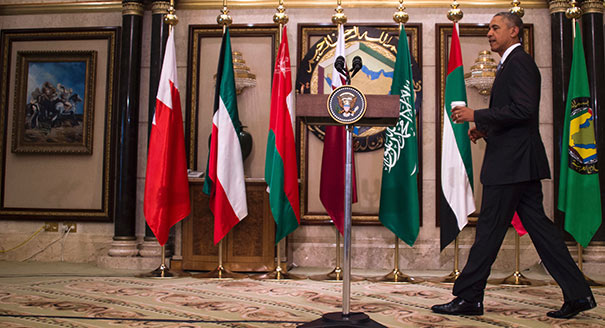
President Obama arrived in Riyadh on Wednesday to join a Gulf Cooperation Council summit. The visit has been widely portrayed as a bid to rebuild America’s currently contentious relations with its Gulf allies. Much of the discussion of U.S.-Saudi tensions has focused on Gulf regime grievances over the nuclear deal with Iran and the American refusal to intervene in Syria.
As I argue in my forthcoming book, “The New Arab Wars,” the deeper driver of these tensions, however, is the existential fear for regime survival unleashed by the Arab uprisings and the fall of Egyptian President Hosni Mubarak. Arab leaders suddenly feared that Washington would be unwilling or unable to come to their rescue if they faced renewed popular mobilization. The erratic and counterproductive policies they pursued in response, at home and across the region, have exacerbated their domestic problems — and put them sharply at odds with American strategic goals in the region.The literature on alliance politics would find much of the surface tensions between the United States and Saudi Arabia familiar. The public posturing about abandonment or resentments would usually be understood as a fairly straightforward bargaining game. The dependent partner complains of their fear of abandonment in order to pressure their patrons for more financial, military or political support. The stronger partner seeks ways to meet those demands without compromising its own core interests. While the language is of reassurance and commitment, the underlying logic is a colder one of negotiations.
Through such a bargaining game lens, Gulf leaders have been frustrated not by Obama’s weakness, but by his strength in refusing to subordinate American interests to their preferences. Still, the overall balance is well within the range of normal alliance politics.
The Saudis have won on many important issues, while Obama has prevailed on his own highest priorities. The Saudi side of the ledger includes Obama’s willingness to turn a blind eye to the sectarian repression of Bahrain’s uprising, support for an obviously doomed and devastating war in Yemen, billions of dollars in arms sales and grudging acceptance of the Gulf-backed military coup in Egypt.
These were not easy concessions for Obama, but his administration evidently viewed them as an acceptable price for prevailing on his own highest priorities. From the start, he had identified an Iran nuclear deal as the highest strategic priority for his administration, and he maintained an impressive focus and clarity in achieving this goal.
Obama also managed to resist Saudi pressure for military intervention in Syria, which he recognized would lead to a disastrous quagmire, even if he was unable to prevent the reckless arming of Syria’s insurgency and the descent into a sectarian jihad fueled by Gulf and Turkish financing. Since the emergence of the Islamic State, he has prioritized and mobilized considerable regional support for his campaign to contain, degrade and ultimately defeat the jihadist challenge.
The twin Saudi fears of entrapment and of abandonment, which have run through the public discourse, are exactly what the alliance politics literature would predict. Certainly, many in the Gulf express the belief that Obama seeks an accommodation with Iran at their expense, if not a full realignment toward Tehran. What is more, they complain frequently that Obama’s unwillingness to intervene in Syria raises questions about American commitments to militarily defend its allies.
That these are predictable gambits in the game of alliance politics does not mean that Gulf elites do not actually feel these concerns intensely. Constructivist international relations theorists are right, after all, that discourse, identity and emotions matter more than rationalist bargaining models admit.
Still, what explains the super-charged atmospherics of crisis and recrimination? Some might point to the public rhetoric and messaging failures on both sides.
The Obama team has not masked its clear distaste for many Saudi policies. This reticence has tended to undermine the reassurance impact of the very real increase in material support to the Gulf, such as major new arms sales.
The new Saudi leadership, for its part, has adopted a sharp-elbowed rhetorical style that has fueled the tensions. It does not help that these rifts have unfolded in the midst of an American election campaign, in which few policy analysts have an incentive to take the side of the incumbent president.
But none of that is really enough to explain the current tensions in the relationship. The unusual intensity of the current relationship is rooted in the profound feeling of existential threat felt by most Gulf regimes ever since the eruption of the Arab uprising. The Obama administration saw this extraordinary moment of popular mobilization as an opportunity to finally bring democracy to a politically stagnant region.
The widespread belief that Obama abandoned Mubarak, however misguided, deeply shook Arab leaders who suddenly began to worry that Washington might not be able or willing to come to their own protection if faced with a similar challenge. Arab regimes saw the uprisings as a mortal threat to their grip on power, the only thing about which they really cared.
This existential fear for monarchies’ survival helps to explain the otherwise irrational nature and degree of Gulf anxiety. For all their talk of American decline, the Gulf leadership understands all too well that they still have nowhere else to go. Their military dependence on the United States has only deepened — even as they have pursued an aggressively independent regional policy that often conflicts with American priorities. The signature Saudi initiative to demonstrate its new military independence, the Yemen war, has proved disastrous. And oil prices show few signs of recovering.
Gulf complaints about Washington are therefore driven as much by their own deep internal government security concerns and policy failures as by the more conventional explanations such as Iran and Syria. Their responses to the Arab uprising ensured their survival in the short term. But this came at great cost to their future stability, creating a vicious cycle allowing no easy escape. The collapsing price of oil only intensifies these regime security challenges.
Across the region, the more that these governments have cracked down on domestic dissent, the more vulnerable they have become. Taking American advice to ease the repression and end the regional proxy wars would be fare more helpful to their security than more weapons. But that is not likely to be a welcome message in Riyadh.
This article was originally published in the Washington Post.

Former Nonresident Senior Fellow, Middle East Program
Marc Lynch was a nonresident senior fellow in Carnegie’s Middle East Program where his work focuses on the politics of the Arab world.
Recent Work
Marc Lynch
Marc Lynch
Carnegie does not take institutional positions on public policy issues; the views represented herein are those of the author(s) and do not necessarily reflect the views of Carnegie, its staff, or its trustees.

A summer of escalation in the Black Sea has hurt Ukraine economically and is exacerbating world food security. A truce is needed—as is a broader reframing of Europe’s Ukraine strategy.

Thomas de Waal

Are Germany’s economic, industrial, and political struggles becoming a liability for the EU’s ability to rise to the geopolitical moment?

Rym Momtaz, ed.

European Commission President Ursula von der Leyen is about to give her annual address on the state of the EU. Here’s what she won’t—but should—say.
Rym Momtaz

Radical-right parties are expected to do well in upcoming elections in four of the EU's biggest member states. If successful, they could prevent the union from addressing key challenges ahead.

Stefan Lehne

The aftermath of the Ceuta crisis shows Europe has drawn the wrong lessons. Rather than doubling down on failed migration policies, the EU needs to address the underlying roots of such episodes.

Richard Youngs