

Commentary
The EU can impose sanctions but struggles to enforce them without the United States. With Washington increasingly disinterested in backing European interests, the bloc must now fend for itself.
Nicu Popescu, Tiago Antunes
{
  "authors": [
    "Alexander Gabuev",
    "Greg Shtraks"
  ],
  "type": "legacyinthemedia",
  "centerAffiliationAll": "dc",
  "centers": [
    "Carnegie Endowment for International Peace",
    "Carnegie China",
    "Carnegie Russia Eurasia Center"
  ],
  "collections": [
    "China’s Foreign Relations"
  ],
  "englishNewsletterAll": "ctw",
  "nonEnglishNewsletterAll": "",
  "primaryCenter": "Carnegie Endowment for International Peace",
  "programAffiliation": "russia",
  "programs": [
    "Russia and Eurasia"
  ],
  "projects": [],
  "regions": [
    "East Asia",
    "China",
    "Russia"
  ],
  "topics": [
    "Economy",
    "Trade",
    "Foreign Policy"
  ]
}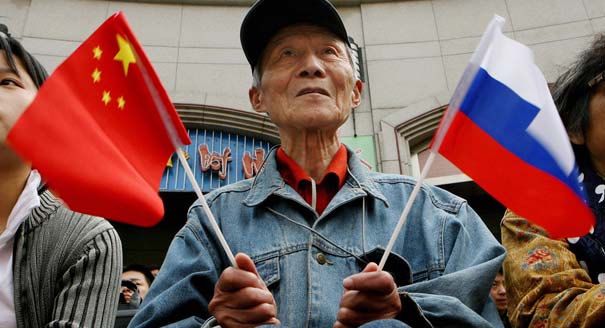
Source: Getty
Russia clearly needs China much more than China needs Russia. China has a diversified economy, including multiple sources of hydrocarbons, and therefore Russia is definitely the dependent partner.
Source: National Bureau of Asian Research
The partnership between Russia and China has become substantially closer since the signing of a natural gas agreement in May 2014. Furthermore, Russia is one of the countries that stands to profit most from China’s One Belt, One Road initiative, which seeks to develop infrastructure connecting China to Europe and the Middle East. To better understand the nuances of this developing relationship, NBR spoke with Alexander Gabuev (Carnegie Moscow Center) about Vladimir Putin’s recent visit to China, the integration of the Eurasian Economic Union with the initiative, and long-term prospects for the Sino-Russian entente.
The declaration on the integration of the EEU and OBOR, announced last year, has ambiguous wording, and the language about coordination is limited to trying to find a link between the two initiatives. What was proposed was not a merger but a linking up. The language is vague and the main challenge over the last year has been to find practical means and models for connecting the projects. The first avenue that Russia and China have explored involves finding and identifying investment projects, particularly logistics and infrastructure projects that would increase connectivity. The second avenue involves implementing the third pillar of OBOR: increasing trade by establishing a free trade zone or an economic partnership that would enable and facilitate trade.
This second avenue is looking more advanced right now. During the recent visit of President Vladimir Putin to China, Commissioner Veronika Nikishkina—head of external relations for the Eurasian Commission, the upper supranational body of the EEU—signed a document with the Chinese minister of commerce Gao Hucheng to formally start negotiations on an economic partnership. This partnership is focused on trade-facilitation measures, such as improving investment protections, removing red tape on customs, and merging different standards on intellectual property, customs, and other areas. The next step will likely be the establishment of a free trade zone. Based on conversations with negotiators on both sides, I expect the talks to last at least seven to ten years. This would be a realistic expectation of the time needed to conclude this deal. The economies of the EEU and China are all protectionist, but China is much more experienced in international trade negotiations than Russia, Kazakhstan, Belarus, Kyrgyzstan, or Armenia. The road obviously won’t be easy, but it is the one that all these countries want to explore.
On the investment project side, there appears no agreement on the list of projects in which China should invest. The Silk Road Fund, a special reserve established by the Chinese government to support OBOR has thus far made three major transactions: one supporting a hydropower dam in Pakistan (in tandem with other Chinese financial institutions); another to help a Chinese company acquire a controlling stake in Pirelli; and a third to purchase a 9.9% stake in the Yamal liquefied natural gas (LNG) project in the Arctic, valued at 21 billion yuan. In April, two Chinese policy banks provided a $12 billion credit line to the LNG project. The Chinese have made these commitments despite risks to the Yamal LNG project posed by current low oil prices and U.S. sanctions on the project and its shareholder, Gennady Timochenko, a member of Putin’s inner circle. Timochenko was one of the first people to be sanctioned by the United States after the Crimea crisis in 2014.
Kazakhstan has done what Russia has failed to do so far: create a comprehensive infrastructure development plan. Kazakhstan’s plan, announced earlier this year, is called the Nurly Zhol, or the “way of light.” This is an initiative directly tied to OBOR. Kazakhstan proactively pitched its agenda to China more than a decade ago, and indeed Kazakhstan’s pitch was one of the reasons Xi Jinping initially presented the OBOR plan in Astana in October 2013. As a result, OBOR’s northern corridor transits through Kazakhstan and Russia, the middle corridor through the Caspian region, and the southern corridor through Iran.
While China frames OBOR as a massive strategic initiative, it has been held up by a lack of shovel-ready projects and successes. In talking to Chinese officials, experts, and members of the business community, I find they are sometimes lost on exactly what OBOR is. They really want to put some “meat” on the bones of OBOR, and if somebody pitches a project that aligns with China’s broader goals, then Beijing is very grateful. This pattern within China has an interstate analogue—it’s exactly what is happening with Kazakhstan.
The Nurly Zhol development plan is the most well-developed and sophisticated infrastructure project in all the post-Soviet states, but funding has materialized much more slowly than most people expected. This is due largely to domestic problems in China, particularly in the financial sector where many of the banks that looked to be in very good shape back in 2013, when the project was initially proposed, are now struggling. This is especially true after the government’s large anticorruption campaign was extended into a variety of banks, including the China Development Bank. Thus, right now some of the OBOR projects in Kazakhstan seem to be stalled because of financial problems on the Chinese side.
Prior to discussing Putin’s recent visit, it is important to understand that Russian-China summits are ritualistic. The unwritten code governing these rituals is that the Russian president goes to China every other year, and in those years the Chinese prime minister visits Russia. During the alternate years, the Chinese leader comes to Russia and the Russian prime minister travels to China. This is the standard protocol, though there may be additional meetings on the sidelines of Shanghai Cooperation Organisation summits. As the core pillar of bilateral relations, the leaders follow this protocol even if there is no specific agenda. When there is no agenda, something needs to be created, whether it be the western gas pipeline through the Altai Mountains, which has yet to be finalized, or a high-speed railway connecting Moscow to Kazan. At every summit, most of the documents signed are just hot air, but there are also some real deals.
This last summit was not particularly successful in commercial terms, largely because many items had been agreed to during the previous meeting. Announcements were limited to smaller agreements associated with the implementation and financing of the Yamal LNG project. The next major announcement will likely be on Chinese financing of the high-speed rail segment between Moscow and Kazan, which insiders believe will be financed by the end of the year. This track, which can be considered part of the OBOR plan, will likely receive a loan of up to $7 billion dollars.
There were also some very important political documents agreed to at this summit. First and foremost, both countries identified as a challenge to their security U.S. plans to position the Terminal High Altitude Area Defense (THAAD) missile defense system in South Korea to help protect that country from the North Korean threat. Both the Russian and Chinese leaders claim the capabilities that the United States intends to put in place will threaten their current strategic deterrents. It is unclear exactly what the strategic response will be, but there might be a joint system aimed at U.S. facilities in South Korea or a form of increased intelligence sharing. A second statement, revolving around global strategic challenges, never actually mentions the United States by name but discusses threats such as “democracy promotion on the internet” and “promotion of a democratic revolution,” thereby clearly pointing fingers at the United States. Russia and China seek to be partners in finding ways to mitigate those challenges that they perceive to be coming from Washington.
There is one major problem with identifying Russia’s turn to the east with the recent prioritization of Sino-Russia relations—chronology. Depending on whom you talk to, you will hear different dates for when Russia’s eastward turn started. The policy was not necessarily connected with the crisis over Ukraine and the resulting estrangement with the West but was instead a long-term project connected with Russia’s interest in boosting its presence in Asian markets. Russia tried to do this back in 2006, again after the global financial crisis in 2009, and most recently after the APEC summit in 2012, when Russia pronounced that it wants to be both a European and Asia-Pacific country since two-thirds of Russian territory is in Asia.
But these pushes were not real. It was only after the Ukraine conflict that the Russian bureaucracy started to seriously look at the Asian market because Russia was frozen out of Western markets. At this stage, Russia started to explore Asian markets for attracting new financing, importing technology, and exporting hydrocarbons and agricultural products. The centerpiece of this pivot was China, because many major economies in the Asia-Pacific are U.S. treaty allies. Japan is one of the countries that sanctioned Russia. South Korea is vulnerable to U.S. pressure as well, and its business community has been very cautious because of the sanctions. ASEAN is too far away, and its trade base with Russia is still very small. So the only realistic option was China, and that’s where Russia in fact pivoted. The results are mixed so far. For example, overall Sino-Russian trade dropped by roughly 30% last year, and we don’t see much additional credit from China coming to Russia because of sanctions and market conditions. On the other hand, China is Russia’s largest creditor (apart from Cyprus, which acts as an offshore money center for round-trip investment into the Russian economy). Russia has become the largest supplier of oil to China over the last three months, bumping Saudi Arabia from the top spot. So while there are some developments that might be the beginning of something bigger, more mature, and more ambitious, the end result will still be asymmetrical as long as Russia clearly needs China much more than China needs Russia. China has a diversified economy, including multiple sources of hydrocarbons, and therefore Russia is definitely the dependent partner.
Land-lease plans are always a very sensitive issue in host countries, particularly when China is the tenant. China has a dreadful reputation for destroying its own arable land, poisoning water, and creating other forms of environmental pollution. Russians are also very sensitive to perceived demographic imbalances, with obvious worries about Chinese migrants staying on in Russia. Theinitial reaction to the announcement in 2015 was negative, and reactions have remained negative because of a lack of persuasive voices that can argue China’s case. The examples of negative Chinese behavior in Africa (which were not necessarily as bad as reported) dominate the discussion, and there is insufficient consideration of how Australia went through this debate ten years ago. Australia discovered that putting regulations in place, having government support for implementation of the lease, and providing long lease periods of up to 49 years gave the Chinese tenants an incentive to preserve the long-term viability of the land. With such measures, Chinese agricultural leases could work well. Unfortunately, success stories are not often mentioned in the debate in Russia—or in Kazakhstan, for that matter.
The fear of migration is also exaggerated. Several Western studies, such as a 2009 report by Maria Repnikova and Harley Balzer, have shown that Chinese migrants to the Far East are not that numerous. Likewise, Russian studies have shown that at any given moment there are not more than 500,000 Chinese in Russia, with most of them living in the European part. Furthermore, with the ruble’s devaluation, many Chinese laborers are returning to China. They were in Russia to earn money and send it back home in remittances, but with a weak ruble, they no longer have incentives to put up with the Russian police and migration authorities and prefer to go back to China and earn money there. There are, however, some Chinese renting land in places like the Jewish Autonomous Region, where Chinese farmers are tenants on up to 80% of the land in the tiny province. At the same time, these farmers are the only mass producers of vegetables and grains for the local market, so it’s a win-win situation wherein Russian residents of the region benefit from lower prices for agricultural products, and the Chinese farmers can export the surplus.
This interview was orginally published on the National Bureau of Asian Research website.

Director, Carnegie Russia Eurasia Center
Alexander Gabuev is director of the Carnegie Russia Eurasia Center. Gabuev’s research is focused on Russian foreign policy with particular focus on the impact of the war in Ukraine and the Sino-Russia relationship. Since joining Carnegie in 2015, Gabuev has contributed commentary and analysis to a wide range of publications, including the Financial Times, the New York Times, the Wall Street Journal, and the Economist.
Greg Shtraks

The EU can impose sanctions but struggles to enforce them without the United States. With Washington increasingly disinterested in backing European interests, the bloc must now fend for itself.


Nicu Popescu, Tiago Antunes

Russia is testing the waters of NATO’s mutual defense clause. What do strikes in Romanian territorial waters mean for the alliance’s posture toward Moscow?

Dimitar Bechev

With its public finances in shambles, the far right polling at 35 percent ahead of the 2027 presidential election, and a growing protest movement, is France’s crisis a threat to the EU’s geopolitical awakening?

Rym Momtaz, ed.

Ahead of a tough winter for Ukraine, Donald Trump’s swing back toward Russia bodes ill. But instead of panicking, Kyiv’s European allies are focusing on action.
Rym Momtaz

Funding Ukraine remains a priority for European leaders. As Russia’s war of aggression heads into another winter, two feasible options to mobilize support for Kyiv should be fast-tracked.


Vladyslav Rashkovan, Gregory P. Wilson