

Paper
Renad Mansour, Faleh A. Jabar
{
  "authors": [
    "Renad Mansour"
  ],
  "type": "legacyinthemedia",
  "centerAffiliationAll": "dc",
  "centers": [
    "Carnegie Endowment for International Peace",
    "Malcolm H. Kerr Carnegie Middle East Center"
  ],
  "collections": [],
  "englishNewsletterAll": "menaTransitions",
  "nonEnglishNewsletterAll": "",
  "primaryCenter": "Malcolm H. Kerr Carnegie Middle East Center",
  "programAffiliation": "MEP",
  "programs": [
    "Middle East"
  ],
  "projects": [],
  "regions": [
    "Levant",
    "Iraq",
    "Middle East"
  ],
  "topics": [
    "Political Reform"
  ]
}
Source: Getty
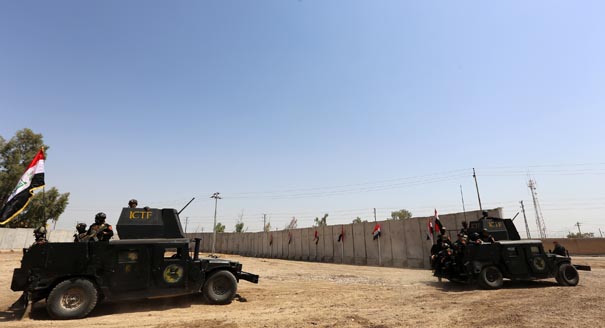
Different political, tribal, and governmental actors are seeking more power and influence through their involvement in the battle for Mosul.
Source: CBC Radio
Renad Mansour spoke on CBC’s The Current with Anna Maria, alongside Bruno Geddo, the UNHCR representative in Iraq, and Eric Mors, co-chair of Security Studies at the Royal Canadian Military Institute. He discussed the potential outcomes for the battle to retake Mosul.
Mansour pointed out that what will happen next in Mosul is unclear and there is a high probability of conflict between the different groups gearing up to expel the Islamic State from the city. Different political, tribal, and governmental actors are seeking more power and influence through their involvement in the battle.
Mansour noted that it will also be particularly hard to maintain security in Mosul. Although all involved military groups -Iraq’s military forces, Popular Mobilization Forces, and the Peshmerga- have one aim to defeat ISIS, none are in agreement with each other. There is a worry that there could be a security vacuum and fighting between the different groups fighting the Islamic State. Mansour believes though that if there is a proper peace settlement between the distinct entities in Mosul, this would enable the displaced locals to return to a safe environment.
Mansour also noted that the Islamic State had already been an underground organization within Mosul and was present in the city even before it was taken over by the group in June 2014. Mansour warned that if the government cannot provide safety and basic services in Mosul than the Islamic State will exploit the situation and attempt to retake the city as they see it vital for their plans.
This interview was originally broadcast on CBC Radio's The Current.
Former El-Erian Fellow, Middle East Center
Mansour was an El-Erian fellow at the Carnegie Middle East Center, where his research focuses on Iraq, Iran, and Kurdish affairs.
Recent Work
Renad Mansour, Faleh A. Jabar
Renad Mansour
Carnegie does not take institutional positions on public policy issues; the views represented herein are those of the author(s) and do not necessarily reflect the views of Carnegie, its staff, or its trustees.

A notable degree of participative democracy has firmly arrived in Europe. But to have more far-reaching impact, democratic deliberation needs to move into a radically new phase.

Richard Youngs

Before the next wave of EU enlargement takes place, the union needs to grapple with thorny questions of how power is distributed among its members.


Emil Sondaj Hansen, Ditte Brasso Sørensen

As the EU confronts profound challenges, several leaders have called for fundamental reform to the union’s model—but only modest, superficial changes have resulted. What if Europe really could be reimagined from zero today: What should such a redesigned European order look like?
Richard Youngs, ed.

The EU’s new migration policy is not suited to today’s realities. With climate change increasingly becoming a driver of displacement, Europe needs to rethink its deterrence-focused approach.

Shana Tabak
Europe seems to have accepted its sidelining in the Middle East. The EU must reassert its support for the international rules-based order and step up engagement.

Rym Momtaz