

Commentary
Judy Dempsey
{
  "authors": [
    "Judy Dempsey"
  ],
  "type": "legacyinthemedia",
  "centerAffiliationAll": "dc",
  "centers": [
    "Carnegie Endowment for International Peace",
    "Carnegie Europe"
  ],
  "collections": [
    "Transatlantic Cooperation"
  ],
  "englishNewsletterAll": "ctw",
  "nonEnglishNewsletterAll": "",
  "primaryCenter": "Carnegie Europe",
  "programAffiliation": "EP",
  "programs": [
    "Europe"
  ],
  "projects": [],
  "regions": [
    "Europe",
    "Western Europe",
    "Iran"
  ],
  "topics": [
    "Security"
  ]
}
Source: Getty
With Europe weakened and divided over a debt crisis, a refugee crisis, and the rise of populist movements, it is hard to imagine EU member states agreeing on a European army.
Source: Washington Post
Donald Trump is right about one thing.
The European members of the NATO alliance have long taken it for granted that the United States would always be their security umbrella. Because of this, the Europeans, with few exceptions, have ignored repeated calls by successive U.S. administrations to share more of the burden for their collective security and defense.
That said, the Republican presidential nominee’s idea that the United States should wash its hands of NATO horrifies the Pentagon, the State Department and America’s European allies. Without America, NATO would become toothless. The United States would lose valuable allies, and Europe would become highly vulnerable. The transatlantic alliance would be dealt a nail in the coffin.However, instead of focusing on strengthening NATO, several European leaders now say it’s time for the European Union to have its own army. But with Europe weakened and divided over a debt crisis, a refugee crisis and the rise of populist movements across the bloc, the last thing Europe needs is its own army.
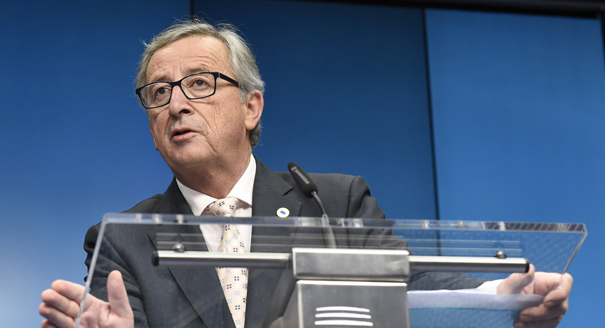
Jean-Claude Juncker, the president of the European Commission, supports the idea of a European force. Juncker’s hope is that such a stronger defense component for Europe would give the Commission – not the member states – more power over defense issues. Europe can no longer afford to piggy-back on the military might of others,” Juncker said in his recent annual State of the Union address. “We have to take responsibility for protecting our interests and the European way of life. … Without a permanent structure, we cannot act effectively.”
But it is hard to imagine that member-states would cede sovereignty over such highly important issues to the commission. France, which has become much closer to NATO in recent years, supports a European army but has yet to spell out how it would work and how it could be commanded. It is also hard to see, for example, the Dutch or German parliaments ceding the right to veto or agree to military missions. Then there is the question of paying for a military force. How would ministers agree to finance a European army at a time when NATO members are supposed to be be increasing their defense spending to 2 percent of gross domestic product?
Not all member-states want a European army, which increases the risk of dividing even further an already fractured bloc. The Nordic countries, such as Denmark, Sweden and Finland have not joined this debate, nor have Spain and Portugal. The latter would certainly not be prepared to duplicate spending on NATO and an E.U. army.
Central European countries have indicated a desire for a European army for their own particular reasons. Traditionally, the Visegrad countries of the Czech Republic, Hungary, Poland and Slovakia have been staunch members of NATO. Bohuslav Sobotka, the Czech prime minister, said that only “E.U.-wide armed forces will allow us to defend our interests on our own.” He added that such a force would become a “more actionable and reliable partner” – as if NATO weren’t anything but that. Viktor Orban, Hungary’s prime minister, supported the idea. “We must prioritize security, and let’s start building a common European army,” he said recently in Warsaw during talks with leaders from the Czech Republic, Hungary, Poland, Slovakia, as well as Chancellor Angela Merkel of Germany. Central European countries want a European army to protect E.U. external borders. They do not see a potential European army as an instrument of hard power in trouble spots outside the bloc or intelligence-sharing or combating cybersecurity.
Poland’s former Civic Platform government wanted the E.U. to strengthen its defense and security policy when it was in power between 2007 and 2015. The E.U. had to be ready for a weakened U.S. focus on Europe as a result of America’s shift to Asia. To be on the safe side, the E.U. would have to have its own independent military headquarters to plan and develop strategic planning.
But those efforts didn’t get far. Britain opposed the idea of an independent military headquarters for the E.U. In its view, it was unnecessary. The E.U. already had access to NATO military planning facilities — creating a new headquarters would lead to duplication and competition.
NATO is needed more than ever today, especially given Russia’s occupation of parts of eastern Ukraine and the massive instability along Europe’s southern neighborhood. A European army would instead be welcomed by Russian president Vladimir Putin because the United States wouldn’t have a say in the affairs of such a force.
In short, calls for a European army are ill-thought-out and strategically shortsighted. This is not the time to weaken or distract from NATO. Instead it’s time to challenge Trump’s views – and debunk Putin’s hopes – that the NATO alliance has run its course.
This article was originally published by the Washington Post.

Nonresident Senior Fellow, Carnegie Europe
Judy Dempsey is a nonresident senior fellow at Carnegie Europe
Recent Work
Judy Dempsey
Judy Dempsey
Carnegie does not take institutional positions on public policy issues; the views represented herein are those of the author(s) and do not necessarily reflect the views of Carnegie, its staff, or its trustees.

Are Germany’s economic, industrial, and political struggles becoming a liability for the EU’s ability to rise to the geopolitical moment?

Rym Momtaz, ed.

European Commission President Ursula von der Leyen is about to give her annual address on the state of the EU. Here’s what she won’t—but should—say.
Rym Momtaz

Radical-right parties are expected to do well in upcoming elections in four of the EU's biggest member states. If successful, they could prevent the union from addressing key challenges ahead.

Stefan Lehne

The aftermath of the Ceuta crisis shows Europe has drawn the wrong lessons. Rather than doubling down on failed migration policies, the EU needs to address the underlying roots of such episodes.

Richard Youngs

An overwhelming victory by a far-right-wing party in a small state in eastern Germany will have major repercussions for Chancellor Friedrich Merz’s coalition.
Judy Dempsey