

Report
- +3
James M. Acton, Alexey Arbatov, Vladimir Dvorkin, …
{
  "authors": [
    "Petr Topychkanov"
  ],
  "type": "legacyinthemedia",
  "centerAffiliationAll": "",
  "centers": [
    "Carnegie Endowment for International Peace",
    "Carnegie Russia Eurasia Center"
  ],
  "collections": [],
  "englishNewsletterAll": "",
  "nonEnglishNewsletterAll": "",
  "primaryCenter": "Carnegie Russia Eurasia Center",
  "programAffiliation": "",
  "programs": [],
  "projects": [],
  "regions": [
    "South Asia",
    "India",
    "Pakistan",
    "Russia"
  ],
  "topics": [
    "Foreign Policy"
  ]
}
Source: Getty
Russia badly needs to produce a long-term strategy towards India and the region of south Asia, and to stop thinking about India and Pakistan tactically and separately.
Source: Newsweek
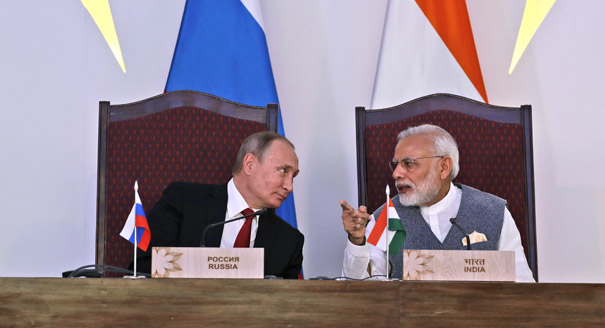
On the weekend of October 15 and 16, Russian president Vladimir Putin visited India for the bilateral meeting of leaders of Russia and India, and the BRICS summit in Goa. As usual, president Putin spent few hours in India.
This made it more difficult to cover all the important issues of the strategic partnership between Russia and India. Russia seemed reluctant to go into details on some issues. Pakistan was one of them.
As ex-speaker of the State Duma Sergey Naryshkin, who is now chief of Foreign Intelligence Service, noted in 2015, the cooperation of Russia and Pakistan has “particular and intrinsic value.” In other words, the most comfortable position for Russians is to have separate tracks and approaches with Pakistan and India.
But it doesn't go down well in south Asia, and it isn't acceptable for Indians, who are following the dramatic development of the military cooperation between Russia and Pakistan with growing concern. Just a week before Putin’s visit, Russia and Pakistan held joint military exercises, Druzhba-2016 (Friendship-2016).
Moscow and Islamabad initially agreed trainings in two places, including Rattu in Gilgit-Baltistan, which is seen by Delhi as an Indian territory, occupied by Pakistan. However, on September 18, there was an attack on a military facility of the Indian Armed Forces in Uri, a town in the Indian-administered state of Jammu and Kashmir. India blamed the attack on a Pakistan-based jihadi group, and the situation added to anger in India over its strategic partner, Russia, deciding to undertake military drills with Pakistan.
In response to the Indian reaction Russia decided to hold Druzhba-2016 exercises only in Cherat in Khyber-Pakhtunkhwa region, rather than in in the disputed region of Gilgit-Baltistan. It would have been wiser to postpone the drills if not to cancel them at all, if Russia sought to take into account the negative feelings of India’s bureaucracy. Yet, to India, Russian authorities seemed almost deaf to voices from Delhi.
In general, before and during Putin's visit to India there was little explanation from the Russian side as to why Russia had decided to boost military cooperation with Pakistan. Indians hardly took seriously the words of the Russian ambassador Alexander Kadakin, as reported in India Times: “"India should not be concerned about military exercises between Russia and Pakistan because the theme of the exercise is anti-terror fighting. [It's] in India’s interests that we teach the Pakistani army not to use itself for terror attacks against India.” The key point of the Indian position, that it considered Pakistan not only part of solution of the terrorist threat in South Asia, but also part of the terrorism problem, was not addressed by the Russian authorities.
For Indian leaders the bilateral summit in Goa became a unique opportunity to convince Russia to change its course in south Asia, and to understand the Russian position about hot topics in the region, including cross-border terrorism and the territorial dispute between India and Pakistan. But when prime minister Narendra Modi explained Indian concerns to president Putin, the Russian response seemed less concerned than expected. Just before Putin’s visit to India, Russia's land force commander-in-chief general Oleg Salyukov confirmed that Russia would hold another round of military exercises with Pakistan in 2017.
As for now it looks like Russia doesn’t want to change its course in south Asia. However, observers could see that the Russian delegation was warmly welcomed by Indian counterparts at the BRICS summit. It might seem like India’s anger over the military cooperation between Russia and Pakistan was over. Yet it would be wrong for Russians to become complacent.
The positive coverage in India could be explained in two ways. First, political leaders of Russia and India decided not to let hot issues leave closed doors. It is in the interests of Putin and Modi to show cordial relations between Russia and India, each for different reasons. At a time of big problems with the West, Moscow tried to show that it has close friends and almost allies around the world. For Modi it was important to show that the foreign policy of India remains diversified and balanced (not pro-American as it’s seen by some inside and outside India).
The second explanation of the positive reaction is that for the Indian side it wouldn't be wise to focus on the drills with Pakistan at a time when they are agreeing the purchase of S-400, stealth frigates, and, reports suggest, the possible lease of a second nuclear submarine. How else could Delhi could give the green light to such strategic projects with the Russians, whose flirting with Pakistan gives them reason for serious concerns?
Being very interested in such projects, India seemed to prefer to stay mute over the issue of the relations between Russia and Pakistan. Moscow could use the planned military-technology cooperation to tackle Delhi's openly negative reaction to the Druzhba-2016 drills. It looks like Moscow succeeded in doing this.
It is widely believed that the Russian leadership is stronger at tactics, short-term planning, than at strategy and long-term foreign policy. If that is the case, the Russian strategic partnership with India may become a victim of this.
Moscow will remain one of the key sources of military technologies for India for many years. No doubt, the Indian path towards acquiring strategic military technologies would be harder and longer without Russian assistance. Moscow played a very important role in the development of the civilian nuclear sector of India. At the summit in Goa, Moscow confirmed its intention to be one of the key players in the oil and gas sector of the Indian economy. And Indians appreciate that.
But the problem is that these long-term projects may be developed separately from the wider relationship between Russia and India, where there is poorer economic interdependence, weaker political contacts, and bigger suspiciousness and even mistrust. Russian tactical gains in the fields of military technologies and energy may be sunk by strategic failures in political and economic relations between Russia and India. To avoid this Russia badly needs to produce a long-term strategy towards India and the region of south Asia, and to stop thinking about India and Pakistan tactically and separately.
Former Fellow, Nonproliferation Program, Moscow Center
Topychkanov was a fellow in the Carnegie Moscow Center’s Nonproliferation Program.
Recent Work

James M. Acton, Alexey Arbatov, Vladimir Dvorkin, …
Petr Topychkanov
Carnegie does not take institutional positions on public policy issues; the views represented herein are those of the author(s) and do not necessarily reflect the views of Carnegie, its staff, or its trustees.

The EU can impose sanctions but struggles to enforce them without the United States. With Washington increasingly disinterested in backing European interests, the bloc must now fend for itself.


Nicu Popescu, Tiago Antunes

Russia is testing the waters of NATO’s mutual defense clause. What do strikes in Romanian territorial waters mean for the alliance’s posture toward Moscow?

Dimitar Bechev

With its public finances in shambles, the far right polling at 35 percent ahead of the 2027 presidential election, and a growing protest movement, is France’s crisis a threat to the EU’s geopolitical awakening?

Rym Momtaz, ed.

Ahead of a tough winter for Ukraine, Donald Trump’s swing back toward Russia bodes ill. But instead of panicking, Kyiv’s European allies are focusing on action.
Rym Momtaz

Funding Ukraine remains a priority for European leaders. As Russia’s war of aggression heads into another winter, two feasible options to mobilize support for Kyiv should be fast-tracked.


Vladyslav Rashkovan, Gregory P. Wilson