

Report
- +9
Richard Youngs, Erik Jones, Dan Baer, …
{
  "authors": [
    "Richard Youngs"
  ],
  "type": "legacyinthemedia",
  "centerAffiliationAll": "dc",
  "centers": [
    "Carnegie Endowment for International Peace",
    "Carnegie Europe"
  ],
  "collections": [
    "EU Integration and Enlargement"
  ],
  "englishNewsletterAll": "ctw",
  "nonEnglishNewsletterAll": "",
  "primaryCenter": "Carnegie Europe",
  "programAffiliation": "EP",
  "programs": [
    "Europe"
  ],
  "projects": [],
  "regions": [
    "Europe",
    "North America",
    "Western Europe",
    "Iran"
  ],
  "topics": [
    "EU",
    "Democracy",
    "Political Reform"
  ]
}
Source: Getty
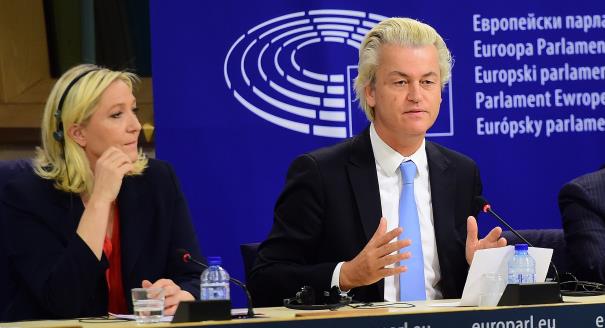
If the age of populism is well and truly upon us, it becomes more vital than ever to understand and conceptualize this phenomenon accurately.
Source: LSE EUROPP blog
The predictions have come thick and fast that Donald Trump’s victory in the U.S. presidential election will further fuel similar anti-establishment or outsider movements in Europe. If America’s election result confirms that the age of populism is well and truly upon us, it becomes even more vital to understand and conceptualise this phenomenon accurately.
So, what is really at stake in the rise of populism in Europe and in the fallout from Trump’s win? Although there is widespread agreement that Europe’s populist surge represents one of the continent’s most serious challenges, greater care is needed in the way that the debate about populism is framed. While most analyses paint populism as a uniformly negative phenomenon, there is significant diversity amongst those parties to which the label is normally attached. And much debate tends to posit a sharp divide between supposedly benign mainstream parties and populists in a way that distorts reality.
Most analysts agree that populism should be understood as a political style, not a well-defined, substantive political project. But simply to say that populism advances the will of ‘the people’ against ‘the elite’ is an unsatisfactorily loose definition. It leaves too many questions unanswered. Who is and is not part of ‘the elite’? In a context of increasing social heterogeneity, how do we identify the popular ‘general will’? And don’t ostensibly mainstream parties also often espouse policies that serve the ‘ordinary citizen’ against the elite?
The better and most focused definition holds that a populist party is one that attacks liberal constitutionalism and the checks and balances that constrain majoritarian power – in short, a party that is politically illiberal. Belying this definition, however, in practice most analysis focuses on populists’ substantive policies – quite separate from the issue of political illiberalism. This is understandable, given how unpalatable some of these policies are.
But the result is that different kinds of political ill get lumped together and sweepingly assumed to be inseparably part of an all-encompassing populist trend. While right-wing populists’ hardline stances against migration and refugees are mean-spirited and lacking in strategic foresight, that does not necessarily mean they are synonymous with an illiberal style of politics. Current trends in migration and refugee policies are best debated and critiqued on their own terms, not conceptually elided with a presumed wider political menace.
Another strand of criticism derides populists – on the left and right – for their hostility toward economic liberalism. Populists undeniably struggle to define well-worked alternatives to the neo-liberalism most of them abhor. But they are hardly alone in this. Their imprecision is not a shortcoming that represents an absolute distinction between them and mainstream parties. And, whatever one thinks of populists’ frequently anti-capitalist rhetoric, it is unclear why criticism of austerity should in itself be admonished as populism.
There is such wide variation amongst rising anti-establishment parties that it is unconvincing to decry the ‘populist threat’ in terms of a particular set of policies. While there is deep unease with the spread of Euroscepticism across Europe, for example, there is no common line on the EU amongst those parties normally labelled as populist. As with debates on migration and neo-liberal economics, deriding a party as populist simply because it questions the current model of European integration is analytically questionable – even if one’s own normative instinct is to reject this anti-EU creep.
A common line is that populists peddle ‘simplistic’ solutions that are unworkable in practice and are undesirable in pandering to citizens’ worst instincts. This is very often indeed the case. But mainstream parties also offer plenty of bad policy ideas and make many promises that are clearly incompatible with each other. Once more, this reflex critique is not a metric that helps identify with precision why populists’ shortcomings are qualitatively different from those of other parties.
If we abide by the narrower definition – populism as political illiberalism – the question is how many parties across Europe really meet this strict classification. While some parties normally labelled as populist exhibit undemocratic tendencies, there is no perfect correlation between political illiberalism and populism. Some populist parties are politically illiberal, but some are not.
Governments in the well-known cases of Poland and Hungary have certainly sought to weaken the liberal structures designed to hold majority power in check. But beyond these two countries, it is not clear that there is an overpowering wave of populist parties poised to dismantle liberal democratic norms. At least, not yet, even if there are parties that could begin to bridle at some liberal institutional constraints in the future. Contrary to the tone struck in some current opinion, just because votes go the ‘wrong’ way does not in itself mean ‘democracy is under threat’.
It is true that in general rightist parties seem to lean more towards majoritarian illiberalism than leftist anti-establishment parties. But the dichotomy some draw between democratic left-wing populists and undemocratic right-wing populists is too stark to capture what is in reality a great deal of variation and nuance amongst populist parties.
Conversely, where political illiberalism has surfaced in recent years it often comes from parties not generally classified as populist. In France, Spain, the UK and other places it is mainstream parties that have introduced laws that impoverish liberal rights protection. Of course, some populist parties may eventually represent a greater danger to liberal constitutionalism than established political actors. But the difference between mainstream and populist illiberalism is for now one of degree rather than an absolute, qualitative divide.
Most populist parties seem to have accommodated themselves to existing political processes, especially at the sub-national level. For all their rhetoric about overturning ‘the system,’ when populists have won a share in power at the local level they have mostly got their heads down to focus on fairly pragmatic issues. They may do not do so especially well – populists’ signature message of ‘the people versus the elite’ works as a protest narrative but is too simplistic to guide day-to-day decision-making. Yet it must be premature to conclude that anti-establishment parties as a whole have proven themselves inherently unable to function within the bounds of liberal constitutionalism.
Populists are often excoriated for espousing direct democracy. Yet, structured in the right way modest mechanisms of direct democracy would be a positive development for European politics. The main concern is surely that channels of representative accountability are still too unresponsive to citizens, not that we are heading towards a dangerous excess of direct democracy. Direct democracy is worrying where it is pursued in a way that dilutes checks and balances and representative processes. Again, the debate should be about safeguarding political liberalism rather than dismissing populists’ views on direct participation per se.
Let me be clear: none of this is meant to celebrate populism or deny the need to robustly combat its chauvinistic elements – elements that the Trump presidency may well nourish in several European states. I am categorically not condoning populist positions. My point is an analytical one, about the way the debate about populism is conceived and framed. The risk is that singling out populism as a qualitatively distinct threat unhelpfully muddies European political debate.
‘Populism’ is often used in such a broad, catch-all fashion that it makes for extremely imprecise analysis and policy prescription. We need to break down specific areas of concern and focus on these in their own right, rather than rooting debate in nebulous notions of a block ‘populist threat’. One suspects that it has become convenient for mainstream politicians to structure the political debate in terms of ‘populists versus the rest’ partly in order to exonerate their own misdemeanours.
As analysts, we surely have to move beyond simply bemoaning the ‘ignorant’ and ‘disastrous’ choices of the people who voted for Brexit, for Trump or for various European populists. Rather, the imperative must be to unpack the different dynamics – some pernicious, others perfectly benign – that are at work in today’s anti-establishment surge.
This article was originally published by the LSE European Politics and Policy Blog.

Senior Fellow, Democracy, Conflict, and Governance Program
Richard Youngs is a senior fellow in the Democracy, Conflict, and Governance Program, based at Carnegie Europe. He works on EU foreign policy and on issues of international democracy.
Recent Work


Richard Youngs, Erik Jones, Dan Baer, …

Richard Youngs, Thomas Carothers
Carnegie does not take institutional positions on public policy issues; the views represented herein are those of the author(s) and do not necessarily reflect the views of Carnegie, its staff, or its trustees.

Trump is distracted and Ukraine wants Europe to step up. The continent’s leaders must find their voice and assert it in talks with Russia.

Alissa de Carbonnel

Mounting economic strain and battlefield losses will not necessarily make the Kremlin less dangerous. They could instead push Moscow toward a more aggressive hybrid campaign designed to test NATO’s Eastern flank, exploit allied hesitation, and fracture European resolve.

Maksym Beznosiuk
Over the past ten years, NATO has held almost as many summits as it did during the entirety of the Cold War. Are they still useful, or is it time to stop holding annual meetings?

Rym Momtaz, ed.

As the EU confronts profound challenges, several leaders have called for fundamental reform to the union’s model—but only modest, superficial changes have resulted. What if Europe really could be reimagined from zero today: What should such a redesigned European order look like?
Richard Youngs, ed.

Nearly a year and a half after Europeans leaned into sucking up to Trump, the strategy has produced some benefits when it comes to Ukraine.
Rym Momtaz