

Commentary
Yezid Sayigh
{
  "authors": [
    "Yezid Sayigh"
  ],
  "type": "legacyinthemedia",
  "centerAffiliationAll": "dc",
  "centers": [
    "Carnegie Endowment for International Peace",
    "Malcolm H. Kerr Carnegie Middle East Center"
  ],
  "collections": [
    "Arab Awakening"
  ],
  "englishNewsletterAll": "menaTransitions",
  "nonEnglishNewsletterAll": "",
  "primaryCenter": "Malcolm H. Kerr Carnegie Middle East Center",
  "programAffiliation": "MEP",
  "programs": [
    "Middle East"
  ],
  "projects": [],
  "regions": [
    "Egypt",
    "Levant",
    "Maghreb",
    "Middle East",
    "North Africa",
    "Syria",
    "Libya"
  ],
  "topics": [
    "Political Reform",
    "Security",
    "Economy"
  ]
}
Source: Getty
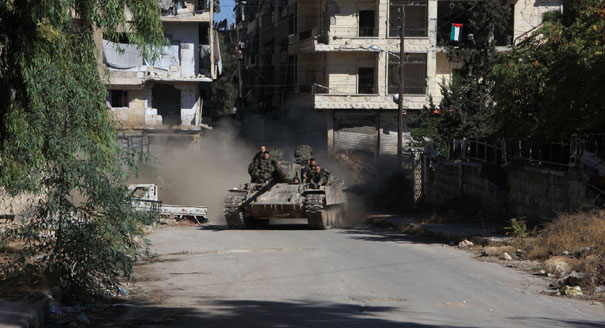
The violence sweeping across the Arab world isn't a consequence of the Arab Spring, but of decades of dictatorship.
Source: Al Jazeera
A recent news item on the BBC's English website neatly captured the sharp contrast in how, five years later, various Arab rulers, citizens and non-Arab observers view the popular uprisings that swept leaders from power in several Arab states and challenged others. The headline read "Arab Spring 'cost region $600bn' in lost growth, UN says", but what the latter actually said differed substantially.
In its Survey of Economic and Social Developments in the Arab Region 2015-2016 (PDF), the United Nation's Economic and Social Commission for Western Asia (ESCWA), which covers 18 Arab countries, attributed a net loss of $613.8bn in economic activity and an aggregate fiscal deficit of $243.1bn not to the attempt to bring about democratic political transition, but to the armed conflicts now involving nearly a dozen Arab states.
Whether intentionally or not, the BBC's headline echoes those who portray the chaos and bloodshed suffered by several Arab states since 2011 as the direct result - indeed the essence - of the Arab Spring. But, there was nothing inevitable about this.Rather, the current reality, or potential threat of state failure and civil war in Arab states, is the outcome of their problematic past trajectories prior to 2011 and of the choices made by those in power on how to respond to evolving political, socioeconomic and institutional challenges since then.
Crucially, decades of authoritarian rule in the Arab states now in crisis or breakdown have eroded their social contracts and constitutional frameworks.
As the ESCWA report rightly noted, ruling regimes invested heavily in repressive, bloated security sectors in order to maintain power while budgeting less for social protection, infrastructure and other priorities.
Significant material rewards were provided, as even authoritarian regimes generally find it cheaper to co-opt society rather than to rely wholly on coercion, but these shrank as economic cronyism deepened and productivity and investment in all sectors of the economy - other than oil and real estate - declined from the 1990s onwards.
The reallocation of state resources and economic opportunities towards privileged elites and social sectors in an era of prolonged financial contraction further "hollowed out" state institutions.
In short, Arab states had left themselves with few reserves - political, economic, social, or institutional - to cope with the impacts of wider events affecting their finances and economies in the decade leading up to 2011, even when macro-level indicators, such as gross domestic product and foreign investment, appeared positive.
This bleak legacy did not wholly preclude more effective responses, whether before the Arab Spring or after. So, why have Arab states in transition fared so poorly?
A significant part of the answer lies in how incumbent regimes chose to respond to popular uprisings and the democratic challenge they posed. Contrary to those who claimed there was "no other choice", the resort to force was neither necessary nor unavoidable.
The Tunisian army's insistence that civilians design and manage their country's entire transitional process, from start to finish, is proof positive of this. So was the "soft security" approach adopted by the Jordanian authorities in response to their own protest movement in 2010 and 2011-2012.
The deployment of massive coercive power in every other instance has led either to open armed conflict and state breakdown or to the corrosion of basic freedoms and social peace and to an endemic crisis of political legitimacy.
But it is the elimination of safeguarded arenas for the conduct of legal - that is, peaceful - political contestation and social negotiation that poses the biggest threat.
Violence has become a primary mode for the conduct of politics, replacing co-optation as the preferred means of control, but at far higher cost, both financially and socially.
This explains why Arab states have failed to follow the precedent of states transitioning from conflict in other regions of the world, which, as the ESCWA report notes, have often experienced a growth rebound to pre-crisis economic levels or better.
Regimes that have insisted on returning to political and economic "business as usual" have prevented the kind of reforms that might resolve the problems that led their countries into social upheaval and systemic crisis in the first place.
At the same time, negative balances of trade and payments, reduced ability to generate foreign currency reserves or attract investment, and declining income from oil-funded remittances and transit trade all mean they cannot restore the old social contracts on which political power and legitimacy partly rested.
Their resistance to change and negotiation of new state-society relations is exhausting the political, institutional and social resilience needed to weather these wider trends.
The absence, since 2011, of meaningful adaptations to domestic and external challenges, let alone genuine and far-reaching reforms in order to anticipate and turn them to advantage, suggests that at least some Arab states in transition are not yet past the worst. The bloody outcome of the Arab Spring was not inevitable, but the systemic crisis that looms for some may be.
This article was originally published on Al Jazeera English.

Senior Fellow, Malcolm H. Kerr Carnegie Middle East Center
Yezid Sayigh is a senior fellow at the Malcolm H. Kerr Carnegie Middle East Center in Beirut, where he leads the program on Civil-Military Relations in Arab States (CMRAS). His work focuses on the comparative political and economic roles of Arab armed forces, the impact of war on states and societies, the politics of postconflict reconstruction and security sector transformation in Arab transitions, and authoritarian resurgence.
Recent Work
Yezid Sayigh
Yezid Sayigh
Carnegie does not take institutional positions on public policy issues; the views represented herein are those of the author(s) and do not necessarily reflect the views of Carnegie, its staff, or its trustees.
Europe has an interest in supporting Armenian leader Nikol Pashinyan as he tries to make peace with neighbors and loosen ties with Russia. But it is depersonalized support in the long term, not quickfire flash, that will win the day.

Thomas de Waal
Following Ursula von der Leyen’s gaffe equating Turkey to Russia and China, relations with Ankara risk deteriorating even further. Without better, more consistent diplomatic messaging, how can the EU pretend to be a geopolitical power?

Sinan Ülgen
Europe has been standing by while its Southern neighborhood is being redrawn by force. To establish a path to peace between Israel and Lebanon, it’s time for Europeans to get involved with hard power.

Rym Momtaz
In Ukraine, Gaza, and Iran, AI warfare has come to dominate, with barely any oversight or accountability. Europe must lead the charge on the responsible use of new military technologies.

Raluca Csernatoni
Montenegro and Albania are frontrunners for EU enlargement in the Western Balkans, but they can’t just sit back and wait. To meet their 2030 accession ambitions, they must make a strong positive case.


Dimitar Bechev, Iliriana Gjoni