

Other
Michael D. Swaine
{
  "authors": [
    "Michael D. Swaine"
  ],
  "type": "legacyinthemedia",
  "centerAffiliationAll": "dc",
  "centers": [
    "Carnegie Endowment for International Peace",
    "Carnegie China"
  ],
  "collections": [
    "China’s Foreign Relations",
    "U.S.-China Relations"
  ],
  "englishNewsletterAll": "asia",
  "nonEnglishNewsletterAll": "",
  "primaryCenter": "Carnegie China",
  "programAffiliation": "AP",
  "programs": [
    "Asia"
  ],
  "projects": [],
  "regions": [
    "North America",
    "United States",
    "East Asia",
    "China",
    "Taiwan"
  ],
  "topics": [
    "Foreign Policy"
  ]
}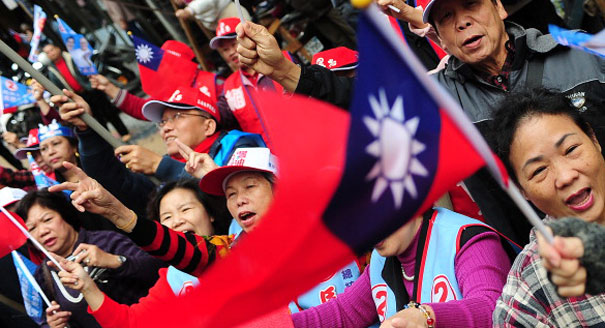
Source: Getty
President-elect Donald Trump should understand the larger meaning of current efforts to move incrementally toward Taiwan independence and reject those efforts as the threat to core U.S. interests they represent.
Source: Defense One
By accepting a simple congratulatory phone call from Taiwan, President-Elect Donald Trump has provided an opportunity for Taiwan independence backers to dust off their highly irresponsible argument that America should abandon its longstanding “One China” policy.
Their argument goes something like this: Taiwan is an independent, democratic country that deserves to be formally recognized by the United States, the beacon of democracy. Any resistance to such a common sense move is based on excessive fears of a negative reaction by a tyrannical, authoritarian China, or simply a reflection of China’s brain-washing of America’s foreign policy elite. In fact, they argue, Beijing will have no choice but to accept U.S. recognition of an independent Taiwan, given their desire to avoid an all-out military confrontation with Washington and serious damage to the U.S.-China relationship. Indeed, Washington must recognize Taiwan sooner rather than later, while China is relatively weak, they insist, to ensure that it can still deter Beijing from retaliating. Given China’s allegedly unbridled commitment to defeating the U.S. in strategic competition, Taiwan must be brought within the U.S. strategic orbit to contain Chinese aggression.
This sounds like an argument tailor-made for Donald Trump: a clear exercise of American power and values in support of Taiwan, an oppressed friend and democratic compatriot, and against Beijing, a well-known economic cheater and global bully. As we all know, bullies back down when confronted by resolve and power. What better way to show the renewed greatness of Trump’s America?
The problem with this argument is that it is based on a fantasy recognized by countless past U.S. political leaders and policy experts: that China’s leaders would not regard an obvious American attempt to permanently separate Taiwan from mainland China as a fundamental, existential threat to the Chinese government and China’s domestic stability, inevitably requiring the use of all means necessary to prevent it, including military force. China will fight back. An examination of this issue by countless numbers of China specialists and foreign policy analysts over many decades has confirmed Chinese resolve on this matter over and over. Indeed, it is highly likely that Beijing would attempt to use force to prevent Taiwan’s permanent separation from China even if it knew it could not succeed, because while other Chinese elites and the Chinese public might possibly forgive a failed attempt to prevent independence, they would without question not forgive inaction in the face of what would assuredly be widely viewed in China as a betrayal of a decades-long understanding between Washington and Beijing and an attack on the Chinese nation.
The very basis for the original normalization of Sino-U.S. diplomatic relations and for the continued stability of those relations today consists of a bilateral understanding reached regarding Taiwan: Washington would not attempt to create a situation of One China and One Taiwan, and Beijing will remain committed to an eventual peaceful resolution of the issue. If the former understanding is violated, all bets are off. And make no mistake, China is in a far better position today to conduct a military action against Taiwan than it has ever been before.
A few of those supporting the phone call from Taiwan’s President Ts’ai Ying-wen to Trump claim that they merely want to continue the gradual improvement of U.S.-Taiwan ties that has occurred in all past U.S. administrations. They are not advocating Taiwan independence, they insist, only a continuation of past practices. In truth, in years past Washington has been extremely careful to avoid open, direct contact between Taiwan’s leaders and the U.S. president (or president-elect) and his most senior cabinet officials. Such contact, and especially a public in-your-face phone conversation, is clearly a move toward recognizing a separate Taiwan. For the advocates of closer U.S.-Taiwan ties, there are no logical limits to such undertakings. Each advance that occurs without a strong Chinese reaction is seen as a confirmation of Beijing’s acceptance and a basis for further movement toward the eventual goal. They will push until the Chinese “inevitably” concede and accept an independent Taiwan.
Does this mean that leaders in Washington cannot improve communication with leaders in Taipei and continue to show support for a democratic Taiwan? No. Washington has undertaken such actions repeatedly and they will no doubt continue. But the well-established parameters for such behavior exist for extremely valid reasons involving war and peace in Asia, and reckless advocates of Taiwan independence play with them at our common peril. Trump should understand the larger meaning of current efforts to move incrementally toward Taiwan independence and reject those efforts as the threat to core U.S. interests they represent.

Former Senior Fellow, Asia Program
Swaine was a senior fellow at the Carnegie Endowment for International Peace and one of the most prominent American analysts in Chinese security studies.
Recent Work
Michael D. Swaine
Michael D. Swaine
Carnegie does not take institutional positions on public policy issues; the views represented herein are those of the author(s) and do not necessarily reflect the views of Carnegie, its staff, or its trustees.

With its public finances in shambles, the far right polling at 35 percent ahead of the 2027 presidential election, and a growing protest movement, is France’s crisis a threat to the EU’s geopolitical awakening?

Rym Momtaz, ed.

Ahead of a tough winter for Ukraine, Donald Trump’s swing back toward Russia bodes ill. But instead of panicking, Kyiv’s European allies are focusing on action.
Rym Momtaz

Funding Ukraine remains a priority for European leaders. As Russia’s war of aggression heads into another winter, two feasible options to mobilize support for Kyiv should be fast-tracked.


Vladyslav Rashkovan, Gregory P. Wilson

While the EU and European governments are embracing the much-lauded middle-power moment, this entails three difficult conundrums.

Richard Youngs

Europe is facing rising populism internally as well as external pressures from Russia, China, Turkey, and the United States.

Dimitar Bechev