

Report
- +2
George Perkovich, Jessica Tuchman Mathews, Joseph Cirincione, …
{
  "authors": [
    "Jon Wolfsthal"
  ],
  "type": "legacyinthemedia",
  "centerAffiliationAll": "dc",
  "centers": [
    "Carnegie Endowment for International Peace",
    "Carnegie China"
  ],
  "collections": [
    "U.S. Nuclear Policy",
    "Korean Peninsula"
  ],
  "englishNewsletterAll": "ctw",
  "nonEnglishNewsletterAll": "",
  "primaryCenter": "Carnegie Endowment for International Peace",
  "programAffiliation": "NPP",
  "programs": [
    "Nuclear Policy"
  ],
  "projects": [],
  "regions": [
    "North America",
    "United States",
    "East Asia",
    "South Korea",
    "Japan",
    "North Korea"
  ],
  "topics": [
    "Security",
    "Foreign Policy",
    "Nuclear Policy",
    "Arms Control"
  ]
}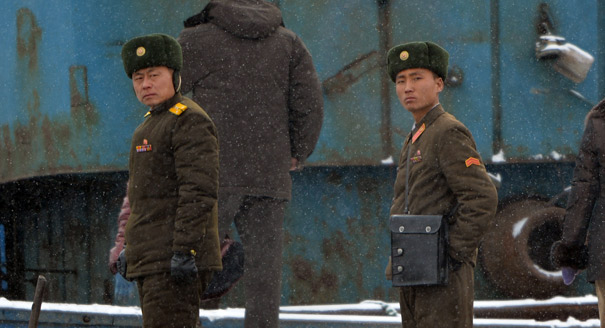
Source: Getty
The risks of a military conflict with North Korea is growing day by day. Not talking has not slowed North Korea’s advance, and sanctions alone will not achieve the desired result.
Source: Foreign Policy
The United States wants North Korea to stop testing, stop developing, and eventually stop having nuclear weapons that can target America and its allies. Washington cannot achieve this goal by sanctioning North Korea, because China will always allow Pyongyang enough support to avoid collapse, and North Korea knows it. And Washington cannot use its massive, advanced military to eliminate North Korea’s nuclear capabilities. There is no way to be certain we would eliminate all of the weapons, and even if we did, North Korea has thousands of archaic but effective artillery pieces and more advanced rockets that could destroy Seoul and kill millions of people in days.
So, by order of elimination, it looks like the only way North Korea is going to slow, end, or reverse its nuclear capabilities is because it wants to, and we won’t find out if it is willing to negotiate restraints unless and until the United States and North Korea engage in some high-level discussions about the future of the North’s nuclear program and Pyongyang’s real goals on the Korean Peninsula.
Such engagement was preconditioned under the Obama administration, and so far under President Donald Trump, on some sign of restraint from North Korea. In the case of the Obama administration, the precondition was that the talks would include the goal of denuclearizing the Korean Peninsula. Such preconditions were politically important in the past to ensure that South Korean and Japanese leaders would retain confidence in America’s commitment to their security. However, the time for such conditions is past. The risks of a military conflict with North Korea is growing day by day, and the risks of a war breaking out by mistake or through unintended escalation is unacceptably high. Not talking has not slowed North Korea’s advance, and sanctions (at least the ones we have available) alone will not achieve the desired result. While more economic pain can be inflicted, including through secondary sanctions on Chinese financial institutions, the Trump administration, which is sadly understaffed and unable to discipline itself, appears unable or unwilling to manage the North Korea crisis effectively.
At a minimum, the United States needs to initiate military-to-military talks with North Korea as soon as possible. North Korea is the only country on the planet with nuclear weapons that we do not engage at a military-to-military level. Chinese, Russian, even Pakistani military leaders talk with our Joint Chiefs regularly and have the means to communicate quickly in a crisis. Not having such a proven and tested link with North Korea is now as close to security negligence as you can get.
These specific discussions don’t need to have any purpose other than to establish a relationship that could be used to manage a potential crisis. Of course, our South Korean and Japanese allies would need to be briefed before and after such talks, and perhaps even Chinese military counterparts could be included, but they need to happen sooner rather than later. The risk is unpredictably high that some unexpected act — a lost fishing vessel, an axe-wielding soldier in the Korean Demilitarized Zone, or a cyberattack with no return address — could spark a hot war. That threat therefore must be managed now.
If and when such talks take place, who knows where they might lead. Given how poorly the Trump administration has handled communications with North Korea and U.S. allies alike, it would seem a good venue for explaining to the North that not only are we committed to defend South Korea and Japan from any attack, but also that any attempt to sell nuclear weapons or nuclear materials would be an unacceptable escalation that would demand a direct U.S. response.
But it would not be the first time such talks opened doors to other types of diplomatic engagement that can lead to other unexpected breakthroughs. Talks with Russian leaders in the 1980s led to important, ongoing arms control agreements. Any opportunity to convince North Korea to restrain its nuclear and missile programs would be an important chance that America must pursue, if for no other reason than the fact that showing the impossibility of such dialogue would make it easier to explain why China and others must do more to constrain the flow of funds and support to the North.
Lastly, despite seemingly constant efforts to undermine the confidence Seoul has in America’s commitment to South Korea’s defense, the Trump administration needs to play perfect ball on alliance management. Recent rumors that Trump might withdraw from the U.S.-Korea Free Trade Agreement, coming less than a few months after suggesting that South Korea should pay for the missile defenses that the United State is deploying, is the last such self-inflicted wounds.
The United States and Trump must remain focused on big picture concerns — that war with North Korea would be a disaster and that we must ensure that North Korea is deterred from attacking our allies and us. The best and indeed the only way to achieve those two outcomes is to maintain strong, vibrant, and undivided alliances with South Korea and Japan. The North Koreans are not going to do us any favors, and we shouldn’t do them any.

Former Nonresident Scholar, Nuclear Policy Program
Jon Wolfsthal was a nonresident scholar with the Nuclear Policy Program.
Recent Work


George Perkovich, Jessica Tuchman Mathews, Joseph Cirincione, …
Jon Wolfsthal
Carnegie does not take institutional positions on public policy issues; the views represented herein are those of the author(s) and do not necessarily reflect the views of Carnegie, its staff, or its trustees.

With its public finances in shambles, the far right polling at 35 percent ahead of the 2027 presidential election, and a growing protest movement, is France’s crisis a threat to the EU’s geopolitical awakening?

Rym Momtaz, ed.

Ahead of a tough winter for Ukraine, Donald Trump’s swing back toward Russia bodes ill. But instead of panicking, Kyiv’s European allies are focusing on action.
Rym Momtaz

Funding Ukraine remains a priority for European leaders. As Russia’s war of aggression heads into another winter, two feasible options to mobilize support for Kyiv should be fast-tracked.


Vladyslav Rashkovan, Gregory P. Wilson

While the EU and European governments are embracing the much-lauded middle-power moment, this entails three difficult conundrums.

Richard Youngs

Europe is facing rising populism internally as well as external pressures from Russia, China, Turkey, and the United States.

Dimitar Bechev