

Commentary
Dmitri Trenin
{
  "authors": [
    "Dmitri Trenin"
  ],
  "type": "legacyinthemedia",
  "centerAffiliationAll": "",
  "centers": [
    "Carnegie Endowment for International Peace",
    "Carnegie China",
    "Carnegie Russia Eurasia Center"
  ],
  "collections": [],
  "englishNewsletterAll": "",
  "nonEnglishNewsletterAll": "",
  "primaryCenter": "Carnegie Russia Eurasia Center",
  "programAffiliation": "",
  "programs": [],
  "projects": [],
  "regions": [
    "North America",
    "United States",
    "East Asia",
    "Russia",
    "North Korea"
  ],
  "topics": [
    "Foreign Policy",
    "Arms Control"
  ]
}
Source: Getty
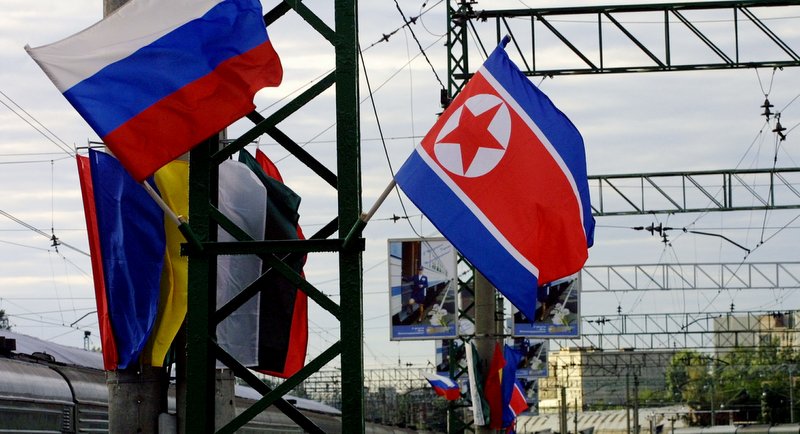
Washington and Pyongyang will eventually need to resume direct talks. With neither party ready for that yet, at first secret contacts will have to be organized in third countries. In the meantime, de-escalation is the order of the day, and Russia one of its unlikely brokers.
Source: New York Times
Russia is usually seen as relatively unimportant to most discussions about the North Korea nuclear crisis, yet it is in a unique position to help de-escalate it.
Despite rising tensions between Moscow and Washington — over Russia’s interventions in Crimea and Syria, and the very principles of the world order — Russia has voted twice in recent weeks at the United Nations to impose sanctions on North Korea. In the summer of 2015, in the midst of the crisis over Ukraine, Moscow was careful not to do anything that might derail the Obama administration’s efforts to cinch a nuclear deal with Iran.
Russia, in other words, is not simply the spoiler it has often been described as in recent years. It plays its hand with Washington much more subtly than that — often adopting an adversarial pose, especially of late, but sometimes a cooperative one. And it has good reason to help with North Korea.
In any discussion of how to handle the increasing belligerence of North Korea’s leader, Kim Jong-un, attention usually turns to China. Beijing and Pyongyang have long been allies, and China is North Korea’s main trade partner. But for a host of strategic reasons, there are inherent limits to what Beijing will do. It is wary of the fallout it would suffer if North Korea imploded, and it wants to preserve a buffer between itself and the United States forces based in South Korea.
Russia is both like and unlike China in just the ways that could make it an effective broker with Pyongyang.
Like China, Russia is a nuclear power, a permanent member of the United Nations Security Council and a neighbor of North Korea with established lines of communication to Pyongyang. During World War II, Kim Il-sung (Kim Jong-un’s grandfather) served as a captain in the Red Army; Kim Jong-il (Kim Jong-un’s father) traveled to Russia several times in the early 2000s. President Vladimir V. Putin of Russia himself went to Pyongyang in 2000. Although he failed to work out a deal to limit North Korea’s missile program at the time, his visit helped restore links with Pyongyang, which had been neglected after the fall of the Soviet Union.
Russia is not among the countries most directly or most intimately affected by North Korea’s nuclear ambitions, such as the United States, South Korea or China. And unlike China, Russia never was an imperial overlord on the Korean Peninsula. Moscow may have less direct influence with Pyongyang than does Beijing, but it evokes far less nationalistic resentment and suspicion among North Koreans.
Russia also has a clear and immediate interest in helping de-escalate the current crisis. Vladivostok, its gateway to the Asia-Pacific region, the headquarters of its Pacific Fleet and a hub for its energy trade, is just a couple hundred miles away from several of North Korea’s nuclear and missile sites. Any malfunction or other mishap with North Korea’s nuclear tests or missile launches could mean contamination in Russia itself. The Russian government is also eager to curb the further deployment of American missile-defense systems in South Korea and Japan, which both those countries are pursuing to protect themselves against North Korea.
North Korea will not denuclearize; it’s too late for that. Neither will it ever formally be recognized as a nuclear power. But it will eventually have crude nuclear weapons with which to strike United States territory.
Sanctions, no matter how strict, will not stop Pyongyang from pursuing its program, which it sees as the key to its very survival; as Mr. Putin said recently, North Koreans will “eat grass” before they give up nuclear weapons. Pyongyang’s latest missile launch on Friday was a direct rebuke to the new sanctions, notably on oil imports, that the U.N. Security Council passed last Monday.
This is not to say that sanctions are a mistake. They remain a valuable expression of collective condemnation and reassert the goal of nuclear nonproliferation. But they will not halt North Korea’s nuclearization.
A total blockade of the country might, but it is too risky to even attempt. It could push North Korea to start a war or cause the country’s collapse, a prospect that China, for one, cannot tolerate.
And so the only viable strategy left is to convince the North Korean leadership that it already has the deterrent it needs, and that going beyond that — by developing more nuclear weapons and longer-range missiles — would only be counterproductive.
This is where Russia comes it: It can help nudge Pyongyang toward strategic restraint, and help defuse tensions in the meantime, by offering it new economic prospects.
One project that has been discussed in the past involves building gas pipelines from Russia to South Korea through North Korea. Another would be to restore an old rail link that used to connect South Korea to the Tran-Siberian. Both would generate transit fees, in foreign currency, for Pyongyang. As another expression of good will, the Russian government could also authorize more North Koreans to work in its eastern provinces: An estimated 30,000 to 50,000 already do, many as construction workers and laborers.
The North Korean economy is doing better than is commonly thought. Its gross domestic product has grown recently — by 3.9 percent between 2016 and 2017 — and market forces are emerging, for the trade of food and real estate, for example. That means not only that North Korea may be better able to withstand sanctions today than it was in the past, but also that economic overtures could hurry its transformation along — and perhaps in time soften its stance internationally.
Washington and Pyongyang will eventually need to resume direct talks. With neither party ready for that yet, at first secret contacts will have to be organized in third countries. In the meantime, de-escalation is the order of the day, and Russia one of its unlikely brokers.
Former Director, Carnegie Moscow Center
Trenin was director of the Carnegie Moscow Center from 2008 to early 2022.
Recent Work
Dmitri Trenin
Dmitri Trenin
Carnegie does not take institutional positions on public policy issues; the views represented herein are those of the author(s) and do not necessarily reflect the views of Carnegie, its staff, or its trustees.

Trump is distracted and Ukraine wants Europe to step up. The continent’s leaders must find their voice and assert it in talks with Russia.

Alissa de Carbonnel

Mounting economic strain and battlefield losses will not necessarily make the Kremlin less dangerous. They could instead push Moscow toward a more aggressive hybrid campaign designed to test NATO’s Eastern flank, exploit allied hesitation, and fracture European resolve.

Maksym Beznosiuk

Over the past ten years, NATO has held almost as many summits as it did during the entirety of the Cold War. Are they still useful, or is it time to stop holding annual meetings?

Rym Momtaz, ed.
Nearly a year and a half after Europeans leaned into sucking up to Trump, the strategy has produced some benefits when it comes to Ukraine.
Rym Momtaz
As Russia's war on Ukraine drags on, NATO is expanding its footprint in the Black Sea. Turkey, Romania, and Bulgaria are upgrading their fleets and deepening trilateral cooperation.

Dimitar Bechev