

Q&A
Sarah Yerkes
{
  "authors": [
    "Sarah Yerkes"
  ],
  "type": "legacyinthemedia",
  "centerAffiliationAll": "dc",
  "centers": [
    "Carnegie Endowment for International Peace"
  ],
  "collections": [
    "Arab Awakening"
  ],
  "englishNewsletterAll": "menaTransitions",
  "nonEnglishNewsletterAll": "",
  "primaryCenter": "Carnegie Endowment for International Peace",
  "programAffiliation": "MEP",
  "programs": [
    "Middle East"
  ],
  "projects": [
    "Tunisia Monitor"
  ],
  "regions": [
    "Middle East",
    "North Africa",
    "Tunisia"
  ],
  "topics": [
    "Political Reform",
    "Democracy",
    "Security"
  ]
}
Source: Getty
Recent moves by the Tunisian government may signal a major backsliding in the country’s democratic development.
Source: Foreign Affairs
Over the course of just one week, the Tunisian government has made three concerning moves that, taken together, signal a major backsliding in its democratic development. The first occurred on September 11 when Tunisia’s Parliament approved a government reshuffle that enabled the replacement of 13 of 28 cabinet ministers. It was an alarming move, as some of the new ministers have ties to the former regime of dictator Zine el Abidene Ben Ali, who was ousted in 2011 during the Arab Spring.
The second incident took place three days later. After a divisive, years-long debate over President Beji Caid Essebsi’s controversial economic reconciliation law (dubbed the “administrative reconciliation law”), Parliament passed it 119 to 98 with 90 members boycotting the vote. (Many of those who abstained joined protesters outside of the Parliament building.) This law grants amnesty to civil servants who facilitated corruption under the Ben Ali regime without putting them through any sort of legal process. It also overrides the authority of the official body for transitional justice, the Truth and Dignity Commission, whose mandate is to investigate corruption and other economic crimes. The law allows the government to overturn the convictions of civil servants who have been found guilty of corruption through the transitional justice process.
Then finally, on September 18, the government announced that Tunisia’s first-ever municipal elections, scheduled for December 17, would be postponed for a third time—likely until the end of March 2018. The elections were originally scheduled for October 2016, but were postponed to March 2017 and then again to December 2017 due to a variety of logistical and political factors. The government postponed them this time because the head of the elections body resigned over the summer, slowing down the election preparation process.
Although each of these actions is troubling by itself, the series of actions as a whole suggests a calculated attempt by the Essebsi government at scaling back the country’s democratic progress.
I was in Tunis while all of this unfolded. The tension there was palpable. Through conversations with civil society activists and government officials, it became clear to me that these three measures have further alienated a people who are already deeply cynical about their government. Tunisia currently suffers from very low levels of trust in government. According to Arab Barometer, a polling organization, the number of Tunisians who say they “trust the government to a medium or a great extent” fell from 62 percent in 2011, just after the revolution, to 35 percent in 2016. Tunisia’s most popular political figures, such as Prime Minister Youssef Chahed, are lucky to get an approval rating above 35 percent. Indeed, some of the Tunisians I spoke with said they think that the government is selling out. (Government officials, conversely, said that they see these measures as moving the country forward economically.) Additionally, although several of Tunisia’s early democratic reforms involved an inclusive public consultation process, these latest measures did not, signaling that the government is uninterested in public buy-in.
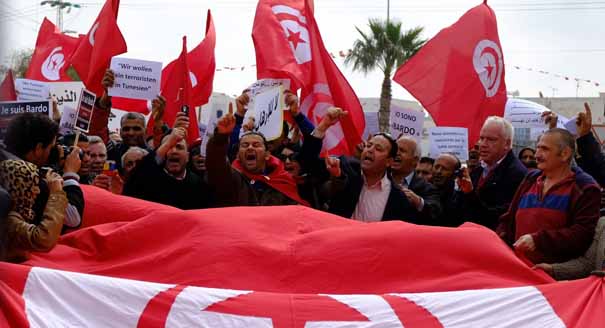
The divide between the people and the government is most evident in the streets. In 2015, when the economic reconciliation bill was first introduced, Manish Msemah, a civil society network, galvanized several thousand people to demonstrate against it. They argued that the legislation circumvented the transitional justice process and would provide amnesty to corrupt business and government officials. Essesbi, and the members of his Nidaa Tounes party who supported the bill, claimed that it would result in the return of money to the state and allow the country to close the book on the past. Although the initial series of protests succeeded in postponing the passage of the law for more than two years, in the end it went through. In the days after the passage of the economic reconciliation law, Manish Msemah threatened to publish the names of the members of Parliament who voted for the legislation and expose those who are benefiting from the law—namely, the civil servants whose corruption convictions the law overturns.
As I have previously argued, Tunisians are increasingly turning to the streets instead of the ballot box to voice their grievances because they are frustrated with the current political parties and view protest as an effective means of achieving their goals. In 2014, two-thirds of Tunisian youth boycotted the legislative and presidential elections, only the second free and fair elections in the country’s history. They felt that the parties did not represent their views. This has led to a vicious cycle in which government officials have no incentive to engage with young Tunisians, knowing they won’t be voting. As long as this continues, the divide between the people and their elected leaders will only continue to grow, providing ammunition for the extremist groups targeting Tunisia and helping to recruit angry and frustrated Tunisians to join the Islamic State (ISIS) or other extremist groups. To date, Tunisia has seen several thousand of its youth join ISIS. The individuals who carried out the horrific terror attacks in Tunis and Sousse in 2015 had trained with ISIS in Libya, and there are thousands of radicalized Tunisians in Syria and Iraq who may someday seek to return home.
Not only are the recent developments divisive, but they confirm the fears of many Tunisian activists that the government is prioritizing efficiency over democracy. In interviews with Tunisians in June 2016—two months before Chahed inaugurated his first government—I was told by a Tunisian journalist that “the old guard is back.” Young Tunisians, in particular, feel as if the revolution has been abandoned—that the government has given up on democratic principles and has begun to disregard the transitional justice mechanisms put in place to safeguard against the authoritarianism of the prior regime. On September 18, when Essebsi said on national television that he was considering changing the 2014 constitution—the most poignant symbol of the revolution’s success—he set off alarm bells among the Tunisian public. There has been speculation that Essebsi thinks that the Parliament is inefficient and ineffective and wants to consolidate power so he can take more direct action.
Preventing any further roll-back of the post-revolutionary reforms will require an alliance between the fragmented political opposition and civil society to fight illiberal forces, both within and outside of the country. The 2019 legislative and presidential elections will be crucial in helping overcoming the divisions among the opposition. The elections will provide an opportunity for Tunisians to express their desire for change in a direct, democratic way. But according to an August poll by the International Republican Institute, only 45 percent of Tunisians are “somewhat or very likely to vote in the municipal elections,” down from 66 percent in November 2015. To attract people to the ballot box, the parties must develop clear platforms and policy positions that show the public how they will address the economic and security challenges facing the country. The people have to understand that protest is only one tool in the democratic toolbox.
The international community has a role to play as well. First, the United States and Europe should continue to support Tunisian civil society, both financially and rhetorically. The civil society plays the crucial role of government watchdog through activities such as sitting in on sessions of Parliament and reporting on each member’s speeches and voting records online, as well as rating officials on their policy promises. Along with the media, Tunisian civil society must continue to inform the public—both domestically and in the West—about the actions of the government.
Tunisia’s friends in the Mediterranean and across the Atlantic also need to keep their eyes on the country. Far too often, Western leaders have incorrectly assumed that Tunisia, as compared to its war-torn neighbors, is faring well and does not require their support. This attitude is neither helpful for Tunisia nor for the region writ large. The Tunisian government has proven to be a strong and reliable security and economic partner to the United States and Europe, and its political and social environment is conducive to increased financial assistance. Democratic transitions are inherently uncertain and tumultuous. With ISIS next door in Libya, the failure of Tunisia’s transition would have implications far beyond its borders. Thus, it is in both the region’s and the West’s interests to make sure that the country succeeds in upholding the democratic principles that so many Tunisians sacrificed their lives for in 2011.

Acting Co-Director and Senior Fellow, Middle East Program
Sarah Yerkes is acting co-director and a senior fellow in the Middle East Program at the Carnegie Endowment for International Peace. Her research focuses on democracy and governance, U.S. foreign policy towards the Middle East and North Africa, and political and economic reform in Tunisia.
Recent Work
Carnegie does not take institutional positions on public policy issues; the views represented herein are those of the author(s) and do not necessarily reflect the views of Carnegie, its staff, or its trustees.

The domestic impacts of how long it is taking to end the war in Ukraine have pushed the French electorate to the political extremes and compromised the country’s diplomatic capacity.

Rym Momtaz

Before the next wave of EU enlargement takes place, the union needs to grapple with thorny questions of how power is distributed among its members.


Emil Sondaj Hansen, Ditte Brasso Sørensen

The new U.S.–Denmark–Greenland agreement will help Washington exert political, economic, and financial dominance under the guise of security. Yet, it acknowledged Copenhagen’s and Nuuk’s sovereignty on the island.

Marc Pierini

A summer of escalation in the Black Sea has hurt Ukraine economically and is exacerbating world food security. A truce is needed—as is a broader reframing of Europe’s Ukraine strategy.

Thomas de Waal

Are Germany’s economic, industrial, and political struggles becoming a liability for the EU’s ability to rise to the geopolitical moment?
Rym Momtaz, ed.