

Q&A
Paul Haenle, Philippe Le Corre
{
  "authors": [
    "Philippe Le Corre"
  ],
  "type": "legacyinthemedia",
  "centerAffiliationAll": "dc",
  "centers": [
    "Carnegie Endowment for International Peace"
  ],
  "collections": [],
  "englishNewsletterAll": "asia",
  "nonEnglishNewsletterAll": "",
  "primaryCenter": "Carnegie Endowment for International Peace",
  "programAffiliation": "AP",
  "programs": [
    "Asia"
  ],
  "projects": [],
  "regions": [
    "East Asia",
    "China"
  ],
  "topics": [
    "Political Reform",
    "Foreign Policy"
  ]
}
Source: Getty
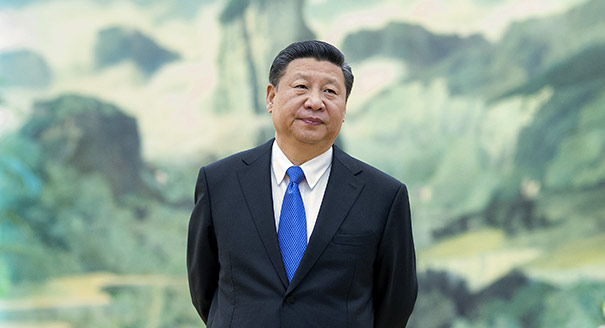
Xi Jinping’s China intends to position itself at the heart of the geopolitical game.
Source: Institut Montaigne
Five years after his debut as General Secretary of the Chinese Communist Party and State President, Xi Jinping surprised the world on February 25. Chinese official media announced that the National People’s Congress would soon receive a proposal to modify the rule, which, in the Constitution, currently prevents anyone to serve more than two consecutive presidential terms. This Monday March 5, the National People’s Congress and the Chinese People's Political Consultative Conference - the two chambers of the Chinese Parliament - will start their annual sessions, will hear policy reports from the outgoing government, formally appoint ministers, and vote on the proposed changes. The latter, if confirmed, could possibly allow Xi Jinping to remain as President beyond 2023 (the General Secretary’s position is bound by no written obligation). In many ways, this proposal is a real gamble for this leader, whose term has been characterized by stronger internal control (the fight against corruption which somewhat also became a witch-hunt) and the promotion of the “rejuvenation of the Chinese dream”. Built on nationalism, the aim of the party leader’s discourse has been (among other things) to flatter the Chinese pride, especially by orchestrating an impressive international expansion program on the economic, cultural, diplomatic and military fronts.
Many questions arise from the proposed constitutional change. After all, isn’t Xi already branded as China’s “COE” (“Chairman of Everything”)? The “Xi Jinping thought” has been included in the party’s Constitution since the 19th CCP last October. Still, this very personal one-man rule disrupts the tradition of the last twenty years, which had set a constitutional limit to the number of presidential terms, as well as an age limit for members of the Standing committee of the Politburo. Regarding the latter, Xi Jinping (64 years old) and his right-hand man - China’s potential Vice President Wang Qishan (69) - are not subjected to these constraints. It is, however, very unlikely that this situation will satisfy the Chinese elites, in particular the previous leaders’ heirs, some of whom have become very rich, when they managed to escape the regime’s throes since 2013.
More importantly, such concentration of power into the hands of one man is unprecedented since the death of Mao Zedong, and reveals the weaknesses of the Chinese system. Economic uncertainties - with the debt level, greenhouse gas, ageing and social problems overshadowing the future - understandably make Chinese leaders anxious. By entrusting China’s supreme governance to only one man, the CCP is ensuring its survival beyond its very symbolic 100th anniversary in 2021, already mentioned on this blog
Indeed, the regime is gambling with its preservation of power. Chinese society is increasingly complex, sophisticated and - paradoxically - open to the world, thanks to the 500.000 Chinese students being sent abroad, and other types of exchanges. Internet censorship, and repression over all, is far from seamless - even though a large number of Chinese citizens probably approve Xi Jinping’s rise to the status of quasi ‘Great Helmsman’.
In any case, it is under Xi’s control that China accelerated its internationalisation. In contrast with a weakened West (in particular the American system, shaken by Donald Trump’s erratic administration), Beijing's authoritarian model appeals to countries from Egypt to Turkey, including Cambodia, Pakistan and Djibouti. It is worth noting that the White House only reacted softly to the Chinese constitutional change. In contrast, dictators across the globe can only rejoice at these recent developments.
As China keeps employing the term “reform”, it is sometimes hard to grasp what it means. It does not imply more freedom of information, judging at the media self-censorship and censorship taking place, including on social media. “Reform” is even less obvious in the political field, given the arrests and bad treatments inflicted upon opponents of the regime, not to mention Hong Kong or minorities in Tibet, in Xinjiang and Inner Mongolia.
Finally, foreigners are also puzzled by China’s definition of economic reform.
If there is a reform, it will not encourage a Western-style liberalization of the economy nor reduce the public sector’s share to the advantage of the private sector. In China, private companies are now under surveillance, on the whim of the government’s choices. Two of the most dynamic private companies, Wanda and HNA, are in a tight spot. Meanwhile, the insurance company Anbang (run by Wu Xiaohui, ex-husband of Deng Xiaoping’s granddaughter) has been placed under the tight control of the Chinese regulator. Two years ago, Wu was parading in Wall Street, trying to buy Starwood Hotels. Other private companies - Fosun, Geely - seem in better shape. Geely’s owner, Li Shufu, was even authorized to take a stake in 9.5% of Daimler’s capital. The financial backup for this highly symbolic deal remains uncertain.
State-owned companies - which Xi had praised during his speech at the 19th Congress, continue to expand globally, often under the banner of the « Belt and Road Initiative » (BRI). From energy to transports to telecommunication networks or big consumer brands, very few sectors have not received investments from state-owned companies, implementing a less “win win” strategy, and more of a unilateral strategy.
Xi Jinping’s China, that of the perhaps future president-for-life (although Chinese media seemed less confident on this topic towards the middle of last week), intends to position itself at the heart of the geopolitical game, either in the existing international institutions when it wishes to (United Nations, World Bank, etc.), or through the Asian Infrastructure Investment Bank, or the BRI, the label currently stamped on most Chinese initiatives, be they economic, related to culture, or education. Launched and defended by Mr. Xi himself, this concept is no less than China’s response to sixty years of US domination of the international order. Europe, for its part, is on Beijing’s radar as China pursues its offensive on the Old Continent, as demonstrated by large-scale Chinese investments throughout Europe. An important alternative for China, whose relations with Trump's United States deteriorated over the past few months (the US Administration having become increasingly hostile towards China regarding trade, as well as strategic issues in North Asia and the South China Sea). Whether Europeans will manage to impose their voice in the context of China’s rise and the United States’ partial retreat is yet to be determined. Given the current state of European forces, nothing is less sure.
This article was originally published by the Institut Montaigne.
Former Nonresident Senior Fellow, Europe Program
Philippe Le Corre was a nonresident senior fellow in the Europe Program at the Carnegie Endowment for International Peace.
Recent Work

Paul Haenle, Philippe Le Corre

Erik Brattberg, Philippe Le Corre, Paul Stronski, …
Carnegie does not take institutional positions on public policy issues; the views represented herein are those of the author(s) and do not necessarily reflect the views of Carnegie, its staff, or its trustees.

Ahead of a tough winter for Ukraine, Donald Trump’s swing back toward Russia bodes ill. But instead of panicking, Kyiv’s European allies are focusing on action.

Rym Momtaz

Funding Ukraine remains a priority for European leaders. As Russia’s war of aggression heads into another winter, two feasible options to mobilize support for Kyiv should be fast-tracked.


Vladyslav Rashkovan, Gregory P. Wilson

While the EU and European governments are embracing the much-lauded middle-power moment, this entails three difficult conundrums.

Richard Youngs

Europe is facing rising populism internally as well as external pressures from Russia, China, Turkey, and the United States.

Dimitar Bechev

A notable degree of participative democracy has firmly arrived in Europe. But to have more far-reaching impact, democratic deliberation needs to move into a radically new phase.
Richard Youngs