

Article
C. Raja Mohan, Darshana M. Baruah
{
  "authors": [
    "C. Raja Mohan"
  ],
  "type": "legacyinthemedia",
  "centerAffiliationAll": "dc",
  "centers": [
    "Carnegie Endowment for International Peace",
    "Carnegie India"
  ],
  "collections": [],
  "englishNewsletterAll": "ctw",
  "nonEnglishNewsletterAll": "",
  "primaryCenter": "Carnegie India",
  "programAffiliation": "SAP",
  "programs": [
    "South Asia"
  ],
  "projects": [],
  "regions": [
    "United States",
    "East Asia",
    "China",
    "Indo-Pacific",
    "North Korea"
  ],
  "topics": [
    "Foreign Policy"
  ]
}
Source: Getty
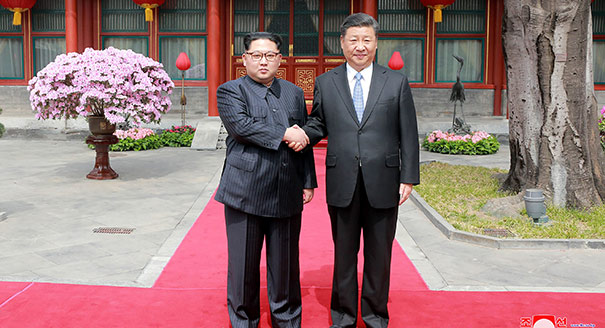
North Korean leader Kim Jong-un went to Beijing after demonstrating that he is capable of standing up to the world, has complete control over his system, and can deal with the United States on his own.
Source: Indian Express
Korea has long been called a shrimp among whales. Caught between China, Japan, Russia and America, the Korean Peninsula has been a plaything of the great powers. But the North Korean leader Kim Jong-un and the South Korean president Moon Jae-in have shown how smart shrimps can occasionally get the better of the whales. Since the beginning of this year, Kim and Moon have repeatedly surprised the world with their diplomacy across the divided peninsula.
Consider, for example, Kim’s visit to China last week. It was Kim’s first trip abroad since he took charge of the nation in 2011. Coming a few days after the plans for Kim’s summit with US President Donald Trump were announced, Kim’s talks with President Xi Jinping were widely seen as the affirmation of China’s central role in the Korean Peninsula.
While that proposition is real and rooted in geography and history, Kim’s visit could also be interpreted as a part of the North Korean leader’s quest for “strategic autonomy” from Beijing. Reports suggest that it was at Kim’s initiative that the visit was set up. It was Kim who decided that the time has come to end the frosty relations with Xi. Kim went to Beijing after demonstrating that he is capable of standing up to the world, has complete control over his system, and can deal with America on his own.
Until now, the conventional wisdom has been that the key to unlocking the doors for Korean peace was with Beijing. Thanks to the boldness of Kim and Trump, the focus has now shifted to potential breakthroughs in the direct negotiation between Washington and Pyongyang. While China will always exercise considerable influence over the Koreas, for now, it is Kim driving the process.
Kim did not go to Beijing to seek Xi’s “permission” to talk to Trump. He went there to “inform” Xi of his decision, “promise” to keep China in the loop and “seek” the Chinese leader’s blessings. After having long called for direct talks between the US and North Korea, Xi could not have said “no”, at least for the moment. Getting formal support from Xi, to be sure further improves Kim’s leverage with Trump.
If Kim has found a way to find generate political space vis a vis Beijing, Moon has done much the same with Washington. Defying the dominant view in Washington, Moon persisted with his outreach to Kim. Even as he opened up to the North, Moon was careful to keep the Trump administration on his side.
Meanwhile, all the major powers are scrambling to respond to the Kim-Moon diplomacy by checking out each other bilaterally. Having hosted Kim, Xi was quick to send out a special envoy to South Korea. China has probably most to lose if North Korea moves either closer to the US or triggers a regional war. Given the unpredictability of both Trump and Kim, Xi stares at a very disconcerting geopolitical moment in his front yard.
The Korean Peninsula is also Tokyo’s front yard and any big change there profoundly affects Japan’s security. Surprised by the Korean manoeuvre in Washington, Japan fears that a deal between Kim and Trump would weaken its alliance with America and leave it exposed. Prime Minister Shinzo Abe, who has been pushing for a hard line against North Korea, is now looking for a summit with Kim sometime in June. Before Trump’s talks with Beijing, Abe will also travel to Washington.
Like China and Japan, Russia, too, will be concerned at the potential entente between Washington and Pyongyang and the consequential loss of influence in the peninsula. Kim is surely aware of this and could be drawing Putin into a separate summit in the coming weeks.
Sceptics have good reasons to fear that the current high-stakes diplomatic poker could end up in a disaster. The very personal traits of Kim and Trump that raised hopes could also result in a quick breakdown and rapid escalation to a war. Even if the two leaders hold steady, the issues at hand — peace and denuclearisation — are so hard to work through.
While the dangers are real, Trump and Kim have many incentives to make their engagement a success. For Kim, a successful deal would liberate him from various sanctions and open the door for regime security and national economic renewal. For Trump, a success in the peninsula could give a massive boost to this political standing at home. Even more important, it could reinforce America’s position as the real arbiter of peace in the region and limit fears of Beijing replacing Washington as the hegemon in East Asia.
What does this all mean for India? Two themes stand out. First, India should stop being a passive observer of the Korean geopolitical theatre. While Delhi is in no position to influence the outcomes in the current diplomacy, a more active engagement with the leadership of the two Koreas would better prepare India for potential historic changes in the region.
Second is the importance of effective neighbourhood diplomacy. Kim and Moon have shown that relaxation of tensions between North and South can give both of them a greater say in regional affairs. If it makes creative moves in the neighbourhood, Delhi could find it a bit easier to cope with the penetration of rival powers into the Subcontinent.
This article was originally published in the Indian Express.
Former Nonresident Senior Fellow, Carnegie India
A leading analyst of India’s foreign policy, Mohan is also an expert on South Asian security, great-power relations in Asia, and arms control.
Recent Work

C. Raja Mohan, Darshana M. Baruah


Alexander Gabuev, Paul Haenle, C. Raja Mohan, …
Carnegie does not take institutional positions on public policy issues; the views represented herein are those of the author(s) and do not necessarily reflect the views of Carnegie, its staff, or its trustees.
The EU had to compromise to adopt a twenty-first sanctions package against Russia, exposing growing cracks in the union’s resolve. Is this latest, weaker round worth it to keep pressure on Moscow?

Rym Momtaz, ed.

Trump is distracted and Ukraine wants Europe to step up. The continent’s leaders must find their voice and assert it in talks with Russia.

Alissa de Carbonnel

Mounting economic strain and battlefield losses will not necessarily make the Kremlin less dangerous. They could instead push Moscow toward a more aggressive hybrid campaign designed to test NATO’s Eastern flank, exploit allied hesitation, and fracture European resolve.

Maksym Beznosiuk
Over the past ten years, NATO has held almost as many summits as it did during the entirety of the Cold War. Are they still useful, or is it time to stop holding annual meetings?
Rym Momtaz, ed.
Nearly a year and a half after Europeans leaned into sucking up to Trump, the strategy has produced some benefits when it comes to Ukraine.
Rym Momtaz