

Commentary
Peter Kellner
{
  "authors": [
    "Peter Kellner"
  ],
  "type": "legacyinthemedia",
  "centerAffiliationAll": "dc",
  "centers": [
    "Carnegie Endowment for International Peace",
    "Carnegie Europe"
  ],
  "collections": [
    "Brexit and UK Politics"
  ],
  "englishNewsletterAll": "ctw",
  "nonEnglishNewsletterAll": "",
  "primaryCenter": "Carnegie Europe",
  "programAffiliation": "EP",
  "programs": [
    "Europe"
  ],
  "projects": [],
  "regions": [
    "Europe",
    "Western Europe",
    "United Kingdom",
    "Iran"
  ],
  "topics": [
    "EU"
  ]
}
Source: Getty
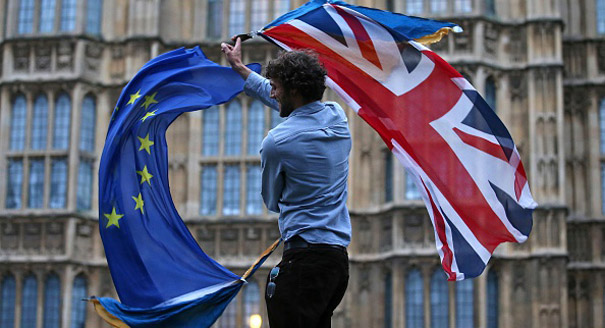
For the UK’s younger generations, the dream of sovereignty takes second place to demands for prosperity to be protected.
Source: Financial Times
The slogan that defined the Brexit referendum campaign has lost its appeal. “Take back control” was a powerful message in the summer of 2016. Today, the dream of sovereignty takes second place to voters’ demands for prosperity to be protected.
This helps to explain a modest, but sustained, shift in public opinion since the vote to leave the EU. A new survey, conducted by DeltaPoll, suggests that another vote today would produce almost exactly the opposite result to the verdict in June 2016: a 5 per cent majority for Remain, compared with a four-point lead for Leave two years ago.Another question explains what is happening — and illuminates a dangerously large gulf between those in early or mid-career, and those who are in or close to retirement. The poll asked people which of two statements about the current Brexit negotiations comes closest to their view:
“It’s vital for jobs, investment and living standards here in the UK for us to continue to trade as freely with the EU as we do today, even if this limits our freedom to decide our own business and trading rules.”
Or:
“It’s vital that Britain regains the right to decide its own business and trading rules, even if this reduces our ability to trade freely with the EU and risks being bad for jobs, investment and living standards.”
Almost half responded that they wished to protect jobs and living standards at all costs, while 38 per cent regarded British sovereignty as the higher priority. Stripping out the “don’t knows”, the verdict is 56-44 per cent in favour of economic strength.
The generation gap on the direction Brexit should take is significant. Among voters who are under 55 — and therefore likely to be directly affected by the impact of Brexit on jobs and investment — the margin is almost two-to-one: 65 to 35 per cent. But the over-55s regard sovereignty as more important, by 59 to 41 per cent.
Some fervently claim that any attempt to reverse the 2016 referendum result would provoke anger from those who voted for Brexit. Perhaps we should also consider the danger that younger Remain voters could rebel against the threat to future prosperity in the pursuit of a sovereignty they consider of secondary importance.
There is another argument that we need to consider. It is that the polling question poses a false dichotomy: that Britain does not have to choose between prosperity and independence, for we can have both. The problem here is that hardly anyone outside the ranks of the most committed Brexiters seems to share this view.
Leaked assessments by the government suggest that full control of our trade could lop 8 per cent off Britain’s economic growth over 15 years. The Institute for Fiscal Studies reckons that both growth and the public finances would suffer: there would be no chance of the much vaunted £350m a week extra for the NHS. The CBI and Institute of Directors have also voiced their concerns.
Only this week, a delegation of business leaders from Europe’s biggest companies met with prime minister Theresa May to warn of the dangers of the persistent uncertainties over Britain’s future relationship with the EU.
That is not all. The most optimistic projections of the Brexiters assume free and frictionless trade with the rest of the EU, as well as new trade deals with the rest of the world. With each passing week, it becomes clear that the price of frictionless trade beyond December 2020 — the end of the “implementation” phase — will be a requirement for the UK to apply the current customs union and single market rules, or something very like them, at least for food, components and manufactured goods.
The prominent Brexit supporter Jacob Rees-Mogg has said this outcome would turn the UK into a “ vassal state”. For the great majority of those with much of their working lives ahead of them, better that than one that threatens future economic prospects for them and their families.

Former Nonresident Scholar, Carnegie Europe
Kellner was a nonresident scholar at Carnegie Europe, where his research focused on Brexit, populism, and electoral democracy.
Recent Work
Peter Kellner
Peter Kellner
Carnegie does not take institutional positions on public policy issues; the views represented herein are those of the author(s) and do not necessarily reflect the views of Carnegie, its staff, or its trustees.

European Commission President Ursula von der Leyen is about to give her annual address on the state of the EU. Here’s what she won’t—but should—say.

Rym Momtaz

Radical-right parties are expected to do well in upcoming elections in four of the EU's biggest member states. If successful, they could prevent the union from addressing key challenges ahead.

Stefan Lehne

The aftermath of the Ceuta crisis shows Europe has drawn the wrong lessons. Rather than doubling down on failed migration policies, the EU needs to address the underlying roots of such episodes.

Richard Youngs

An overwhelming victory by a far-right-wing party in a small state in eastern Germany will have major repercussions for Chancellor Friedrich Merz’s coalition.

Judy Dempsey

Canadian Prime Minister Mark Carney has twice inspired praise for standing up to U.S. President Donald Trump: at the 2026 World Economic Forum in Davos and on Canada-U.S. trade negotiations. Is Carney showing a third way better than the EU has in dealing with the Trump administration?
Rym Momtaz, ed.