

Q&A
- +1
Sheena Chestnut Greitens, Oriana Skylar Mastro, Yukon Huang, …
{
  "authors": [
    "Tong Zhao"
  ],
  "type": "other",
  "centerAffiliationAll": "",
  "centers": [
    "Carnegie Endowment for International Peace",
    "Carnegie China"
  ],
  "collections": [
    "China’s Foreign Relations",
    "Hypersonic Weapons",
    "Carnegie China Commentaries"
  ],
  "englishNewsletterAll": "",
  "nonEnglishNewsletterAll": "",
  "primaryCenter": "Carnegie China",
  "programAffiliation": "",
  "programs": [],
  "projects": [],
  "regions": [],
  "topics": [
    "Arms Control",
    "Security"
  ]
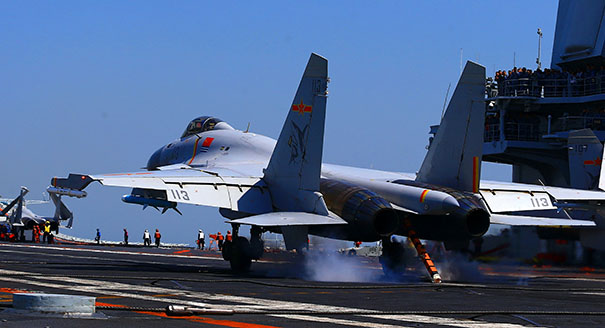
}
Source: Getty
Chinese experts are increasingly using the term “strategic stability” to refer to a bilateral nuclear relationship of mutual vulnerability. Maintaining such a mutually vulnerable relationship with other major nuclear powers, especially the United States, is of ultimate importance for Chinese decisionmakers.
Traditionally, within the Chinese strategic community, strategic stability constituted a comprehensive concept for describing the overall stability of a bilateral relationship that was affected by a wide range of factors—military, political, diplomatic, and economic. In recent decades, the Western literature on nuclear weapons and deterrence issues has started to be introduced to and embraced by the Chinese strategic community. As a result, Chinese experts are increasingly using the term “strategic stability” to refer to a bilateral nuclear relationship of mutual vulnerability. Maintaining such a mutually vulnerable relationship with other major nuclear powers, especially the United States, is of ultimate importance for Chinese decisionmakers. However, despite Beijing’s efforts to enhance its nuclear retaliatory capability through modernization programs, it sees itself facing significant new challenges.
The emergence of advanced conventional weapons is widely recognized as one of the major challenges to strategic stability in the so-called second nuclear age. Such conventional weapons can travel at extremely high speeds and strike targets with extraordinary accuracy. Among all conventional military capabilities, hypersonic weapons present perhaps the greatest challenge. These types of weapons, which are currently under development in both the United States and China, can potentially travel long distances at speeds of more than Mach 5, and they have a much greater capability to change flight trajectory than ballistic missiles. This emerging conventional military technology is potentially capable of disrupting mutually vulnerable relationships between nuclear powers by blurring the lines between conventional and nuclear warfare.
The United States has the most advanced hypersonic technology development program, and it has expressed interest in deploying such weapons. According to the Obama administration’s 2010 Nuclear Posture Review Report, for instance, conventional weapons are slated to play a more important role in the U.S. deterrence posture. Hence, the US investment in the development of hypersonic weapons is causing major Chinese concerns.
This paper draws directly on the Chinese literature to answer these questions: What are China’s specific concerns about hypersonic weapons? How do Chinese experts expect hypersonic technologies to alter future nuclear relationships and, therefore, affect traditional understandings of strategic stability? Also, what are the major mutual misunderstandings regarding each other’s hypersonic technology development, and what are the implications for maintaining U.S.-China strategic stability in the future?
A revised version of this paper was published in the book The End of Strategic Stability? Nuclear Weapons and the Challenge of Regional Rivalries

Senior Fellow with the Nuclear Policy Program and Carnegie China
Tong Zhao is a senior fellow with the Nuclear Policy Program and Carnegie China, Carnegie’s East Asia-based research center on contemporary China. Formerly based in Beijing, he now conducts research in Washington on strategic security issues.
Recent Work



Sheena Chestnut Greitens, Oriana Skylar Mastro, Yukon Huang, …
Carnegie does not take institutional positions on public policy issues; the views represented herein are those of the author(s) and do not necessarily reflect the views of Carnegie, its staff, or its trustees.

With its public finances in shambles, the far right polling at 35 percent ahead of the 2027 presidential election, and a growing protest movement, is France’s crisis a threat to the EU’s geopolitical awakening?

Rym Momtaz, ed.

Europe is facing rising populism internally as well as external pressures from Russia, China, Turkey, and the United States.

Dimitar Bechev

The new U.S.–Denmark–Greenland agreement will help Washington exert political, economic, and financial dominance under the guise of security. Yet, it acknowledged Copenhagen’s and Nuuk’s sovereignty on the island.

Marc Pierini

A summer of escalation in the Black Sea has hurt Ukraine economically and is exacerbating world food security. A truce is needed—as is a broader reframing of Europe’s Ukraine strategy.

Thomas de Waal

Are Germany’s economic, industrial, and political struggles becoming a liability for the EU’s ability to rise to the geopolitical moment?
Rym Momtaz, ed.