

Paper
George Perkovich
{
  "authors": [
    "George Perkovich"
  ],
  "type": "commentary",
  "centerAffiliationAll": "dc",
  "centers": [
    "Carnegie Endowment for International Peace"
  ],
  "collections": [
    "U.S. Nuclear Policy",
    "Korean Peninsula"
  ],
  "englishNewsletterAll": "ctw",
  "nonEnglishNewsletterAll": "",
  "primaryCenter": "Carnegie Endowment for International Peace",
  "programAffiliation": "NPP",
  "programs": [
    "Nuclear Policy"
  ],
  "projects": [],
  "regions": [
    "North America",
    "United States",
    "East Asia",
    "North Korea"
  ],
  "topics": [
    "Security",
    "Nuclear Policy",
    "Arms Control"
  ]
}
Source: Getty
What might a realistic approach to one of the most complex and delicate nuclear negotiations ever attempted look like? Here’s why the United States and North Korea must tread carefully to resolve their impasse.
“North Korea leader offers to dismantle nuclear site – but only after U.S. acts.” It’s a headline from this week’s summit between South Korean President Moon Jae-in and North Korean Chairman Kim Jong-un, which shows why it will be so difficult to resolve the impasse over North Korea’s nuclear program.
President Donald Trump’s bold summitry with Kim in Singapore started what could be a step-by-step process to greatly reduce the risk of nuclear war on the Korean Peninsula. But success will depend on accepting less than everything he wants up front.
The United States, along with South Korea, Japan, and the UN Security Council, insists that North Korea should completely eliminate its nuclear weapons arsenal. As a reward, it would then receive a peace treaty, the removal of sanctions, and other steps that the North Korean leadership seeks. Otherwise, providing benefits up front would remove the incentive for North Korea to implement denuclearization.
Success will depend on accepting less than everything [Trump] wants up front.
But the North Korean regime feels just as strongly that once it gives up its nuclear arsenal, it will no longer be able to fend off aggression, subversion, or the reimposition of sanctions against it. Both positions have historical merit.
The problem is how to phase the removal of threats and the delivery of benefits in ways that give all parties what they can live with. One way might be to declare the formal end of the Korean War, which ended inconclusively in 1953. In Singapore, President Trump reportedly showed interest in a peace declaration, as part of a deal to achieve the “denuclearization” of North Korea. Subsequent negotiations at lower levels snagged.
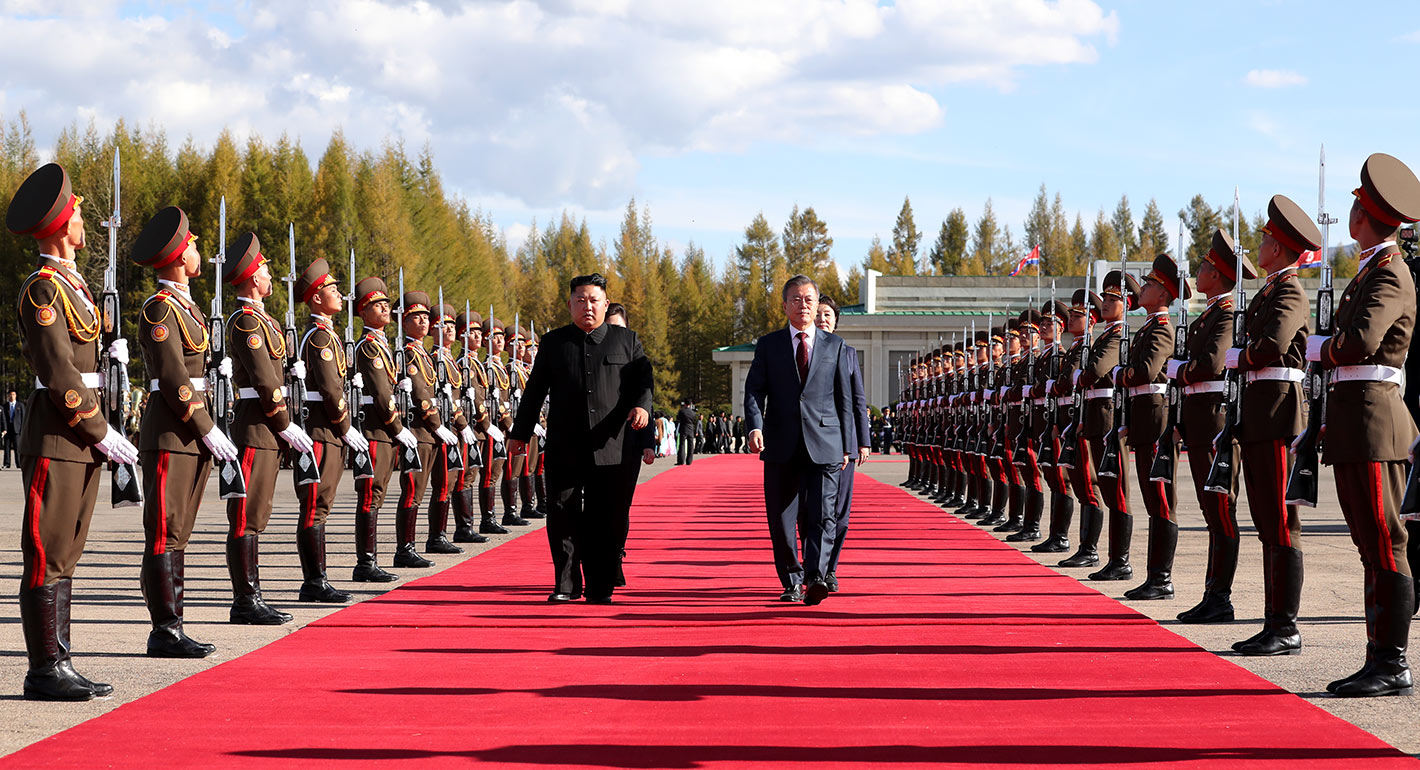
When South Korean President Moon Jae-in traveled to Pyongyang to meet Kim this week, Moon reportedly sought to negotiate a political statement that would declare the end of the Korean War. North Korea wants a formal treaty involving both South Korea and the United States to legally end the war. But the challenge of winning the two-thirds of the U.S. Senate to ratify such a treaty makes a declaration more feasible, as a declaration would not need to be signed off by the Senate.
Many security experts fret that agreeing to end the war would give North Korea a victory, without forcing them to give up their nuclear program in return. In the words of a former South Korean vice minister of foreign affairs, Kim Sung-han, this could “lead to North Korea escalating its campaign to disband the United Nations Command and undermine the South Korea-U.S. alliance, instead of focusing on denuclearization.”
In contrast, the U.S. demand that North Korea immediately declare all of its nuclear and missile capabilities poses a mirror-image of the same problem. North Korean leaders worry that such a declaration would make it possible for the United States to target North Korea’s deterrent for attack. This would remove North Korea’s bargaining lever, so the United States and its partners would not need to ease sanctions and provide other security and political assurances.
President Trump’s diplomatic gambit is already showing that a phased process of reciprocal concessions is the only way to succeed. North Korea has stopped testing nuclear weapons and long-range ballistic missiles. Kim Jong-un on Wednesday reportedly offered to “permanently dismantle” a missile-engine-test facility and launchpad, and the nuclear-fuel-production facilities in the Yongbyon complex.
Of course, there is reason to be cautious. North Korea has frozen activities at Yongbyon before, and then resumed them when negotiations collapsed. This suggests the importance of maintaining diplomatic momentum and not reaching for too much too soon.
Defining, let alone implementing, the complete and verifiable “denuclearization” of North Korea will require many more steps and careful negotiation. No country with such an extensive nuclear arsenal has ever disarmed. The practical and verification challenges are enormously complicated. Incrementalism and reciprocity will be essential, so each side has space and political cover to back out of an agreement if the other fails to deliver.
No country with such an extensive nuclear arsenal has ever disarmed.
President Trump and Chairman Kim, along with South Korean, Chinese, and Japanese leaders, must set the tone and establish direction. Detailing the steps and sequence will require the expertise and constant attention that emissaries such as Special Representative Stephen Biegun and his international counterparts can provide.
Naturally, the United States and its allies would prefer a more immediate verifiable elimination of the North Korean nuclear threat. So, too, North Korean leaders want a quicker normalization of relations and the permanent removal of sanctions. While imperfect for everyone, extending the phased process that has now begun to remove threats and provide reassurances could significantly improve international security. There is no other way to a more perfect outcome.

Japan Chair for a World Without Nuclear Weapons, Senior Fellow
George Perkovich is the Japan Chair for a World Without Nuclear Weapons and a senior fellow in the Carnegie Endowment for International Peace’s Nuclear Policy Program. He works primarily on nuclear deterrence, nonproliferation, and disarmament issues.
Recent Work
George Perkovich
George Perkovich
Carnegie does not take institutional positions on public policy issues; the views represented herein are those of the author(s) and do not necessarily reflect the views of Carnegie, its staff, or its trustees.

The EU can impose sanctions but struggles to enforce them without the United States. With Washington increasingly disinterested in backing European interests, the bloc must now fend for itself.


Nicu Popescu, Tiago Antunes

Russia is testing the waters of NATO’s mutual defense clause. What do strikes in Romanian territorial waters mean for the alliance’s posture toward Moscow?

Dimitar Bechev

With its public finances in shambles, the far right polling at 35 percent ahead of the 2027 presidential election, and a growing protest movement, is France’s crisis a threat to the EU’s geopolitical awakening?

Rym Momtaz, ed.

Ahead of a tough winter for Ukraine, Donald Trump’s swing back toward Russia bodes ill. But instead of panicking, Kyiv’s European allies are focusing on action.
Rym Momtaz

While the EU and European governments are embracing the much-lauded middle-power moment, this entails three difficult conundrums.

Richard Youngs