

Article
C. Raja Mohan, Darshana M. Baruah
{
  "authors": [
    "C. Raja Mohan"
  ],
  "type": "legacyinthemedia",
  "centerAffiliationAll": "",
  "centers": [
    "Carnegie Endowment for International Peace",
    "Carnegie India"
  ],
  "collections": [],
  "englishNewsletterAll": "",
  "nonEnglishNewsletterAll": "",
  "primaryCenter": "Carnegie India",
  "programAffiliation": "",
  "programs": [],
  "projects": [],
  "regions": [
    "South Asia",
    "India",
    "Europe",
    "France"
  ],
  "topics": [
    "Foreign Policy"
  ]
}
Source: Getty
Ending India’s amnesia about the two World Wars must now be followed by a more purposeful engagement with Europe in reordering the security architecture of Eurasia and the Indo-Pacific.
Source: Indian Express
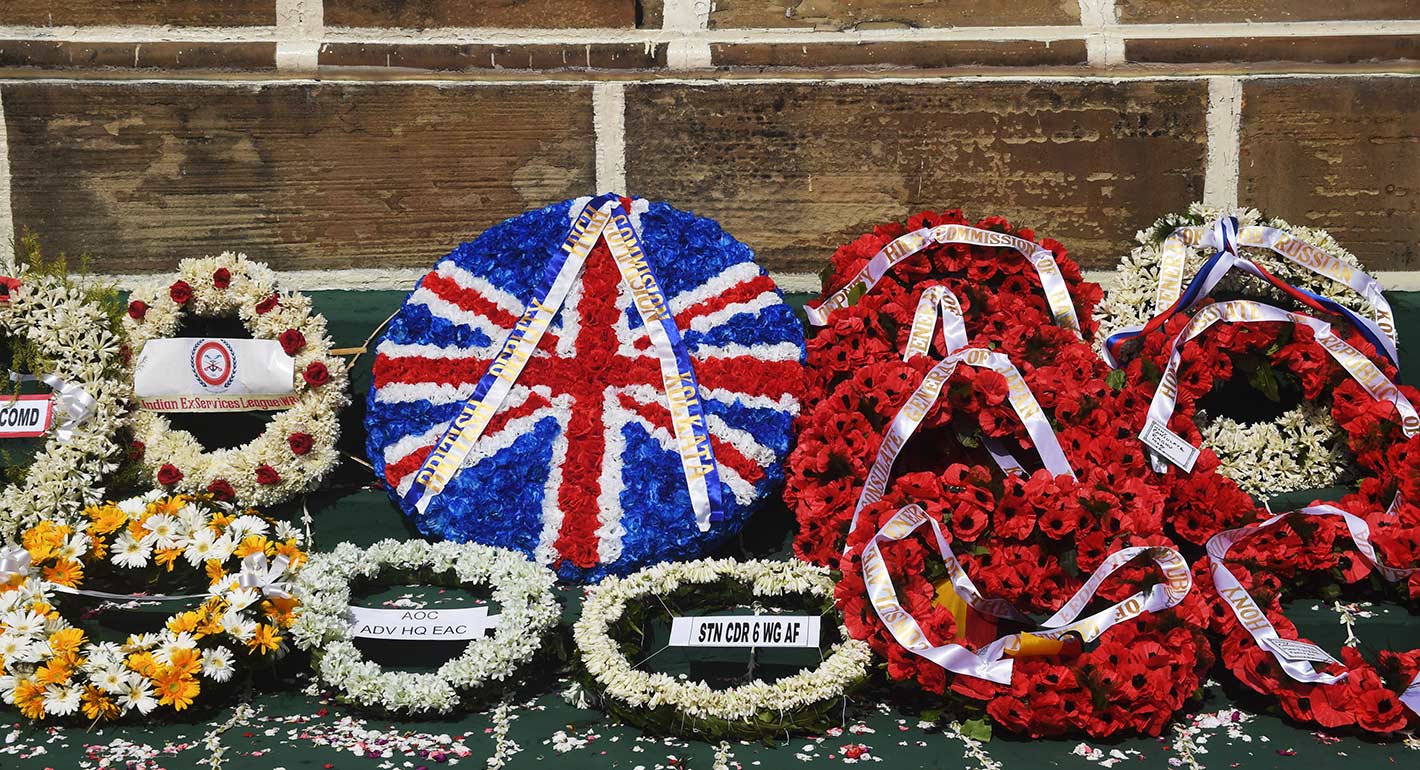
One of the important ways in which Prime Minister Narendra Modi has altered India’s thinking about international affairs is the long overdue revision of Delhi’s position on the two World Wars. Vice President M Venkaiah Naidu’s participation at the centennial ceremonies to mark the end of World War I completes that change.
One consequence of the new thinking is the wider appreciation of India’s contribution to the making of the modern world. It has also laid the foundation of a new military partnership between India and Europe amidst the current tectonic shifts in global power structure. After Independence, Delhi was reluctant to acknowledge India’s role in the two wars. During World War I, nearly 1.2 million Indians were recruited for service in the army. When it ended, about 9,50,000 Indian troops were serving overseas. Nearly 75,000 Indian soldiers were killed in what came to be known as the Great War.
In World War II, the Indian army saw action on fronts ranging from Italy and North Africa to East Africa, the Middle East and the Far East. In Southeast Asia alone, 7,00,000 troops joined the effort to oust Japanese armies from Burma, Malaya and Indo-China. By the time the war ended, the Indian army numbered 2.5 million men, the largest all-volunteer force the world had ever seen.
To cut a long and complicated story short, Delhi’s argument after Independence was that the contributions were by a colonial army; therefore, independent India should have nothing do with it. India’s political class had no problem in simply re-branding the “colonial” army as the “national” army after Independence. But it was too embarrassed to accept the history of these armed forces. The problem was managed with a compromise — the armed forces would mark their history in the cantonments, but there would be no political participation in these events.
The first break in this deliberate forgetting of India’s role in the two World Wars came under the UPA government when Prime Minister Manmohan Singh was the guest of honour in France’s Bastille Day celebrations in July 2009. The then French president, Nicolas Sarkozy, was eager to celebrate the new strategic partnership with India by reminding his nation of the Indian role in defending France in the First World War.
A contingent of 400 Indian troops marched down Champs Elysees but it did not result in changing the way Delhi thought about the two World Wars. Then came Modi’s visit to Paris in the spring of 2015. He traveled to a war memorial in northern France and paid respects to the Indian soldiers. Addressing the Indian diaspora in Paris, the PM wove a broader narrative around the Indian contributions to international peace and security through the 20th century — in the two World Wars as well as the international peace keeping operations in the post-War world. Three months later, a unit of the Indian army joined the Victory Day parade in Moscow to mark the 70th anniversary of the German surrender in the Second World War.
When he traveled to Israel in 2017, Modi marked the role of the Indian army in liberating Haifa and during Prime Minister Benjamin Netanyahu’s trip to India in January 2018, the Teen Murti Chowk in Central Delhi was renamed as Teen Murti-Haifa Chowk. The three figures in the chowk represented the cavalry regiments from Mysore, Hyderabad and Jodhpur who participated in the Haifa operations in 1918.
To be sure, the two World Wars were politically contentious for the Indian national movement. But a century after the conclusion of the First World War and nearly 80 years after the beginning of the Second, it’s about time India came to terms with the complex history of its role in the two world wars.
Mahatma Gandhi, for example, volunteered to join the Indian Army during First World War. But a group of radical nationalists, led by Raja Mahendra Pratap and Maulana Barkatullah set up a provisional government in Kabul in December 1915 with the help of Germany, Britain’s rival in the Great War.
The divisions were much sharper in the Second World War. The Congress refused to support the War, the communist left joined the war effort after initial opposition, and Subhas Chandra Bose set up the Azad Hind government in exile with the help of the axis powers. These divisions reflected the difficult choices the national movement confronted at the intersection of the anti-colonial struggle and the great power conflict. To add to the complexity, there was the question of rising Fascism and how the Indian national movement should think about it in the inter-war period.
Like the rival European powers who now jointly commemorate the Wars, it is sensible for India to recall and reflect on its role on both sides of the great divide. That is what Modi has done in the last few years. When he addressed the Afghan parliament in December 2015, Modi thanked Kabul for its support to Raja Pratap’s government. Last month he joined ceremonies to mark the 75th anniversary of the founding of Subhas Bose’s Indian National Army. If there is one thing that Modi has missed out it is to invoke the contribution of the rest of South Asia to the two Wars.
As we reflect on the two Wars, one thing stands out: Indian resources were critical in shaping the final outcomes. Ending India’s amnesia about the two Wars must now be followed by a more purposeful engagement with Europe in reordering the security architecture of Eurasia and the Indo-Pacific. As America signals potential retrenchment from its alliance commitments to Europe — witness the unbending arguments between Trump’s emphasis on “America First” and the European drift towards “strategic autonomy” — India and Europe will need each other again.
France was the first to see the value of a partnership between Delhi and Paris in the Indo-Pacific. Britain, which is breaking from the European Union (EU), wants to reconnect with India bilaterally as well as through the Commonwealth. The EU is about to unveil an India strategy this month that is expected to highlight among other things, collaboration between Delhi and Europe’s emerging security structures. Meanwhile, India’s leading partner in the east, Japan, is eager to draw France, Britain and Germany into the Indo-Pacific.
In the first half of the 20th century, the subcontinent’s colonial armies as well as nationalist forces were inevitably drawn into Europe’s wars. In the 21st century, India, as a coherent independent actor, can and must work with Europe in shaping the global security order.
This article was originally published in the Indian Express.
Former Nonresident Senior Fellow, Carnegie India
A leading analyst of India’s foreign policy, Mohan is also an expert on South Asian security, great-power relations in Asia, and arms control.
Recent Work

C. Raja Mohan, Darshana M. Baruah


Alexander Gabuev, Paul Haenle, C. Raja Mohan, …
Carnegie does not take institutional positions on public policy issues; the views represented herein are those of the author(s) and do not necessarily reflect the views of Carnegie, its staff, or its trustees.

The EU can impose sanctions but struggles to enforce them without the United States. With Washington increasingly disinterested in backing European interests, the bloc must now fend for itself.


Nicu Popescu, Tiago Antunes

Russia is testing the waters of NATO’s mutual defense clause. What do strikes in Romanian territorial waters mean for the alliance’s posture toward Moscow?

Dimitar Bechev

With its public finances in shambles, the far right polling at 35 percent ahead of the 2027 presidential election, and a growing protest movement, is France’s crisis a threat to the EU’s geopolitical awakening?

Rym Momtaz, ed.

Ahead of a tough winter for Ukraine, Donald Trump’s swing back toward Russia bodes ill. But instead of panicking, Kyiv’s European allies are focusing on action.
Rym Momtaz

Funding Ukraine remains a priority for European leaders. As Russia’s war of aggression heads into another winter, two feasible options to mobilize support for Kyiv should be fast-tracked.


Vladyslav Rashkovan, Gregory P. Wilson