

Research
- +10
Jarrett Blanc, Thomas de Waal, Karim Sadjadpour, …
{
  "authors": [
    "Jarrett Blanc"
  ],
  "type": "commentary",
  "centerAffiliationAll": "dc",
  "centers": [
    "Carnegie Endowment for International Peace",
    "Malcolm H. Kerr Carnegie Middle East Center"
  ],
  "collections": [
    "Iranian Proliferation"
  ],
  "englishNewsletterAll": "americanStatecraft",
  "nonEnglishNewsletterAll": "",
  "primaryCenter": "Carnegie Endowment for International Peace",
  "programAffiliation": "ASP",
  "programs": [
    "American Statecraft"
  ],
  "projects": [],
  "regions": [
    "North America",
    "United States",
    "Middle East",
    "Iran"
  ],
  "topics": [
    "Political Reform",
    "Economy",
    "Foreign Policy",
    "Nuclear Policy"
  ]
}
Source: Getty
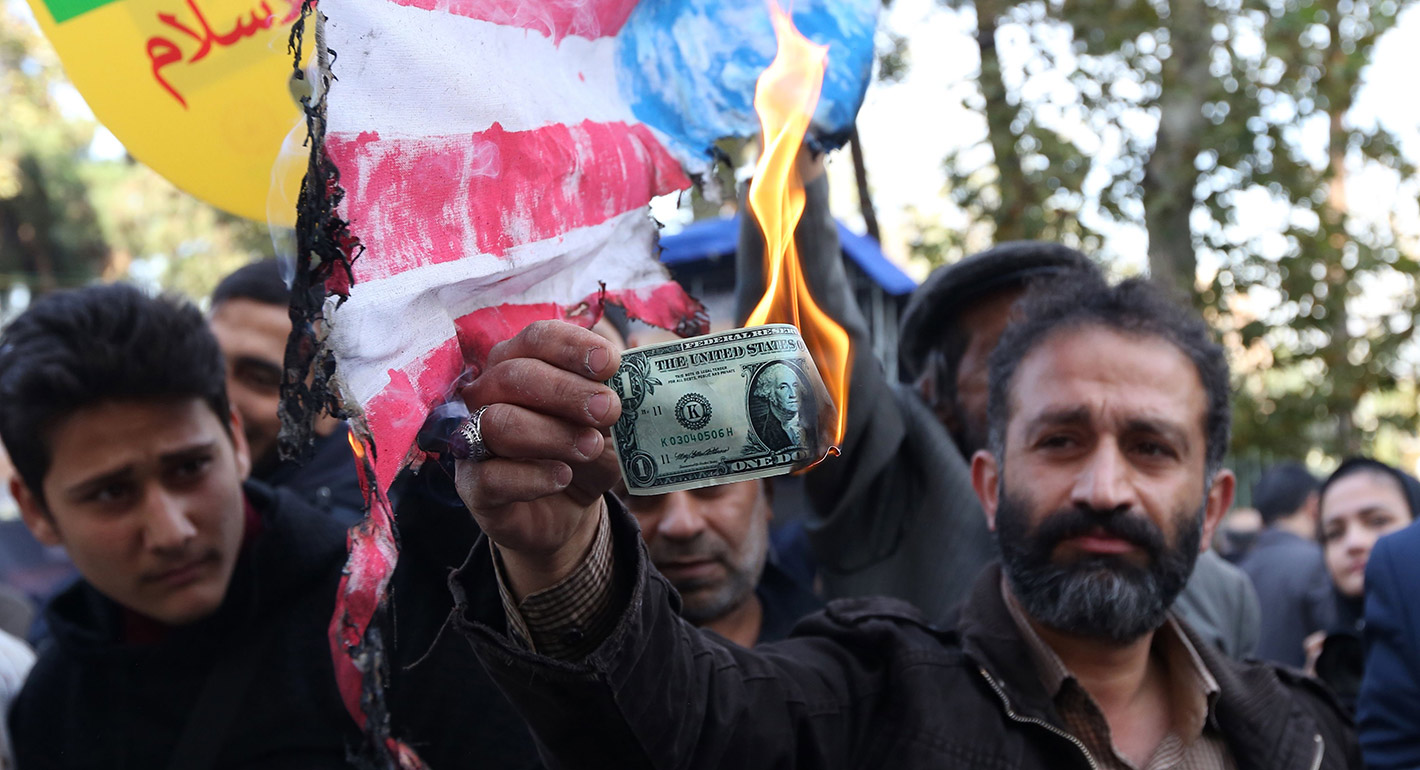
Reimposed U.S. sanctions on Iran are short on details and risk leaving U.S. partners uncertain about Washington’s intentions.
On November 5, 2018, the United States is taking another step toward withdrawing from the Iran nuclear deal by re-imposing sanctions on non-American companies doing business with Tehran. Secretary of State Mike Pompeo and Secretary of the Treasury Steven Mnuchin have made a number of announcements over the last week to clarify these sanctions, but many important questions remain outstanding.
First, the administration announced sanctions waivers for eight countries that are continuing to buy oil products from Iran. This list includes Iran’s two largest customers, mainland China and India, as well as Greece, Italy, Japan, South Korea, Taiwan, and Turkey. Technically called “significant reduction exceptions,” these waivers are premised on the idea that the recipient countries already have or will reduce their oil purchases from Iran. However, the administration has not announced any details about its agreements with each country. Apparently, recipient countries have been asked not to share the details either.
One reason for secrecy might be that the administration does not have much to report regarding China. It would be very unusual for Beijing to make any kind of formal agreement with Washington in this area. Under former president Barack Obama, China reduced its purchases but was always careful neither to negotiate the details with the United States, nor to credit U.S. sanctions pressure for these decisions. Have China’s leaders changed course? If so, how much have they agreed to reduce their purchases, and how will they handle payments to Iran? Will the payments go into escrowed accounts for non-sanctionable purchases, as Pompeo has suggested, or will they be available for general Iranian trade?
Without answers to these questions, it is impossible to assess how tightly the renewed sanctions will ramp up the macroeconomic pressure on Iran.
Other questions relate to whether or not the United States is taking allies’ and partners’ concerns and interests seriously. The European Union is trying to create alternative financial institutions to facilitate trade with Iran, but Brussels is encountering difficulties. With enough political motivation, though, these obstacles can be overcome, an outcome that would reduce global dependence on the U.S. banking system with dangerous political and economic consequences for the United States.
Second, how were these waiver decisions made? In particular, why were Greece, Italy, and Turkey the only European countries granted waivers? Is it just a coincidence that the two EU member states have Eurosceptic governments? What about Iraq, which relies on Iranian natural gas for electricity production and, therefore, political stability?
Without more transparency, U.S. allies and partners will wonder if Washington is acting without regard to their interests, and they made conclude that U.S. sanctions power needs to be countered.
Third, how will humanitarian and other non-sanctioned trade with Iran be facilitated? Tehran depends on food and medical imports, but Western banks are increasingly reluctant to handle even these legal transactions.
The U.S. position, as stated in a November 2 press briefing, is that “the burden is not on the United States to identify the safe channels. The burden is on the Iranian regime to create a financial system that complies with international banking standards.”
But this expectation is unrealistic. In particular, the recent U.S. designation of Iran’s Parsian Bank as a specially designated global terrorist complicates these allowable transactions. The bank handled a substantial amount of humanitarian trade for European counterparties, so effectively removing them from commerce is complicated. More importantly, Parsian’s designation is based on a link to another designated entity, the Basij militia, removed by several degrees of separation. European banks now worry that they cannot meet unrealistic due diligence requirements, and they will likely decide not to handle any Iran transactions even if they are exempted.
Unless the Treasury Department makes it clear that practical and accessible channels for humanitarian trade exist, Washington’s allies and partners are likely to believe the real U.S. goal is to create domestic chaos in Iran so as to prompt regime change. For the sake of stability, Europe and other actors will be further incentivized to counter U.S. sanctions policy by creating an alternative to the U.S. financial system.
Fourth, what waivers will be granted for nuclear nonproliferation projects? The nuclear deal has provisions for international cooperation on nuclear projects in Iran that are designed to limit proliferation risks. Iran’s nuclear agencies and firms are again being sanctioned as of today, but they can be excepted for specified projects. Pompeo said that there would be three waivers. Yet he did not provide any details about the reconstruction of the Arak heavy water reactor so that it cannot produce plutonium for nuclear weapons, an effort led by China and the UK. Nor did he clarify the status of attempts to convert the former enrichment facility at Fordow into an international physics research facility. This lack of clarity suggests a complication. The only project that merited a specific mention was the Russian-led expansion of Iran’s Bushehr power reactor (which is the only project that is commercially important for Moscow).
The bottom line is this: U.S. allies and partners are more likely to defy U.S. sanctions policy by creating alternatives to the U.S. financial sector if they believe that Washington is acting haphazardly. By eschewing transparency, discarding clear nonproliferation accomplishments, and generally disregarding the interests of key allies, the United States risks much for little clear gain with its new Iranian sanctions policy.
Former Senior Fellow, Geoeconomics and Strategy Program
Jarrett Blanc was a senior fellow in the Geoeconomics and Strategy Program at the Carnegie Endowment for International Peace.
Recent Work


Jarrett Blanc, Thomas de Waal, Karim Sadjadpour, …

Dan Baer, Rosa Balfour, Jarrett Blanc, …
Carnegie does not take institutional positions on public policy issues; the views represented herein are those of the author(s) and do not necessarily reflect the views of Carnegie, its staff, or its trustees.

The EU can impose sanctions but struggles to enforce them without the United States. With Washington increasingly disinterested in backing European interests, the bloc must now fend for itself.


Nicu Popescu, Tiago Antunes

Russia is testing the waters of NATO’s mutual defense clause. What do strikes in Romanian territorial waters mean for the alliance’s posture toward Moscow?

Dimitar Bechev

With its public finances in shambles, the far right polling at 35 percent ahead of the 2027 presidential election, and a growing protest movement, is France’s crisis a threat to the EU’s geopolitical awakening?

Rym Momtaz, ed.

Ahead of a tough winter for Ukraine, Donald Trump’s swing back toward Russia bodes ill. But instead of panicking, Kyiv’s European allies are focusing on action.
Rym Momtaz

Funding Ukraine remains a priority for European leaders. As Russia’s war of aggression heads into another winter, two feasible options to mobilize support for Kyiv should be fast-tracked.


Vladyslav Rashkovan, Gregory P. Wilson