

Article
Steve Feldstein, Jodi Vittori
{
  "authors": [
    "Jodi Vittori"
  ],
  "type": "commentary",
  "centerAffiliationAll": "dc",
  "centers": [
    "Carnegie Endowment for International Peace"
  ],
  "collections": [
    "Violence and Conflict"
  ],
  "englishNewsletterAll": "democracy",
  "nonEnglishNewsletterAll": "",
  "primaryCenter": "Carnegie Endowment for International Peace",
  "programAffiliation": "DCG",
  "programs": [
    "Democracy, Conflict, and Governance"
  ],
  "projects": [],
  "regions": [
    "North America",
    "United States",
    "Middle East",
    "Saudi Arabia",
    "United Arab Emirates"
  ],
  "topics": [
    "Security",
    "Military",
    "Foreign Policy"
  ]
}
Source: Getty
It is crucial that the United States and other arms exporting nations conduct additional due diligence and controls on any exports to Saudi Arabia and the United Arab Emirates.
Earlier this month, a CNN investigation provided further evidence that U.S. military equipment has been transferred from Saudi Arabia and the United Arab Emirates (UAE) to a variety of militias, including some linked to al-Qaeda. Given the additional scrutiny of U.S.-Saudi relations since the murder of journalist Jamal Khashoggi, recent U.S. Senate and House resolutions on arms sales to Saudi Arabia, and ongoing Saudi and Emirati tensions with neighbor Qatar, now is the time for a full-scale review of U.S. arms sales to the Gulf region.
There are clear rules against arms transfers to third parties. There are also end-use monitoring requirements for U.S. arms exports, but these checks are hardly universal. Given that at least some of the equipment found in militia hands can be tied to U.S. arms sales, the Department of Defense, State Department, and Commerce Department are clearly not adequately monitoring sales. (Which U.S. agency is responsible for end-use checks depends on the type of sale conducted.)
The United States is the largest arms supplier to Saudi Arabia and the UAE, two lucrative customers of the U.S. defense industry. Saudi Arabia was the largest importer of U.S. arms, having purchased $112 billion in weapons from 2013 through 2017. The UAE was the second-largest importer of U.S. arms in the same time span. Since 2009, over $27 billion in weapons have been offered to the UAE in thirty-two separate deals under the Pentagon’s Foreign Military Sales program.
These arms sales continue, despite both countries’ history of diverting arms to favored militias. Saudi Arabia has been purchasing weapons from third parties to pass on to allied governments and groups at least since the 1970s, sometimes on behalf of the U.S. government. Transparency International’s Government Defense Anti-Corruption Index ranks Saudi Arabia and the UAE in its high-risk category for corruption, with Saudi Arabia receiving a score of zero out of four (zero being the worst) and the UAE receiving a score of one for lacking a well-scrutinized process for arms export decisions that aligns with international protocols.
The CNN investigation comes as Congress ramps up its opposition to U.S. support for the Saudi-led coalition. Former U.S. president Barack Obama’s administration only reluctantly agreed to support the Saudi-led coalition as it went on the offense in 2015, seeing it as an unwinnable proxy war against Iran. Obama had put restrictions on arms sales and intelligence cooperation with the coalition in 2016, but President Donald Trump’s administration lifted those restrictions in March 2017, just prior to Trump’s overseas visit to Saudi Arabia.
Saudi human rights abuses in Yemen using U.S. weapons, such as the airstrike on a school bus in August 2018 that killed forty children, and the murder of Khashoggi have shocked the U.S. public and Congress. In the National Defense Authorization Act for Fiscal Year 2018, Congress required the departments of Defense and State to certify that the Saudi-led coalition was doing all it could to prevent civilian casualties; the State Department failed to provide that justification when it was due earlier this month. In December, the Senate approved a measure to end arms shipments to Saudi Arabia, despite the Trump administration’s strong opposition to the bill. The measure did not have enough votes to override a presidential veto, but senators have promised to introduce an even tougher bill in 2019. Last week, the House also passed a measure to end U.S. assistance to the Saudi-led coalition in Yemen, but again without enough votes to override an expected presidential veto.
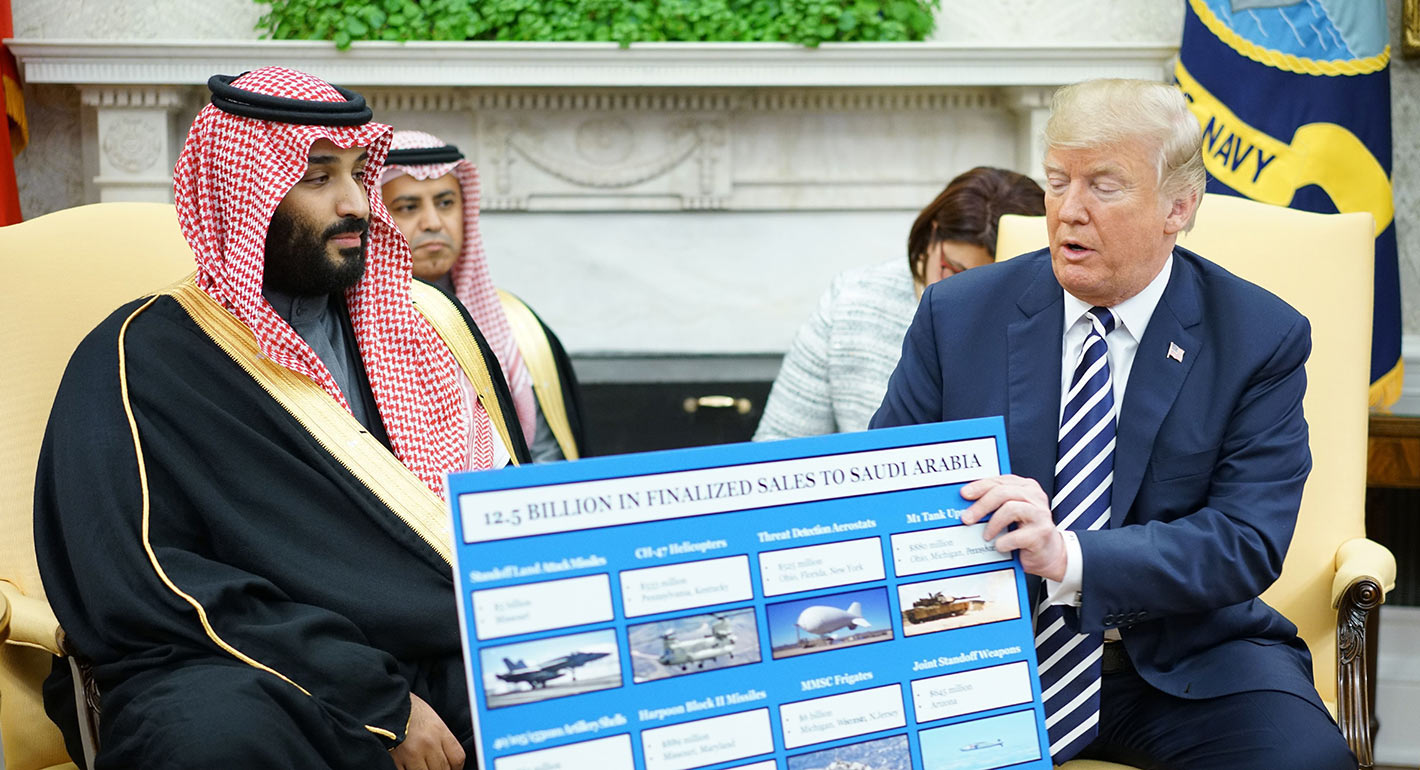
The Trump administration continues to approve arms shipments to the Saudi coalition. In 2018 alone, the United States directly sold $4.4 billion in arms to Saudi Arabia, and the administration approved the latest sale of Patriot missile upgrades in December. Tens of billions of dollars in deals with Saudi Arabia remain in the pipeline as well, awaiting approvals as part of the controversial, alleged May 2017 $110 billion arms deal with Saudi Arabia. The Trump administration has shown little inclination to loosen its close ties with Saudi Arabia and the UAE despite the death of Khashoggi or the conduct of the war in Yemen.
The monarchs of Saudi Arabia and the UAE can conduct these proxy operations and divert equipment with no oversight and almost no input from their own citizens. Both countries are absolute monarchies, and their legislative bodies are advisory and contain only regime-approved members. Both countries also stamp out any free press and most independent civil society. Information on defense policies, including the war in Yemen, is kept secret by the monarchs and their inner circles.
Most available information on Saudi and Emirati coalition operations and weapons transfers comes from external parties, such as U.S. government weapons sales notifications, news organizations, and human rights organizations. Given the lack of effective Saudi and Emirati citizen or parliamentary oversight on the conduct of the war in Yemen and associated weapons transfers, it is crucial that the United States and other arms-exporting nations conduct additional due diligence and put controls on any exports to Saudi Arabia and the UAE. The CNN investigation demonstrates that the stringent due diligence and accountability that should be required for such sales has not been conducted. As the Trump administration continues to approve arms sales, an emboldened Congress inches ever closer—often across partisan lines—to cutting off those very same sales.
Former Nonresident Scholar, Democracy, Conflict, and Governance Program
Jodi Vittori was a nonresident scholar in the Democracy, Conflict, and Governance Program. She is an expert on the linkages of corruption, state fragility, illicit finance, and U.S. national security.
Recent Work

Steve Feldstein, Jodi Vittori
Lakshmi Kumar, David Szakonyi, Clare Rewcastle Brown, …
Carnegie does not take institutional positions on public policy issues; the views represented herein are those of the author(s) and do not necessarily reflect the views of Carnegie, its staff, or its trustees.

The EU can impose sanctions but struggles to enforce them without the United States. With Washington increasingly disinterested in backing European interests, the bloc must now fend for itself.


Nicu Popescu, Tiago Antunes

Russia is testing the waters of NATO’s mutual defense clause. What do strikes in Romanian territorial waters mean for the alliance’s posture toward Moscow?

Dimitar Bechev

With its public finances in shambles, the far right polling at 35 percent ahead of the 2027 presidential election, and a growing protest movement, is France’s crisis a threat to the EU’s geopolitical awakening?

Rym Momtaz, ed.

Ahead of a tough winter for Ukraine, Donald Trump’s swing back toward Russia bodes ill. But instead of panicking, Kyiv’s European allies are focusing on action.
Rym Momtaz

Funding Ukraine remains a priority for European leaders. As Russia’s war of aggression heads into another winter, two feasible options to mobilize support for Kyiv should be fast-tracked.


Vladyslav Rashkovan, Gregory P. Wilson