

Paper
Ashley J. Tellis
{
  "authors": [
    "Ashley J. Tellis"
  ],
  "type": "legacyinthemedia",
  "centerAffiliationAll": "dc",
  "centers": [
    "Carnegie Endowment for International Peace"
  ],
  "collections": [],
  "englishNewsletterAll": "ctw",
  "nonEnglishNewsletterAll": "",
  "primaryCenter": "Carnegie Endowment for International Peace",
  "programAffiliation": "SAP",
  "programs": [
    "South Asia"
  ],
  "projects": [],
  "regions": [
    "South Asia",
    "India",
    "Afghanistan",
    "Pakistan",
    "East Asia"
  ],
  "topics": [
    "Security",
    "Military",
    "Foreign Policy"
  ]
}
Source: Getty
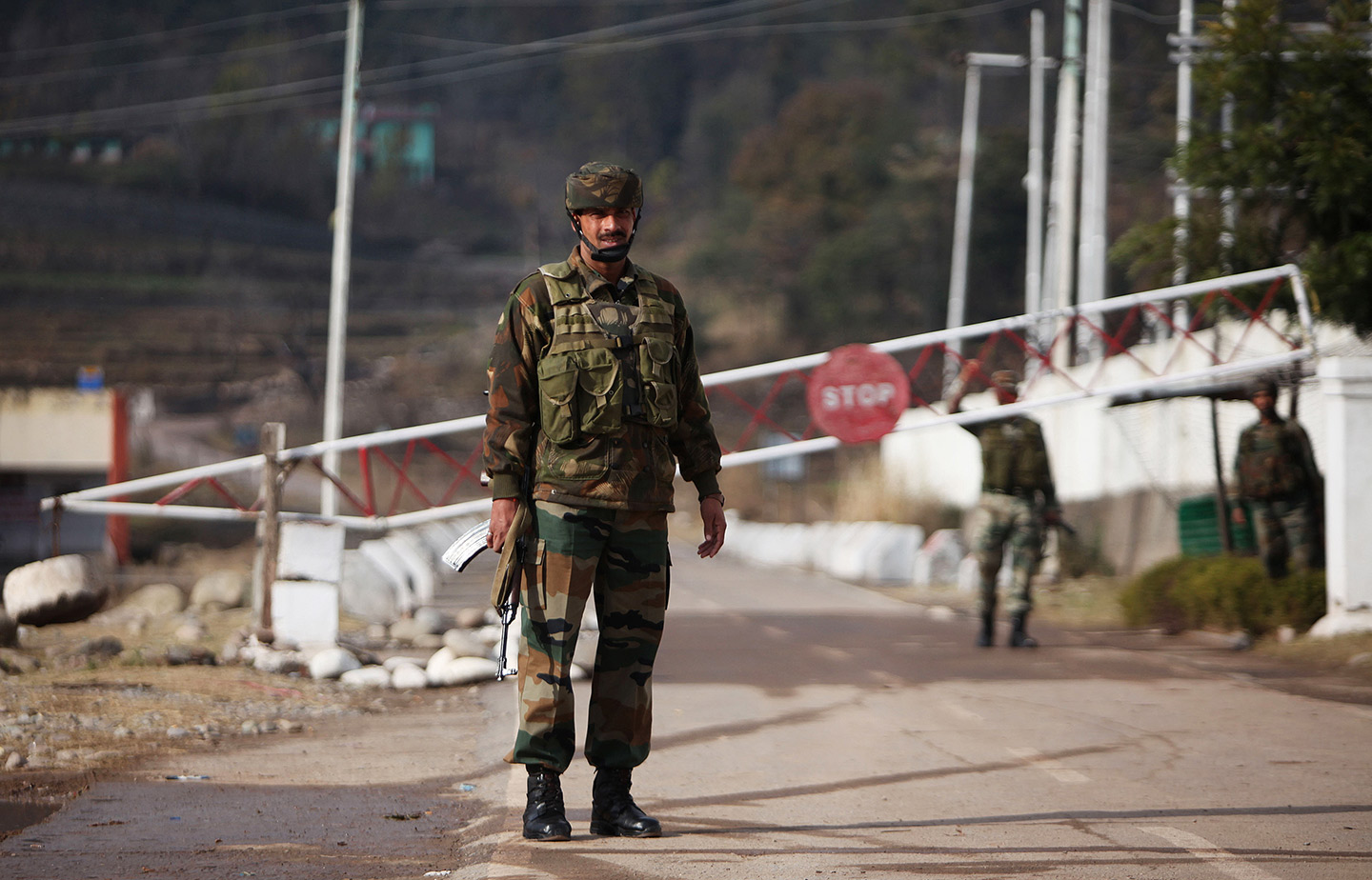
India must recognize that any response to the attack at Pulwama can at best mitigate—not eliminate—Pakistani terrorism. But India can do much more to equip and protect its security forces.
Source: Economic Times
The February 14 vehicle bomb attack perpetrated by the Jaish-e-Mohammed (JeM) at Pulwama, Jammu & Kashmir, tragically confirmed yet again that India remains a persistent target of terrorism. The details pertaining to the bombing and its linkages to Rawalpindi will occupy India’s intelligence agencies for some time to come.
In the interim, the public clamor for retribution persists, with Prime Minister Narendra Modi promising to avenge “each drop of tear shed” due to the atrocity. Simultaneously, Indians of all stripes are once more engaged in a national discussion about what could have been done to prevent such an attack from occurring.
India has arguably run through much of the playbook already. It has engaged in dialogue with Pakistan at times, abstained from engagement at others. It has punished Pakistan through military instruments, but has also offered olive branches. It has sought international intervention in restraining Pakistan with as much zeal as it has discouraged unwanted external meddling in subcontinental affairs. Hence, it is not surprising that many Indians often plaintively ask what more can be done to stop Pakistani terrorism.
Irrespective of how Indian responses to the Pulwama attack finally play out, New Delhi cannot escape three painful realities.
First, even if a solution to the vexed problem of Kashmir were found, Pakistan is unlikely to give up on jihadi terrorism against India. The Pakistani Army’s grievances are, by now, too deeply rooted for Rawalpindi to forego its most effective instrument for bleeding India. The army’s animus is driven by its abiding desire to avenge the humiliation of 1971, a geopolitical imperative to weaken its ascending neighbor, and an undying obsession with wresting Kashmir away from Indian control.
Even if it fails to achieve these goals, jihadi terrorism remains the perfect instrument for continuously coercing India. It provides the “deep state” in Pakistan with plausible deniability. It avoids the major conventional confrontations that Pakistan is certain to lose. And it transforms Pakistan’s nuclear deterrent into a license by which Rawalpindi can needle New Delhi without exposing itself to exorbitant Indian retaliation.
Transforming this Pakistani behavior fundamentally would require India to either engineer its own failure (so as to cease unnerving Pakistan through its strength) or surrender to Pakistani extortion over Jammu and Kashmir. Because neither outcome is plausible—and the prospect of a civilian government in Pakistan truly controlling the deep state is a pipedream—India has to accept that Pakistan’s efforts at strategic coercion through terrorism will persist well into the future.
Pakistan may occasionally change tactics: it may sporadically restrain its proxies to permit the realization of certain ends, such as encouraging bilateral negotiations or demonstrating Pakistan’s credentials as a responsible state. But such pauses will always be ephemeral, because the overriding objective remains perpetual resistance to India. And there is no better instrument of defiance today than terrorism by proxy.
Second, the international community will sympathize with India’s plight, but it cannot neuter Pakistan’s exploitation of terrorism. Whatever Pakistan’s weaknesses may be, it is strong enough to resist any international pressures that might ordinarily materialize. The only exception to this rule is if Pakistan’s proxies attack the homelands of the major powers, especially the United States and China. Not surprisingly, then, Rawalpindi has been extraordinarily careful in ensuring that its wards abstain from infuriating these nations in particular.
India, in contrast, is fair game: it is not only weaker than the great powers but Pakistan can also resist quotidian Indian coercion without significant pain. The historical record clearly bears out the fecklessness of international pressure on Pakistan.
After 9/11, Washington blew the one opportunity it had to compel Pakistan towards genuine reform. Instead it ended up turning a Nelson’s eye towards Pakistan’s preservation of its anti-India proxies as the price of its cooperation against Al Qaeda. An opportunity of this sort has never materialized again.
Expecting China to enjoin Pakistan to eschew terrorism against India is laughable. Whatever the Wuhan spirit may be, it does not extend to squeezing all-weather friends against strategic rivals.
Consequently, persuading the international community to press Pakistan on terrorism is something that India does because there are few other good solutions. But expecting that to produce a reformed Pakistan would be expecting too much, and is not worth undue investment.
Third, India must recognize that Pakistani terrorism can at best be mitigated—not eliminated—in the absence of a fundamental transformation within Pakistan. Mitigation may occasionally require punitive military or covert action but, even when these are tactically successful, their larger effects are rarely enduring.
Even targeting of terrorist leaders rarely produces permanent benefits. Not only would they require repeated applications of force inside Pakistan, they would also open the door to destabilizing retaliations inside India with consequences that could spiral out of control.
Without foregoing punitive options therefore, New Delhi must continually invest in increasing its national resilience. Admittedly, this is easier said than done, and Indian leaders have made significant improvements in internal security since the attack on Parliament in 2001. But truth be told, the Indian defense forces, including the army units manning the Line of Control (LoC) and those internal security components deployed in Jammu and Kashmir, are woefully underequipped and often lack even the most rudimentary technologies now available to combat terrorism.
The failure of Indian policymakers to invest in these capabilities is indeed unconscionable. Beyond the technological and operational lacunae of the Indian security forces, which have been widely highlighted, the political dimension of Indian failures in managing the situation in Jammu and Kashmir is far more consequential.
Recent Indian counter-terrorism activities have inflicted significant damage on terrorist cadres and their local leadership in the Valley. But these tactical gains have been undermined by the persistent alienation of its population—which then provides Pakistan with plentiful opportunities for meddling.
In any event, even if New Delhi did everything right operationally and politically, it must brace itself for persistent Pakistani terrorism and its occasionally devastating success. Indian policymakers, consequently, have to be honest both to themselves and their citizenry about the inevitable consequences of living in a bad neighborhood. They do the body politic no favor by pretending that discrete retribution, no matter how immediately satisfying or effective, will suffice to permanently deter Pakistani terrorism.
While the Indian government contemplates its response to Pulwama, it is worth remembering that any actions that reinstate the hyphenation of India and Pakistan in international consciousness, undermine the laborious progress made in Indian nation-building over the decades, and divert New Delhi from sustained economic growth, would be far more corrosive for India’s fortunes than any toll exacted by Pakistani terrorism. Such an outcome would tragically fulfill the deep state’s reprobate yearnings and provide it with a victory that it could never achieve through its own pernicious efforts.
Former Senior Fellow
Ashley J. Tellis was a senior fellow at the Carnegie Endowment for International Peace.
Recent Work
Ashley J. Tellis
Ashley J. Tellis
Carnegie does not take institutional positions on public policy issues; the views represented herein are those of the author(s) and do not necessarily reflect the views of Carnegie, its staff, or its trustees.

Ahead of a tough winter for Ukraine, Donald Trump’s swing back toward Russia bodes ill. But instead of panicking, Kyiv’s European allies are focusing on action.

Rym Momtaz

Funding Ukraine remains a priority for European leaders. As Russia’s war of aggression heads into another winter, two feasible options to mobilize support for Kyiv should be fast-tracked.


Vladyslav Rashkovan, Gregory P. Wilson

While the EU and European governments are embracing the much-lauded middle-power moment, this entails three difficult conundrums.

Richard Youngs

Europe is facing rising populism internally as well as external pressures from Russia, China, Turkey, and the United States.

Dimitar Bechev

Much has been said of the changes Brussels is trying to make to the EU enlargement process. Here’s why gradual integration might—or might not—be the answer.
Dimitar Bechev