

Commentary
Russia is testing the waters of NATO’s mutual defense clause. What do strikes in Romanian territorial waters mean for the alliance’s posture toward Moscow?
Dimitar Bechev
{
  "authors": [
    "Rhea Menon",
    "Sharanya Rajiv"
  ],
  "type": "other",
  "centerAffiliationAll": "",
  "centers": [
    "Carnegie Endowment for International Peace",
    "Carnegie India"
  ],
  "collections": [],
  "englishNewsletterAll": "",
  "nonEnglishNewsletterAll": "",
  "primaryCenter": "Carnegie India",
  "programAffiliation": "",
  "programs": [],
  "projects": [
    "Security Studies"
  ],
  "regions": [
    "Asia",
    "India",
    "Russia",
    "China"
  ],
  "topics": [
    "Foreign Policy"
  ]
}
Source: Getty
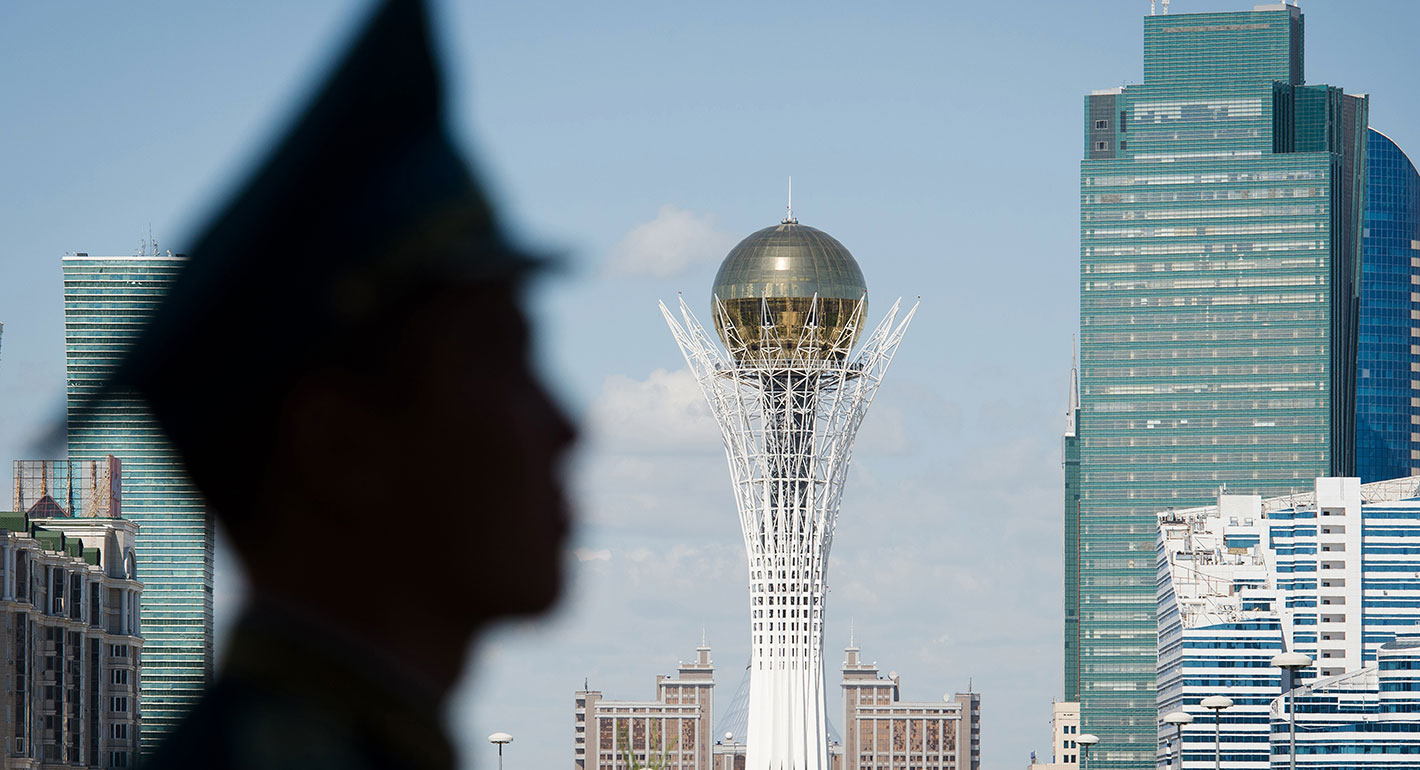
The rise of China as an economic powerhouse in Asia, along with rapid globalization, has brought Central Asia back in the limelight as a bridge connecting the established markets of the West with the emerging markets of the East.
Source: Seminar
ONCE the epicentre of global trade, culture, and politics, Central Asia – composed of Kazakhstan, Kyrgyzstan, Uzbekistan, Tajikistan, and Turkmenistan – found itself isolated following the dissolution of the ancient Silk Road. However, in recent years, external powers have stepped up efforts to develop overland connectivity – from China’s Belt and Road Initiative to the European Union’s Connecting Europe and Asia Strategy 2018 as well as India’s renewed push for the International North-South Transport Corridor (INSTC), in partnership with Russia and Iran.
Located at the juncture between these initiatives, international interest in the region also focuses on its unrealized economic potential as well as security threats. The first draws from its vast natural resource wealth, particularly hydrocarbons and minerals, and demographic dividend, which could just as easily present challenges. The second relates to fears, within the region and among its neighbours, regarding Central Asia’s possible role as a conduit for instability, Islamist extremism, and illicit trade.
While Russia’s traditional dominance in the region has been enduring, the growing involvement of external powers presents it with difficulties. Russia’s direct control over the region lasted from the Tsarist conquest of Central Asia in the nineteenth century to the collapse of the Soviet Union in 1991, which resulted in the region’s independence. Since then Russian influence – political, military, and economic – in the region has been challenged twice. The first was when the US established military bases in the region to support its forces in Afghanistan, but this chapter came to a close with the US closing the last base in 2014. This was a result of America’s appetite for the Afghan war declining and the region aligning itself with Russia and China, the latter of which has now emerged as the second challenger.
The rise of China as an economic powerhouse in Asia, along with rapid globalization, has brought Central Asia back in the limelight as a bridge connecting the established markets of the West with the emerging markets of the East. On 7 September 2013, Chinese President Xi Jinping announced his ambitious project of rebuilding the Silk Road. With roots in the historic Silk Road, ‘Xi Jinping proposed that in order to make the economic ties closer, mutual cooperation deeper and space of development broader between the Eurasian countries, we can innovate the mode of cooperation and jointly build the “Silk Road Economic Belt” step by step to gradually form overall regional cooperation.’1 This announcement in Kazakhstan heralded the onset of China’s Belt and Road Initiative (BRI). While this strategy includes various continental and maritime corridors, the strategic and economic importance of Central Asia in this project is undeniable.
Since the announcement of the BRI, Chinese investment in the region has been multi-layered. This has not only been limited to infrastructure projects, but also encompasses import substitution and digital connectivity. Beyond economic development, China is increasingly willing to adopt the role of a net security provider in the region.
As India continues to expand its foreign policy outreach, and is in the process of moving beyond its role as a South Asian power, Central Asia is the perfect avenue for India to take the lead with regard to development in the region. In 2018, Prime Minister Modi’s visit to Kazakhstan, Kyrgyzstan, Uzbekistan, Turkmenistan and Tajikistan marked India’s renewed interest in the region. Similarly, the introduction of India to the Shanghai Cooperation Organization (SCO) as well as the semi-operationalization of the INSTC, provide the impetus for both sides to work together. Reflecting a new coherent approach toward the region, both sides also held the first ever ‘India-Central Asia Dialogue’ earlier this year. These strides move beyond bilateral engagements to include a multilateral framework for strategic and economic cooperation.
Geography places Central Asia at the crossroads of these initiatives. To ensure their viability, given the region’s critical role, the republics must build on recent efforts – especially as Uzbekistan has been appointed Secretary General of the SCO – to resolve intra-regional disputes, and minimize physical and institutional barriers to integration in the region.
With contributors from various Central Asian nations and beyond, this issue of Seminar provides a selection of perspectives about the past, present, and future trajectory of Central Asia, and the growing role of external actors, particularly India, China, Russia, and the EU in this evolving and dynamic space.
This article was originally published in the Seminar.
Notes:
1. President Xi Jinping Delivers Important Speech and Proposes to Build a Silk Road Economic Belt with Central Asian Countries, Ministry of Foreign Affairs, China, https://www.fmprc.gov.cn/mfa_eng/topics_665678/xjpfwzysiesgjtfhshzzfh_665686/t1076334.shtml
Rhea Menon
Rhea Menon is a research assistant at Carnegie India.
Sharanya Rajiv
Carnegie does not take institutional positions on public policy issues; the views represented herein are those of the author(s) and do not necessarily reflect the views of Carnegie, its staff, or its trustees.

Russia is testing the waters of NATO’s mutual defense clause. What do strikes in Romanian territorial waters mean for the alliance’s posture toward Moscow?

Dimitar Bechev

With its public finances in shambles, the far right polling at 35 percent ahead of the 2027 presidential election, and a growing protest movement, is France’s crisis a threat to the EU’s geopolitical awakening?

Rym Momtaz, ed.

Ahead of a tough winter for Ukraine, Donald Trump’s swing back toward Russia bodes ill. But instead of panicking, Kyiv’s European allies are focusing on action.
Rym Momtaz

Funding Ukraine remains a priority for European leaders. As Russia’s war of aggression heads into another winter, two feasible options to mobilize support for Kyiv should be fast-tracked.


Vladyslav Rashkovan, Gregory P. Wilson

While the EU and European governments are embracing the much-lauded middle-power moment, this entails three difficult conundrums.

Richard Youngs