

Commentary
Dmitri Trenin
{
  "authors": [
    "Dmitri Trenin"
  ],
  "type": "legacyinthemedia",
  "centerAffiliationAll": "",
  "centers": [
    "Carnegie Endowment for International Peace",
    "Malcolm H. Kerr Carnegie Middle East Center",
    "Carnegie Russia Eurasia Center"
  ],
  "collections": [],
  "englishNewsletterAll": "",
  "nonEnglishNewsletterAll": "",
  "primaryCenter": "Carnegie Russia Eurasia Center",
  "programAffiliation": "",
  "programs": [],
  "projects": [],
  "regions": [
    "Levant",
    "Middle East",
    "Syria",
    "Russia"
  ],
  "topics": [
    "Political Reform",
    "Foreign Policy"
  ]
}
Source: Getty
Russia is back and here to stay. Others had better accept it and learn to deal with it — without undue expectations, but also without inordinate fear.
Source: New York Times
For many in the West, Russia’s return to the world stage over the past few years has come as a surprise, and not an especially pleasant one. After the downfall of the Soviet Union, the country was written off as a regional power, a filling station masquerading as a state.
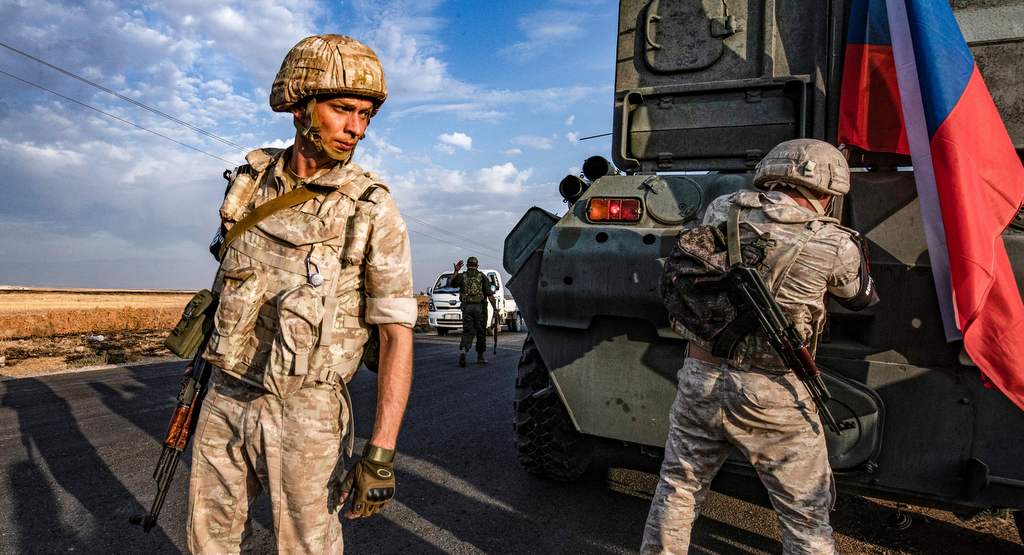
Five years later, however, Russia is still resilient, despite the Western sanctions imposed over its actions in Ukraine. It has effectively won, militarily, in Syria: Today it is a power broker in that country; the victory has raised its prestige in the Middle East and provided material support for Moscow’s claims to be a great power again.
Those who experience this moment with some discomfort should get used to it: Russia is not a superpower, but it is back as an important independent player. And it will be playing in various regions around the world in the years to come.
To the Russians themselves, this feels natural enough. In the 1990s, when the world saw Russia on its back, Russia’s leaders never looked at the country as finished. Rather, they saw its post-Soviet decline and withdrawal from the world scene as only temporary — something that Russia had experienced before and would eventually overcome. The only question was what form it would take.
In the 2000s, Moscow became disillusioned over its desire to become part of the extended Euro-Atlantic community: Its pleas to be treated as an equal by the United States did not impress Washington, and its demands that its national security interests be respected were ignored in the process of NATO enlargement. And so from the early 2010s, the Kremlin started charting a course that was clearly at odds with its earlier policies of Western integration.
With the Russian military intervention in Ukraine in 2014, the breakout from the post-Cold War, Western-dominated order was complete. The takeover of Crimea and support for separatism in Donbass did not presage a policy of reconquering Eastern Europe, as many in the West feared, but it clearly set Ukraine and other former Soviet republics off limits to any future NATO enlargement. The security buffer was back. If the use of force in Ukraine, from the Kremlin’s standpoint, was essentially defensive, Russia’s intervention in Syria in 2015 was a risky gambit to decide geopolitical outcomes in the Middle East — a famously treacherous area for outsiders vacated by the Soviet Union at the time of the Persian Gulf war of 1991. Since then, the results of the military operation and diplomatic maneuvering have not only confounded early critics but also outdone even President Vladimir Putin’s own expectations.
Russia’s achievements in the Middle East go way beyond the success in Syria proper. Moscow benefits from flexible semi-alliances with Turkey and Iran, oil price arrangements with Saudi Arabia and newly revived military ties with Egypt. It is again a player of some consequence in Libya, a power to which many Lebanese look to help them hold their country together, and a would-be security broker between Iran and the Gulf States — all this while maintaining an intimate relationship with Israel.
Today, such a degree of involvement with the Middle East obviously stands out in the Russian foreign policy landscape. Tomorrow, this is unlikely to be an exception. Already for some time, Moscow, in parallel with Washington, has been pursuing a political settlement in Afghanistan. This requires maneuvering between Kabul and the Taliban; Pakistan and India; and China and the United States. Last month, Mr. Putin held court for 43 African leaders in Sochi; it was Russia’s first summit with a continent where Moscow advertises itself above all as a security partner.
The credibility of this claim is supported not only by the Syria experience but also by Russia’s political and material support for Nicholas Maduro in Venezuela, who is still holding on, despite being declared illegal almost a year ago by some 50 nations led by the United States. Cuba, again under pressure by the Trump administration, is strengthening its ties with Russia, as demonstrated by the recent twin visits to Havana by Prime Minister Dmitri Medvedev and to Russia by President Miguel Diaz-Carnel. Besides Latin America’s leftist regimes, Moscow is reaching out to Brazil (a fellow BRICS member), Argentina and Mexico.
If the Middle East record is any guide, Russia’s newly energized foreign policy is not so much about the world order as about Russia’s place in that order. The Soviet Union used to march around the world spending huge resources on a lost ideological cause and an outsize geopolitical ambition. The Russian Federation has learned from this. When it travels abroad, it goes for security buffers as in Ukraine, status as in Syria and mostly money elsewhere. There is no grand design, but a lot of opportunity-seeking, based on the merits of each potential engagement. Russia imposes no models on others and in its present state, hardly serves as a model for anyone.
And there lies the big caveat. Russia is obviously punching above its weight. Its major-power foreign policy is not backed by commensurate economic might. Its former technological prowess has been severely dented. Its ruling elite is too busy chasing money to give enough time to thinking and acting in the national interest. And of course, Russia’s recent foreign policy has had its share of failures and outright blunders.
The choice to weaponize internet technologies to influence other countries’ domestic politics, for instance, has provoked accusations from such important partners as Germany and France but failed to advance Russia’s political goals. Regarding elections interference, Russia, as indeed any other country, would be wise to abstain from sneaking into other nations’ political bedrooms — not because gentlemen don’t do this, but because there is usually no payoff, only a pushback.
Be that as it may, however, Russia is back and here to stay. Others had better accept it and learn to deal with it — without undue expectations, but also without inordinate fear. In the world increasingly dominated by the United States-China rivalry, major independent actors such as Russia could play an important role in averting a costly bipolar confrontation.
Former Director, Carnegie Moscow Center
Trenin was director of the Carnegie Moscow Center from 2008 to early 2022.
Recent Work
Dmitri Trenin
Dmitri Trenin
Carnegie does not take institutional positions on public policy issues; the views represented herein are those of the author(s) and do not necessarily reflect the views of Carnegie, its staff, or its trustees.

Funding Ukraine remains a priority for European leaders. As Russia’s war of aggression heads into another winter, two feasible options to mobilize support for Kyiv should be fast-tracked.


Vladyslav Rashkovan, Gregory P. Wilson

While the EU and European governments are embracing the much-lauded middle-power moment, this entails three difficult conundrums.

Richard Youngs

Europe is facing rising populism internally as well as external pressures from Russia, China, Turkey, and the United States.

Dimitar Bechev

A notable degree of participative democracy has firmly arrived in Europe. But to have more far-reaching impact, democratic deliberation needs to move into a radically new phase.
Richard Youngs

Much has been said of the changes Brussels is trying to make to the EU enlargement process. Here’s why gradual integration might—or might not—be the answer.
Dimitar Bechev