

Paper
Christopher S. Chivvis, Rohan Mukherjee, Milan Vaishnav
{
  "authors": [
    "Milan Vaishnav"
  ],
  "type": "legacyinthemedia",
  "centerAffiliationAll": "",
  "centers": [
    "Carnegie Endowment for International Peace"
  ],
  "collections": [],
  "englishNewsletterAll": "",
  "nonEnglishNewsletterAll": "",
  "primaryCenter": "Carnegie Endowment for International Peace",
  "programAffiliation": "",
  "programs": [],
  "projects": [],
  "regions": [
    "North America",
    "United States",
    "South Asia",
    "India"
  ],
  "topics": [
    "Political Reform",
    "Democracy",
    "Foreign Policy"
  ]
}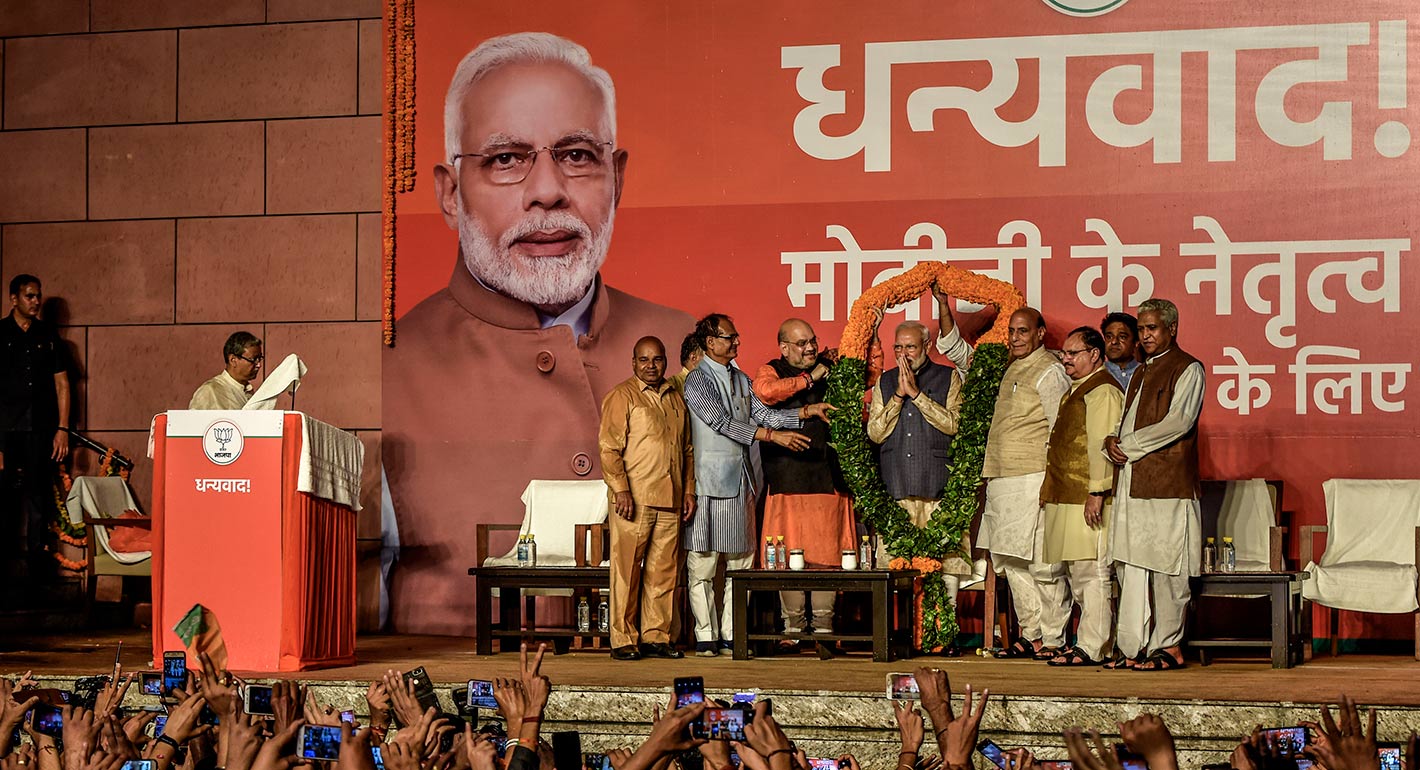
Source: Getty
Modi’s ruling Bharatiya Janata Party has long propagated two core ambitions: building a culturally Hindu-centric nation and aggressively advancing India’s economic development.
Source: Washington Post
The government of Indian Prime Minister Narendra Modi is putting the finishing touches on its annual budget, to be released Feb. 1. In contrast to most other major economies, India’s yearly budget presentation is a grand affair, inspiring wall-to-wall television coverage, special sections in major newspapers and a cornucopia of wonky think tank discussions.
But this year, the heady buzz that typically surrounds the government’s flagship economic statement is missing in action for at least two reasons.
For starters, India is experiencing its most severe economic slowdown in three decades. At last week’s World Economic Forum in Davos, Switzerland, India’s commerce minister assured global economic influencers that India’s economy was “poised to take off.” This rings true only because the vaunted Indian economy appears to be bottoming out, with no place to go but up.
But there is a second, more worrisome reason for the lack of buzz. Modi’s ruling Bharatiya Janata Party has long propagated two core ambitions: building a culturally Hindu-centric nation and aggressively advancing India’s economic development. Since clinching a historic reelection last May, the BJP appears to have prioritized majoritarianism over economic renewal.
India’s present economic woes are multifaceted. The country’s gross domestic product is set to grow at 5 percent in the current fiscal year — its most sluggish pace in 11 years. Growth has slowed to such an extent that the International Monetary Fund has slashed its estimate for global growth based on India’s subpar performance. India’s investment cycle remains moribund, with the number of stalled capital investment projects nearly at a record high. Inflation has spiked to nearly 7.5 percent, fueling concerns of “stagflation” and scuttling hopes that India’s central bank will cut interest rates.
Layered on top of this financing crisis is a consumption slowdown partially precipitated by a an overly complicated new nationwide goods and services tax that has snarled small businesses, resulting in severe revenue shortfalls. The ill-advised 2016 gambit to “demonetize” the economy by invalidating high-denomination currency notes in a quixotic attempt to curb “black money” wreaked further havoc on India’s outsize informal sector. Together, these measures are partly responsible for a decline in household consumption for the first time in 40 years, according to government data.
Last but not least, India’s boom years were associated with a fantastic rise in exports. Today, thanks in part to sagging global trade — punctuated by the U.S.-China trade spat — India has lost the option of exporting its economy back to health.
While these challenges are sizable, they are hardly insurmountable. Yet analysts are pessimistic about a swift recovery not because of India’s economics but its politics. It is clearer now than ever before that the prime minister — who is a gifted orator, savvy marketer and highly effective project manager — does not necessarily espouse a well-articulated macroeconomic worldview.
This is by no means a guarantee of failure; after all, his predecessor Manmohan Singh of the Congress Party was the finance minister during India’s 1991 market opening yet failed to push reforms when he held the top job from 2004 to 2014. However, in the absence of clear direction from the top, no cabinet official with a vision for reform has filled the void or assembled a supporting technocratic cast and detailed blueprint.
And there is an even darker truth behind India’s economic malaise: Reform is simply not at the top of the government’s to-do list.
An Indian bureaucrat I recently spoke with asked me to draw up a list of the government’s top 10 priorities. What I would find, he quipped, is that economic reform comes in at No. 11. Instead, the ruling party appears motivated by its dogged pursuit of core Hindu nationalist objectives. In August, the government unilaterally abrogated a constitutional provision that provided a semblance of autonomy to Jammu and Kashmir, India’s only Muslim-majority state. And in December, it passed a bill granting expedited citizenship to a bevy of non-Muslim minorities from three of India’s neighbors fleeing religious persecution. The home minister has framed this act as a prelude to a controversial nationwide citizens’ registry that is designed to root out “infiltrators” undermining the polity “like termites.”
This strain of potent nationalism doesn’t just distract from the economic task at hand; it actively undermines it. India’s recent citizenship battles have sapped the bandwidth of government officials, intensified feelings of minority exclusion and heightened political risk. In recent weeks, business titans from Microsoft chief executive Satya Nadella to mega-investor George Soros have warned of the adverse economic impacts of divisive nationalism. The strategic consultancy Eurasia Group has even dubbed the BJP’s controversial social policies one of its top 10 global political risks for 2020.
Since December, ordinary Indians have hit the streets to voice their concern over the government’s priorities. While the protests were sparked by the citizenship law, economic disenchantment served as the kindling. In response, addressing a local election rally on Monday in Delhi — where protesters have camped out in the streets for the past six weeks — India’s junior minister for finance led chants proposing the “traitors” be shot.
So while this weekend’s budget is an opportunity for the government to reset its priorities and rededicate itself to delivering on Modi’s promise of achhe din (good days) for the economy, critics are — understandably — not holding their breath.
This article was originally published by the Washington Post.

Director and Senior Fellow, South Asia Program
Milan Vaishnav is a senior fellow and director of the South Asia Program and the host of the Grand Tamasha podcast at the Carnegie Endowment for International Peace. His primary research focus is the political economy of India, and he examines issues such as corruption and governance, state capacity, federalism, and electoral behavior. He also conducts research on the Indian diaspora.
Recent Work
Christopher S. Chivvis, Rohan Mukherjee, Milan Vaishnav



Sophia Besch, Eric Ciaramella, Steve Feldstein, …
Carnegie does not take institutional positions on public policy issues; the views represented herein are those of the author(s) and do not necessarily reflect the views of Carnegie, its staff, or its trustees.

Funding Ukraine remains a priority for European leaders. As Russia’s war of aggression heads into another winter, two feasible options to mobilize support for Kyiv should be fast-tracked.


Vladyslav Rashkovan, Gregory P. Wilson

While the EU and European governments are embracing the much-lauded middle-power moment, this entails three difficult conundrums.

Richard Youngs

Europe is facing rising populism internally as well as external pressures from Russia, China, Turkey, and the United States.

Dimitar Bechev

A notable degree of participative democracy has firmly arrived in Europe. But to have more far-reaching impact, democratic deliberation needs to move into a radically new phase.
Richard Youngs

Much has been said of the changes Brussels is trying to make to the EU enlargement process. Here’s why gradual integration might—or might not—be the answer.
Dimitar Bechev