

Paper
Ahmed Nagi
{
  "authors": [
    "Ahmed Nagi"
  ],
  "type": "commentary",
  "centerAffiliationAll": "dc",
  "centers": [
    "Carnegie Endowment for International Peace",
    "Malcolm H. Kerr Carnegie Middle East Center"
  ],
  "collections": [],
  "englishNewsletterAll": "menaTransitions",
  "nonEnglishNewsletterAll": "",
  "primaryCenter": "Malcolm H. Kerr Carnegie Middle East Center",
  "programAffiliation": "MEP",
  "programs": [
    "Middle East"
  ],
  "projects": [],
  "regions": [
    "Gulf",
    "Saudi Arabia",
    "Yemen",
    "Middle East"
  ],
  "topics": [
    "Political Reform",
    "Security",
    "Foreign Policy"
  ]
}
Source: Getty
Division and self-interest have largely derailed efforts to restore legitimate governance in Yemen.
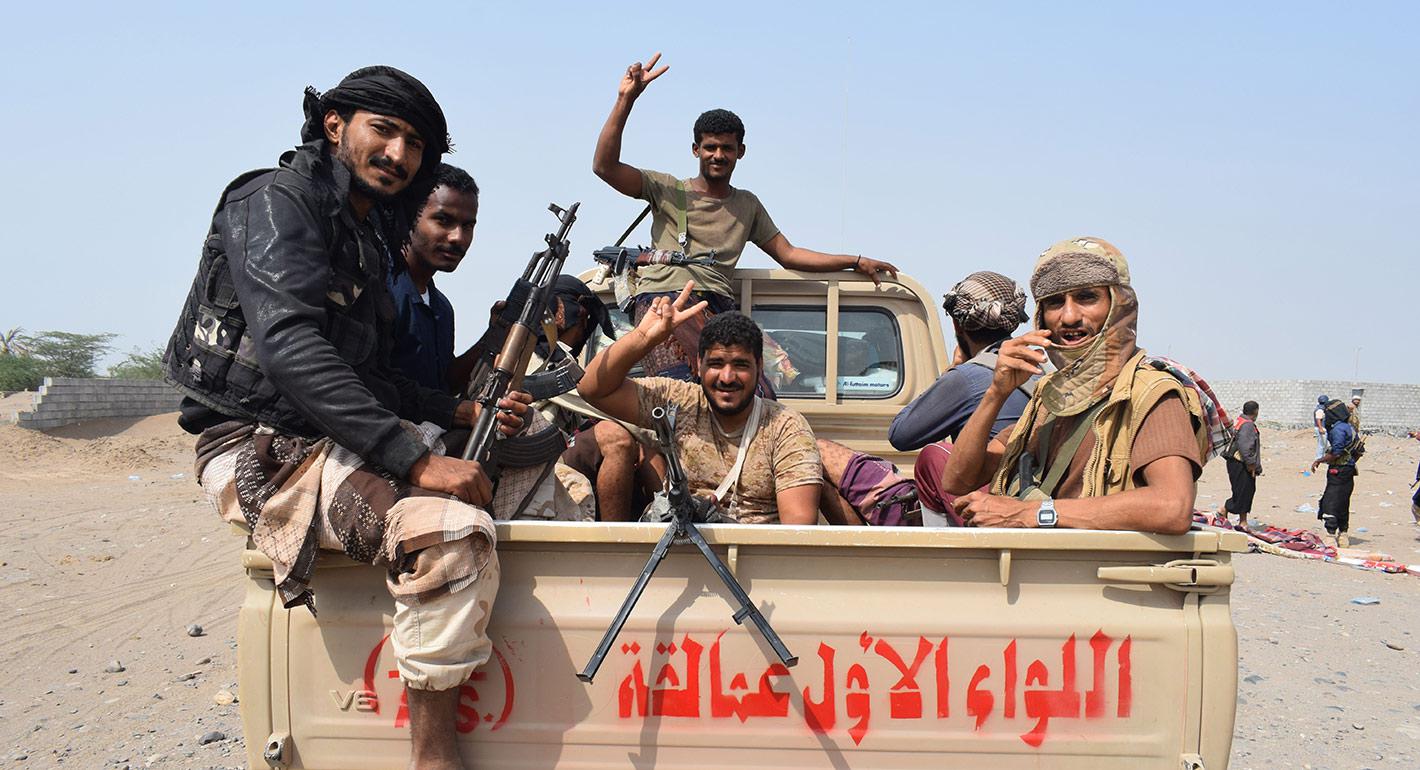
As Saudi Arabia’s military intervention in Yemen enters a sixth year, the coalition has still not achieved its announced goal: defeating the Houthi rebels and restoring Yemen’s legitimate government. Instead, the Saudi coalition has become fragmented by conflicts of interests among its members, allowing the Houthis to advance on several fronts. But how did a coalition that entered the fight with such advantages come to face so many setbacks? And does it have any hope of succeeding?
In March 2015, the Saudi coalition began military operations against Ansar Allah, the Iran-backed Shia group in Yemen more commonly known as the Houthi movement. The coalition hoped to restore the legitimacy of Yemeni President Abd’ Rabbo Mansour Hadi, who escaped to the southern city of Aden after the Houthis took over Sanaa that January. At first, the coalition’s intervention slowed down the Houthis, pushing them out of critical areas in southern Yemen.
But five years on, Hadi’s government is still in exile. Aiming to capture him, the Houthis had advanced from the northern mountainous areas to Aden. When his forces failed to resist them, Hadi fled through the eastern governorate of Mahra and across the border to Oman. Separatists backed by the United Arab Emirates now control Aden and refuse the return of Hadi’s government to the city. The military forces nominally under his control splintered as coalition partners increasingly pursue their own interests.
The Houthis have benefited from those rifts. They regained large areas in the northern province and expect to continue their advance. They are also conducting back-channel negotiations with the Saudis without the involvement of Hadi’s government.
The Saudi-led military coalition began with the participation of ten countries. As time passed, Morocco withdrew, Qatar was expelled, and Jordan and Egypt kept their distance. The rift with Qatar worsened the Saudi-UAE relationship with Yemen’s Islah Party, a local faction that aligns ideologically with the Qatari-supported Muslim Brotherhood.
The UAE remains the only key coalition partner, though it has parted ways with Saudi strategy. Despite continued Saudi backing of Hadi’s government, the UAE helped form a separatist entity, the Southern Transitional Council (STC), to be its military arm on the ground.
Further, conflict erupted between coalition proxies in Aden, Shabwa, Socotra, and other areas. Tensions escalated in July 2019, when the UAE announced its withdrawal from Yemen after reaching its own nonaggression understanding with the Houthis. But the UAE did not leave the landscape to the Saudis; instead, it trained 200,000 STC soldiers and other proxies in the north who would help protect the UAE homeland and preserve open shipping lanes off Yemen’s coast.
Local divisions among Yemenis have shifted during the coalition’s military intervention, driven in part by a coalition strategy to divide and more easily control the various anti-Houthi groups. The original warring parties—the Houthis and former president Ali Abdullah Saleh on one hand and the coalition-backed government on the other—are no longer the opposing sides. But the coalition’s divided front has been unable to make much headway against the Houthis, a comparatively tight-knit group.
In a separate rift, the UAE refuses to recognize the Hadi government’s national army, alleging that many of its commanders are loyal to the Islah Party. The Saudis have similar concerns. While the UAE pulled support for Hadi’s army, the Saudis continue their support, as the Islah Party remains their only real option for an anti-Houthi group on the ground.
Yet Saudi support is conditional. Saudi Arabia is now supervising all military operations itself and has sought to recruit up to 15,000 Yemenis to fight under its direct leadership. In another sign of their dissatisfaction, the Saudis have failed to pay the salaries of several army units whose loyalties they doubt most.
The Houthi takeover of Sanaa laid bare the weakness of Hadi’s government even before the Saudi-led coalition intervened. Hadi has no strategy for the security challenges his people face. From Saudi Arabia, where he moved in 2015 after leaving Oman, Hadi has given the coalition a blank check to manage the situation, but that process has hollowed out any sense of authority his government once had. Today, most government officials remain in exile and receive lush salaries from the coalition.
Beyond Hadi’s failure to govern, Yemen’s parliament has come to a standstill, having convened in April 2019 for its only meeting of the past five years. Public institutions are paralyzed without support. Instead, coalition partners position themselves according to their own strategic interests, as in development projects like the Saudi-backed King Salman Center and the UAE-backed Sheikh Khalifa Bin Zayed Foundation.
A critical shortcoming of the coalition is its attitude toward democracy and even relatively democratic regimes like Yemen’s. The coalition has duplicated the monarchical governance models of its backers when dealing with Yemeni communities, often turning to loyal families and groups to secure its interests and achieve its policies. For instance, the coalition dispensed with vestiges of democratic political life such as local councils, civil society organizations, and press freedom. Moreover, many opponents were assassinated in the areas supervised by the coalition.
These governance failures have undermined the legitimacy of the state the coalition ostensibly intervened to restore, leaving it even weaker than it was five years ago. At the same time, the coalition’s local factions have transformed into new versions of the Houthi militias.
While the UAE has tried to protect its interests in South Yemen by supporting its own local factions and de-escalating tensions with the Houthis, Saudi Arabia has deepened its connections with the Houthis through back-channel ceasefire negotiations. Its goal is an agreement that would secure its borders and protect its territories from Houthi missile attacks. Should the two parties come to terms, Saudi Arabia would recognize the Houthis as the de facto leaders in the north of Yemen and turns its back on the Hadi government.
The current geopolitical map of Yemen effectively sums up the results of the five-year war: land and maritime borders fully militarized by Saudi Arabia and the UAE-backed factions and a vast expanse of central towns mired in chaos and conflict. With the Saudis more focused on securing their southern border than restoring legitimate governance in Yemen, and the UAE more focused on securing its own interests, a resolution for Yemen does not seem near at hand.

Senior Analyst at the International Crisis Group
Ahmed Nagi is a senior Analyst at the International Crisis Group.
Recent Work
Ahmed Nagi
Carnegie does not take institutional positions on public policy issues; the views represented herein are those of the author(s) and do not necessarily reflect the views of Carnegie, its staff, or its trustees.

Before the next wave of EU enlargement takes place, the union needs to grapple with thorny questions of how power is distributed among its members.


Emil Sondaj Hansen, Ditte Brasso Sørensen

The new U.S.–Denmark–Greenland agreement will help Washington exert political, economic, and financial dominance under the guise of security. Yet, it acknowledged Copenhagen’s and Nuuk’s sovereignty on the island.

Marc Pierini

A summer of escalation in the Black Sea has hurt Ukraine economically and is exacerbating world food security. A truce is needed—as is a broader reframing of Europe’s Ukraine strategy.

Thomas de Waal

Are Germany’s economic, industrial, and political struggles becoming a liability for the EU’s ability to rise to the geopolitical moment?

Rym Momtaz, ed.

European Commission President Ursula von der Leyen is about to give her annual address on the state of the EU. Here’s what she won’t—but should—say.
Rym Momtaz