

Commentary
Oliver Stuenkel, Adrian Feinberg
{
  "authors": [
    "Oliver Stuenkel"
  ],
  "type": "commentary",
  "centerAffiliationAll": "dc",
  "centers": [
    "Carnegie Endowment for International Peace"
  ],
  "collections": [],
  "englishNewsletterAll": "democracy",
  "nonEnglishNewsletterAll": "",
  "primaryCenter": "Carnegie Endowment for International Peace",
  "programAffiliation": "DCG",
  "programs": [
    "Democracy, Conflict, and Governance"
  ],
  "projects": [],
  "regions": [
    "South America"
  ],
  "topics": [
    "Democracy"
  ]
}
Source: Getty
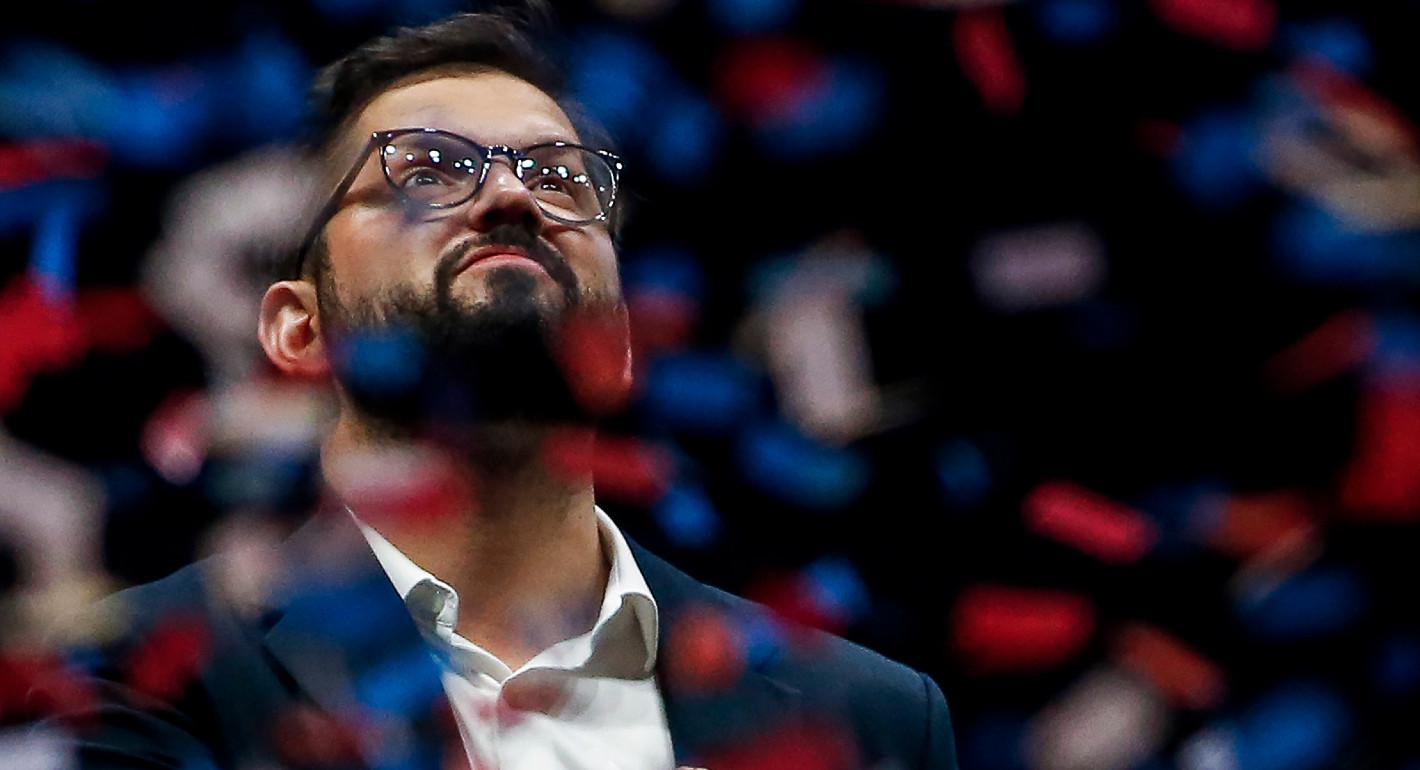
President-elect Gabriel Boric must now find the right formula to engage skeptics while also maintaining support from the radical elements of his alliance.
Gabriel Boric, a thirty-five-year-old leftist congressman, will become the youngest president in Chile's history after obtaining 56 percent of the vote in Sunday’s runoff election against fifty-five-year-old far-right former congressman Jose Antonio Kast. The result surprised many observers, who expected a closer race.
Boric now faces the challenge of unifying a country that, after decades of political stability, was thrown into uncertainty after massive protests in 2019 against political elites and discontent with growing inequality and inadequate public services. He must craft and implement a new national vision after the majority of voters expressed the wish to move away from Chile’s free-market economic model. He also must steer the country through the period of the constituent assembly, which began in response to the protests and is expected to last until voters approve or reject the new constitution next year.
In many ways, the political climate during the runoff suggested that Chile is falling prey to the kind of destructive polarization so visible in other Western democracies. The collapse of centrist parties in the first round of the presidential election, unprecedented since Chile returned to democracy three decades ago, generated ample concern. Analysts across Latin America had wondered whether Chile would suffer a similar fate as Brazil, which entered a spiral of extreme polarization, political instability, and economic stagnation after mass protests in 2013 that ultimately led to the rise of the right-wing populist and antiestablishment President Jair Bolsonaro.
The heated campaign rhetoric and mutual demonization also set this presidential contest apart from Chile’s relatively tame—and, one may say, even a bit boring—election cycles over the past decade. Kast framed the election as one between freedom and communism, implying that the bearded and tattooed Boric would follow the footsteps of Hugo Chávez and oversee Chile’s collapse, and it became increasingly clear in the final weeks of the campaign that whoever won would face deep distrust among those who had supported the losing candidate.
Election day, however, suggested that Chile stands a chance to take a step back from the abyss of extreme polarization. Kast, an admirer of the dictatorial Pinochet regime and was likened to Bolsonaro, called Boric to congratulate him and concede about half an hour after the polls closed and posted a highly conciliatory message on social media. Boric’s victory largely came down to his capacity to appeal to centrist voters who felt uneasy with both him and Kast. (Even the most ardent Boric supporter would likely agree that many who voted for their candidate did so because they found the alternative even more unpalatable.) In addition, an evenly split Senate creates an incentive for Boric to reach across the aisle to govern. Perhaps aware of this situation, the president-elect emphasized “change with responsibility” in his first speech on Sunday evening.
But there is a risk that those who think Chile can serve as an example of how to constructively channel popular discontent underestimate the severe risks the country continues to face—despite being ranked as one of Latin America’s most stable democracies. It is easy to overlook the trauma the 2019 protests produced in parts of the country’s electorate. At the height of the uprisings, the country had become ungovernable and saw the ransacking of churches and government buildings and the closure of schools, and some neighborhoods in Santiago have not yet recovered economically from the physical destruction (not to mention the pandemic that followed).
During the runoff, Boric decidedly moved to the center on economic matters and emphasized fiscal responsibility—positions long anathema to Chile’s left. He also supports the independence of the Central Bank and is advised by moderate economists, perhaps in an attempt to win support of conservatives and small-business owners. None of these proposals are revolutionary. Still, Boric could very well fail to find to right formula to engage skeptics while also maintaining the support of the more radical elements of his alliance, including the Chilean Communist Party, which controversially supported Daniel Ortega’s recent sham election in Nicaragua.
Finding compromise on economic issues may even be easier than on social issues such as gay rights and abortion—topics conservatives are likely to prioritize. Deeply conservative until recently, Chile’s society is experiencing the coming of age of a generation that is far more progressive than their parents. Boric exemplifies this change: Raised in a Catholic family, he declares himself agnostic; emphasized LGBTQ rights during his campaign; and plans to legalize abortion, largely banned in Chile. Kast, on the other hand, is an ultraconservative Catholic and father of nine who promised a return to “traditional values.”
Yet Boric has shown that he does not shy away from unpopular positions within his ideological camp. In November 2019, then congressman Boric supported an agreement to hold a plebiscite for a new constitution, a proposal rejected by the far left at the time. This move disappointed many of his most radical supporters but established him as a consensus-builder. His willingness to criticize Venezuela’s authoritarian regime—something even moderate leftist leaders across Latin America are reluctant to do—is another example that Boric may understand that he needs to act as a bridge-builder to move Chile forward. This capacity will be in high demand in the coming years, and observers from across South America will watch closely as the region’s richest country charts a new path.
Senior Fellow, Democracy, Conflict, and Governance Program
Oliver Stuenkel is an associate professor at the School of International Relations at Fundação Getulio Vargas (FGV) in São Paulo, Brazil. He is also a senior fellow affiliated with the Democracy, Conflict, and Governance Program at the Carnegie Endowment for International Peace.
Recent Work
Oliver Stuenkel, Adrian Feinberg
Oliver Stuenkel, Adrian Feinberg
Carnegie does not take institutional positions on public policy issues; the views represented herein are those of the author(s) and do not necessarily reflect the views of Carnegie, its staff, or its trustees.

A notable degree of participative democracy has firmly arrived in Europe. But to have more far-reaching impact, democratic deliberation needs to move into a radically new phase.

Richard Youngs

The domestic impacts of how long it is taking to end the war in Ukraine have pushed the French electorate to the political extremes and compromised the country’s diplomatic capacity.

Rym Momtaz

Before the next wave of EU enlargement takes place, the union needs to grapple with thorny questions of how power is distributed among its members.


Emil Sondaj Hansen, Ditte Brasso Sørensen

Radical-right parties are expected to do well in upcoming elections in four of the EU's biggest member states. If successful, they could prevent the union from addressing key challenges ahead.

Stefan Lehne

An overwhelming victory by a far-right-wing party in a small state in eastern Germany will have major repercussions for Chancellor Friedrich Merz’s coalition.

Judy Dempsey