

Article
Леонид Гозман, Michael McFaul
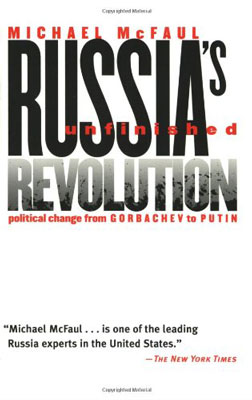
Michael McFaul traces Russia's tumultuous political history from Gorbachev's rise to power in 1985 through the 1999 resignation of Boris Yeltsin in favor of Vladimir Putin.
Source: Ithaca, NY: Cornell University Press, 2001
About the Book
For centuries, dictators ruled Russia. Tsars and Communist Party chiefs were in charge for so long some analysts claimed Russians had a cultural predisposition for authoritarian leaders. Yet, as a result of reforms initiated by Mikhail Gorbachev, new political institutions have emerged that now require election of political leaders and rule by constitutional procedures. Michael McFaul traces Russia's tumultuous political history from Gorbachev's rise to power in 1985 through the 1999 resignation of Boris Yeltsin in favor of Vladimir Putin.
McFaul divides his account of the post-Soviet country into three periods: the Gorbachev era (1985-1991), the First Russian Republic (1991-1993), and the Second Russian Republic (1993-present). The first two were, he believes, failures—failed institutional emergence or failed transitions to democracy. By contrast, new democratic institutions did emerge in the third era, though not the institutions of a liberal democracy. McFaul contends that any explanation for Russia's successes in shifting to democracy must also account for its failures. The Russian/Soviet case, he says, reveals the importance of forging social pacts; the efforts of Russian elites to form alliances failed, leading to two violent confrontations and a protracted transition from communism to democracy.
Having spent a great deal of time in Moscow in the 1990s, McFaul witnessed firsthand many of the events he describes. This experience, combined with frequent visits since and unparalleled access to senior Russian policy makers and politicians, has resulted in an astonishingly well-informed account. Russia's Unfinished Revolution is a comprehensive history of Russia during this crucial period.
Michael McFaul is senior associate in the Russian and Eurasian Program at the Carnegie Endowment for International Peace and teaches political science at Stanford University.
"Both a path-breaking study of Russian politics and a major work on institutional change, Russia's Unfinished Revolution provides the best analytic and theoretical account I have seen of how and why a broad range of actors may come to accept an ambiguous and flawed regime. The access that Michael McFaul has won and the understanding that he has mobilized are nothing short of breathtaking. This is a deeply informative, fascinating, and at time gripping history."
—Larry Diamond, coeditor of the Journal of Democracy
Former Senior Associate
In addition to his role at Carnegie, McFaul is Peter and Helen Bing Senior Fellow at the Hoover Institution and associate professor of political science at Stanford University.
Recent Work
Леонид Гозман, Michael McFaul
Michael McFaul, Sanja Tatic
Carnegie does not take institutional positions on public policy issues; the views represented herein are those of the author(s) and do not necessarily reflect the views of Carnegie, its staff, or its trustees.

A summer of escalation in the Black Sea has hurt Ukraine economically and is exacerbating world food security. A truce is needed—as is a broader reframing of Europe’s Ukraine strategy.

Thomas de Waal

As the EU confronts profound challenges, several leaders have called for fundamental reform to the union’s model—but only modest, superficial changes have resulted. What if Europe really could be reimagined from zero today: What should such a redesigned European order look like?

Richard Youngs, ed.

When the U.S.-Iran memorandum of understanding was announced, the UK, France, Germany, and Italy declared their readiness to help demine the Strait of Hormuz and lift nuclear sanctions on Tehran. But does Europe need new tools to recover a diplomatic role?

Rym Momtaz, ed.

As geopolitical rivalry weaponizes global supply chains, the EU’s true vulnerability lies in emerging-risk imports. For these goods, suppliers are growing more concentrated, substitution more difficult, and political risk is looming.

Sinan Ülgen
The EU is putting together a new security strategy to meet today’s myriad challenges. But for any proposal to be effective, the union needs to grapple with its identity and ambitions.

Pierre Vimont