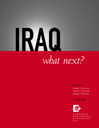
Far from being exhausted, the inspections process has just begun. Inspections should be pursued without ruling out future use of force. Iraq’s lack of full cooperation is a material breach, but not a casus belli.
This new analysis, by the Carnegie team who helped write Iraq: A New Approach, last fall’s groundbreaking report that helped define the current inspections regime, provides a concise outline of the concerns over Iraq’s missile, nuclear, biological, and chemical weapons capabilities that inspectors are investigating. It addresses the effectiveness of intelligence sharing, site visits, the inspectors’ use of advanced technology, and Iraq’s willingness to cooperate. The report argues that a realistic timeframe for inspections is another year for the discovery process, followed by dismantlement and permanent monitoring.
Among its conclusions: Far from being exhausted, the inspections process has just begun. Inspections should be pursued without ruling out future use of force. Iraq’s lack of full cooperation is a material breach, but not a casus belli. As the report argues, "Disarmament achieved without a war would be an enormous—and enormously popular—achievement." In the meantime, "Saddam Hussein is effectively incarcerated and under watch by a force that could respond immediately and devastatingly to his aggression." However, if the aim is not, in fact, disarmament but regime change as a matter of principle, "then the inspection and disarmament processes now underway are largely irrelevant."
About the Authors Joseph Cirincione is a senior associate and director of the Carnegie Non-Proliferation Project. Jessica T. Mathews is president of the Carnegie Endowment, and George Perkovich is its Vice President for Studies.
Miriam Rajkumar is a project associate and Marshall Breit is a research assistant with the Non-Proliferation Project. Dipali Mukhopadhyay is the project's Junior Fellow.
Japan Chair for a World Without Nuclear Weapons, Senior Fellow
George Perkovich is the Japan Chair for a World Without Nuclear Weapons and a senior fellow in the Carnegie Endowment for International Peace’s Nuclear Policy Program. He works primarily on nuclear deterrence, nonproliferation, and disarmament issues, and is leading a study on nuclear signaling in the 21st century.
Carnegie does not take institutional positions on public policy issues; the views represented herein are those of the author(s) and do not necessarily reflect the views of Carnegie, its staff, or its trustees.
Europe’s industrial supply chains leave it vulnerable to global shocks. The EU needs a pragmatic green industrial strategy that balances durable partnerships and bolsters homegrown clean tech without sacrificing low-carbon ambition.
Defense tech innovations will be at the heart of Europe’s new security strategy. But so far, Brussels has been making moves without a broader plan, undermining readiness and credibility.
When the U.S.-Iran memorandum of understanding was announced, the UK, France, Germany, and Italy declared their readiness to help demine the Strait of Hormuz and lift nuclear sanctions on Tehran. But does Europe need new tools to recover a diplomatic role?
The Franco-German relationship is on the rocks again. But unlike previous moments of tension, the epochal changes on the world stage require that both step up investment in their bilateral ties.
As geopolitical rivalry weaponizes global supply chains, the EU’s true vulnerability lies in emerging-risk imports. For these goods, suppliers are growing more concentrated, substitution more difficult, and political risk is looming.