

Commentary
With its public finances in shambles, the far right polling at 35 percent ahead of the 2027 presidential election, and a growing protest movement, is France’s crisis a threat to the EU’s geopolitical awakening?
Rym Momtaz, ed.
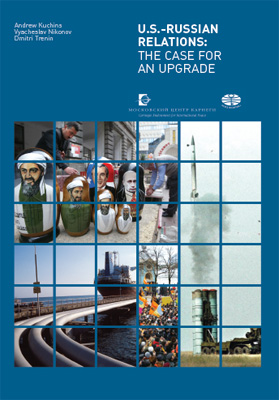
Highly touted in both Washington and Moscow as a "strategic partnership" in 2001, the relationship has drifted and the gap between glowing rhetoric and thin substance has grown. When major policy differences emerge, as over war in Iraq in 2002-2003 and recently over Ukraine, all too easily the U.S.-Russian relationship spirals into "crisis," and the threat of a "new Cold War" looms.
"The recent sharp dispute over the Ukrainian presidential elections vividly illustrated the fragile and shallow nature of the U.S.-Russian relationship. Highly touted in both Washington and Moscow as a "strategic partnership" in 2001, the relationship has drifted and the gap between glowing rhetoric and thin substance has grown. When major policy differences emerge, as over war in Iraq in 2002-2003 and recently over Ukraine, all too easily the U.S.-Russian relationship spirals into "crisis," and the threat of a "new Cold War" looms."
Click on the link above for full text of this Carnegie report in English and Russian.
About the Authors
Andrew C. Kuchins is Director of the Carnegie Moscow Center. He conducts research and writes widely on Russian foreign and security policy. He is a member of the governing council of the Program on Basic Research and Higher Education in Russia, the advisory committee of Washington Profile, and the editorial board of the journal, Demokratizatsiya.
Vyacheslav Nikonov is the President of the Polity Foundation in Moscow. He is the author of "Contemporary Russian Politics" (2003), "The Age of Change: Russia of the 1990s through Conservative's Eyes" (1999), "Conservative Manifesto" (1994), "The Republicans: From Nixon to Reagan" (1988), "Iran-Contra Affair" (1987), "The Republicans : From Eisenhower to Nixon" (1984).
Dmitri Trenin is Deputy Director of the Carnegie Moscow Center, where he also co-chairs the Program on Foreign and Security Policy. He is the author of numerous articles and books on Russian security issues, including, most recently, Russia’s Restless Frontier: The Chechnya Factor in Post-Soviet Russia (Carnegie, 2004)

Former Senior Associate and Director, Russian & Eurasian Program
Vyacheslav A. Nikonov
Polity Foundation
Former Director, Carnegie Moscow Center
Trenin was director of the Carnegie Moscow Center from 2008 to early 2022.
Carnegie does not take institutional positions on public policy issues; the views represented herein are those of the author(s) and do not necessarily reflect the views of Carnegie, its staff, or its trustees.

With its public finances in shambles, the far right polling at 35 percent ahead of the 2027 presidential election, and a growing protest movement, is France’s crisis a threat to the EU’s geopolitical awakening?

Rym Momtaz, ed.

Ahead of a tough winter for Ukraine, Donald Trump’s swing back toward Russia bodes ill. But instead of panicking, Kyiv’s European allies are focusing on action.
Rym Momtaz

Funding Ukraine remains a priority for European leaders. As Russia’s war of aggression heads into another winter, two feasible options to mobilize support for Kyiv should be fast-tracked.


Vladyslav Rashkovan, Gregory P. Wilson

While the EU and European governments are embracing the much-lauded middle-power moment, this entails three difficult conundrums.

Richard Youngs

Europe is facing rising populism internally as well as external pressures from Russia, China, Turkey, and the United States.

Dimitar Bechev