

Commentary
Trump is distracted and Ukraine wants Europe to step up. The continent’s leaders must find their voice and assert it in talks with Russia.
Alissa de Carbonnel

REQUIRED IMAGE
Unlike the United States, European Union (EU) member states do not have an EU legal obstacle to surmount in order to renew nuclear trade with India. But before any EU nation embarks on trade, it will need the U.S. Congress to act.
Unlike the United States, European Union (EU) member states do not have an EU legal obstacle to surmount in order to renew nuclear trade with India. But before any EU nation embarks on trade, it will need the US Congress to act.
Currently, it is illegal for the United States to trade nuclear technology or material to India. The Atomic Energy Act (AEA) of 1954 stipulates that receiving countries must have full scope safeguard agreements (all their nuclear facilities under inspections) with the International Atomic Energy Agency (IAEA). India now plans to put 14 of its 22 current and planned nuclear power reactors under safeguards, leaving 8 power reactors free to produce plutonium for nuclear weapons.
There is no actual agreement yet between India and the United States. Such nuclear cooperation agreements can take years to negotiate and implement. The US-China nuclear cooperation agreement, for example, took three years to negotiate and 13 years before final congressional approval. Prior to having an agreement, the administration is proposing that Congress change U.S. laws to create a permanent exception for India.
The European Union has similar export laws to the United States, but none that require full scope safeguards as a condition of supply. The only thing that legally binds EU states is the Nuclear Supplier’s Group (NSG) Full-Scope Safeguard Policy adopted in 1992 (and originally championed by the United States). This policy requires full scope safeguards as a condition of supply. It was subsequently endorsed at the 1995 Non-Proliferation Treaty (NPT) Review and Extension Conference and reaffirmed at the 2000 NPT Review Conference.
Some EU states are eager to see the US Congress vote to exempt India from US law. These countries hope that once the administration wins an exception for India from its national laws, it will go to the NSG and push for an exemption for India from the 1992 NSG policy. This appears to be the administration’s plan. Officials are pushing for congressional action by this May, before the next NSG meeting.
Euro Obstacles
In June of 2000, a new European dual use law (1334/2000) was created to enhance EU export controls for security reasons. The law obliges EU states to ask for a license for all goods exported that are on the NSG trigger list. The NSG trigger list includes any materials or equipment that could be used in the processing of fissionable material. The law does not however (as does section 123 (a)(2) of the AEA) mention full scope safeguards as a condition of supply.
Although there is no mention of full scope safeguards as a condition of supply, the European dual use law asks member states to “take into account all relevant considerations including; the obligations and commitments they have each accepted as a member of the relevant international non-proliferation regimes and export control arrangements.” All 25 European Union states are members of the NSG and the NPT, although the European Community as a whole only has observer status in the NSG. Therefore a change in NSG policy appears to be the only necessary step before EU states, like France, can begin nuclear commerce.
Not So Fast
The administration is unlikely to get the rapid congressional approval it seeks. The legislative proposal sent to the Hill March 9 has gotten a cool reception. Senior leaders want more details before they act. “This is a complex agreement with profound implications for U.S. and global interests,” said House International Relations Committee Chairman Henry Hyde (R.-IL), “Congress will need to take a close look at its many provisions in order to come to an informed decision.” The committee’s ranking member, Tom Lantos (D-CA), and Hyde suggested that Congress may seek conditions for its approval. “The issues involved are complicated and technical, and it will take some time for Congress to absorb them as we move the agreement to fruition,” Lantos noted. “I view the new strategic alliance between the world’s oldest and largest democracies as a breakthrough, but all members of Congress will undoubtedly wish to see the details of the agreement before deciding how to vote.”
The Congress must think through not only how making such an exception could effect an India-US partnership, but also how such a change could severely alter international nonproliferation norms--norms the US itself worked to establish after India used safeguarded material to set off its first nuclear weapons test in 1974. Until Congressional approval, the NSG is unlikely to change its policies, the EU states most eager to sell nuclear fuel and reactors to India will have to keep their plans on ice, and NSG members strongly against the deal will have time to rally support for the protection of endangered nonproliferation standards.
Relevant Sources:
European Community Council Regulation 1334/2000. Article 8 pg.5
CRS Report for Congress, U. S. Nuclear Cooperation with India:
Issues for Congress, July 29, 2005, by Sharon Squassoni
Jill Marie Parillo
Carnegie does not take institutional positions on public policy issues; the views represented herein are those of the author(s) and do not necessarily reflect the views of Carnegie, its staff, or its trustees.

Trump is distracted and Ukraine wants Europe to step up. The continent’s leaders must find their voice and assert it in talks with Russia.

Alissa de Carbonnel
Over the past ten years, NATO has held almost as many summits as it did during the entirety of the Cold War. Are they still useful, or is it time to stop holding annual meetings?

Rym Momtaz, ed.

As the EU confronts profound challenges, several leaders have called for fundamental reform to the union’s model—but only modest, superficial changes have resulted. What if Europe really could be reimagined from zero today: What should such a redesigned European order look like?

Richard Youngs, ed.
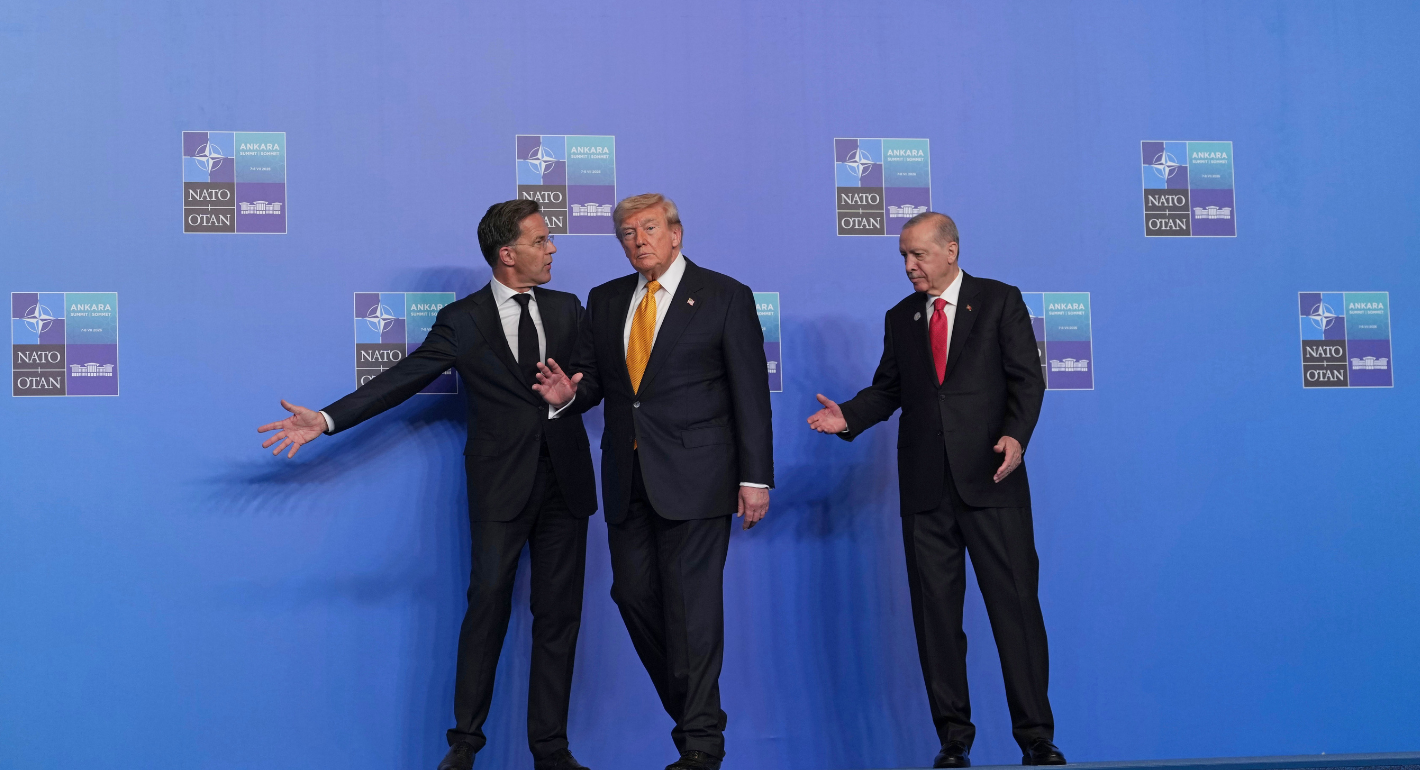
Nearly a year and a half after Europeans leaned into sucking up to Trump, the strategy has produced some benefits when it comes to Ukraine.
Rym Momtaz

Autonomous AI agents are increasingly prevalent in cyberspace. The EU needs a real-time monitoring strategy, to invest in AI defenses, and to reduce its strategic dependence on U.S. frontier models.


Raluca Csernatoni, Patryk Pawlak