

Paper
Yezid Sayigh
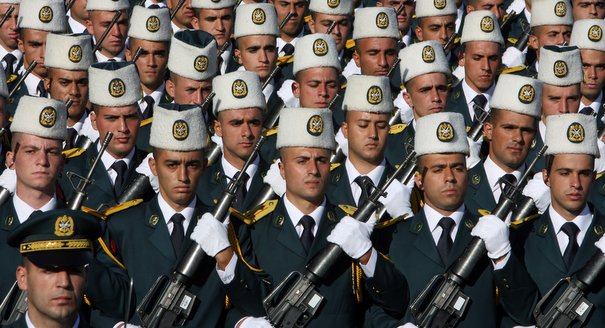
Source: Getty
The bulk of development security sector aid in Palestine, Lebanon, and Yemen has consisted of military training and equipment. The West should adopt a comprehensive approach to aid where security reform is only one part of a broader reform strategy.
Although important, development assistance aimed at reforming the security sectors in Palestine, Lebanon, and Yemen has achieved only limited results. The bulk of such aid has consisted of military training and equipment, which does nothing to ensure that security forces answer to legitimate civilian leaders.
Whether by design or default, the United States and European countries have a narrow focus on counterterrorism in Palestine, Lebanon, and Yemen—all countries with weak and quasi-democratic governments. Without an integrated approach that includes support for democracy and the rule of law, security sector reforms are not sustainable and can reinforce local power struggles.
Five Lessons for the United States and Europe:
“To enable real reform, the West must adopt a comprehensive approach which treats security reform as only one part of a broader political strategy, and encourage governments and security commanders in Palestine, Lebanon, and Yemen to buy into such a strategy,” says Sayigh. “Pursuing counterterrorism in the absence of the rule of law perpetuates the undemocratic governance of the security sector and undermines state building and post-conflict reconstruction.”

Senior Fellow, Malcolm H. Kerr Carnegie Middle East Center
Yezid Sayigh is a senior fellow at the Malcolm H. Kerr Carnegie Middle East Center in Beirut, where he leads the program on Civil-Military Relations in Arab States (CMRAS). His work focuses on the comparative political and economic roles of Arab armed forces, the impact of war on states and societies, the politics of postconflict reconstruction and security sector transformation in Arab transitions, and authoritarian resurgence.
Recent Work
Yezid Sayigh
Yezid Sayigh
Carnegie does not take institutional positions on public policy issues; the views represented herein are those of the author(s) and do not necessarily reflect the views of Carnegie, its staff, or its trustees.

With its public finances in shambles, the far right polling at 35 percent ahead of the 2027 presidential election, and a growing protest movement, is France’s crisis a threat to the EU’s geopolitical awakening?

Rym Momtaz, ed.

Ahead of a tough winter for Ukraine, Donald Trump’s swing back toward Russia bodes ill. But instead of panicking, Kyiv’s European allies are focusing on action.
Rym Momtaz

Funding Ukraine remains a priority for European leaders. As Russia’s war of aggression heads into another winter, two feasible options to mobilize support for Kyiv should be fast-tracked.


Vladyslav Rashkovan, Gregory P. Wilson

While the EU and European governments are embracing the much-lauded middle-power moment, this entails three difficult conundrums.

Richard Youngs

Europe is facing rising populism internally as well as external pressures from Russia, China, Turkey, and the United States.

Dimitar Bechev